


Classes Still Create Hoosier Hysteria
July 27, 2017
By Rob Kaminski
MHSAA benchmarks editor
This is the fourth part in a series on MHSAA tournament classification, past and present, that will be published over the next two weeks. This series originally ran in this spring's edition of MHSAA benchmarks.
Twenty years ago, Bloomington North High School won the Indiana High School Athletic Association boys basketball championship, defeating Delta 75-54 at the RCA Dome in Indianapolis.
The date, March 22, 1997, is at the same time revered and disdained by traditionalists in the state who saw it as the last schoolboy championship game the state would ever host.
That’s how devout the game of basketball, particularly interscholastic basketball, had become in the Hoosier state during the 87 years a state champion – one state champion, to be precise – was crowned.
Following that 1997 season, the IHSAA moved to a four-class system for its roundball tournaments, like so many of its state association counterparts had done years earlier.
It would be shocking to find more than a small percentage of current high school basketball players around the country unfamiliar with the iconic movie Hoosiers, even though the film is now more than 30 years old.
And, the storyline for that blockbuster unfolded more than 30 years prior to its release, when small-town, undermanned Milan High School defeated Muncie Central High School 32-30 in the 1954 IHSAA title game.
Perhaps it’s because of the David vs Goliath notion, or the fame of the movie that replaced Milan with the fictional Hickory and real-life star Bobby Plump with Hollywood hero Jimmy Chitwood, or the simple fact that Indiana had something other states didn’t.
Whatever the reason, plenty of opposition remains to this day to basketball classification in the state.
The fact is, the small rural schools were regularly being beaten handily by the much larger suburban and city schools as the tournament progressed each season.
Small schools also were closing at a rapid rate following the state’s School Reorganization Act in 1959, as students converged on larger, centralized county schools. From 1960 to 2000, the number of schools entering the tournament dropped from 694 to 381, and in 1997 a total of 382 schools and 4,584 athletes began competition at the Sectional level (the first level of the IHSAA Basketball Tournament).
It was at the entry level of the tournament where school administrators felt the pain of the new class system, but not necessarily for the same nostalgic reasons as the fans who either attended or boycotted the tournament.
At the Sectional round of the tournament, the IHSAA was culling just 2 percent of the revenue, with the participating schools splitting the balance. So, when Sectional attendance dropped by 14 percent in that first year of class basketball, many schools realized a financial loss. It was money they had grown to count on in prior years to help fund various aspects of the department.
Schools cumulatively received more than $900,000 from Sectional competition in 1998, but that total was down from more than $1 million in the last year of the single-class tournament.
Yet, the current format provides a great deal more opportunity and realistic chances at championship runs for schools of all enrollments.
To date, 60 additional teams have championship or runner-up trophies on display in school trophy cases around Indiana.
That was the mission in front of then-IHSAA commissioner Bob Gardner (now National Federation executive director) once the board made its decision: to give thousands more student-athletes the opportunity for once-in-a-lifetime experiences.
As any statistician knows, figures can be manipulated to tell any side of a story. Declining attendance in year one of class basketball is such a number.
The truth is tournament attendance had been on a steady downward spiral since its peak of just over 1.5 million in 1962. By the last single-class event in 1997, the total attendance was half that.
The challenge then and today, as it is for all state associations, is to find that delicate balance for those holding onto tradition, those holding onto trophies, and the number of trophies to hand out.
Editor’s Note: Stories from the Fort Wayne Journal Gazette in 1998 and from a 2007 issue of Indianapolis Monthly provided facts in this article.
Brothers' Success Just Start for Beaverton
By
Paul Costanzo
Special for MHSAA.com
November 28, 2018
In a movie, this season and the future of the Beaverton wrestling program would be the epilogue, explained to us with words on the screen while triumphant music played.
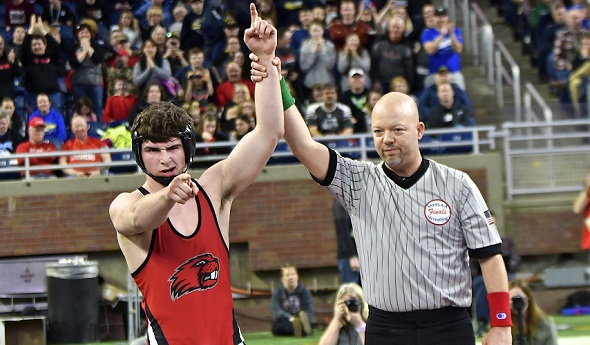
 When Eric and Kyle Cassiday won Division 4 individual MHSAA championships in back-to-back matches last season with their father Bryan – who had started the program four years earlier – coaching matside, the script could have been completed.
“It’s one of the top five moments of my entire life,” said Kyle Cassiday, now a senior at Beaverton. “(After my match) all I could focus on was Eric – he went through so much with injuries, so to see him win it was amazing.”
But while the Cassidays are certainly at the heart of the program, creating this program wasn’t just about them. And there are plenty more memories to be made.
“I wanted to provide an opportunity for the kids who had been through the youth program, and those that wanted to join, to at least experience what I experienced in high school wrestling,” Bryan Cassiday said. “We were all brothers, and I wanted them to get to be able to do that. We had a lot of help (from outside the program). We’ve had a lot of people helping to influence a lot of different kids. It’s been a wonderful experience.”
Bryan Cassiday is a Gladwin graduate who coached the youth program there. That included his sons Eric, Kyle and Jacob, who started when they were elementary and preschool age. Bryan continued to coach when the family moved to Beaverton, but there appeared to be a cap on how much time they could be involved with the sport and attend their new school, as Beaverton didn’t have a wrestling program.
When Eric was about to enter high school, the Cassidays started looking at options to transfer, going as far as having a family vote at the dinner table. Kyle voted for Beaverton. Little did he or his family know that was about to become an option.
“Some of the football coaches came to me and said, ‘What would it take to start a program?’” Bryan Cassiday said. “We put together some numbers on what it would cost, did some fundraising, and started one.”
For the kids, it was a relief.
“I was so happy,” Kyle said. “I didn’t want to leave my friends. They deserved to wrestle as much as we did. It was more than just for me.”
That first season, Beaverton had 12 or 13 wrestlers, Bryan Cassiday said, including a solid core of youth wrestlers who were finally able to stay at their home school, like Eric.
By Year 3 of the program, the three boys all were part of it, with Jacob as a freshman, Kyle a sophomore and Eric a junior.
Wrestling was and is a way of life for the Cassidays, who have a mat in the garage to train – or settle a dispute, even if that was rare and mostly in the past.
“It doesn’t matter what season it is, we’re always looking forward to wrestling,” said Jacob Cassiday, who was a Finals qualifier at 152 pounds a year ago. “We don’t wrestle much in the house. We broke a couple light fixtures, then that stopped.”
For Jacob, growing up as the youngest of four children (they have an older sister, Brooke, who is 21), allowed him to learn quite a bit.
 “I’ve always been the smaller one, and I’ve always had to work hard,” he said. “I never had it easy, and they never did either. I was a little pudgy, and they helped me get into shape, then helped me with getting through wrestling. They taught me how to work hard. My oldest brother Eric had probably the best motivation I’ve ever seen. He was always in the weight room or on the mat or on the football field. There was no offseason. And, of course, they taught me how to be humble, because there’s always someone out there who’s better.”
The older brothers got to see each other plenty in practice, as Kyle was at 189 pounds and Eric at 215 a year ago.
“We’re both really competitive – we love to win, it’s what we strive to do,” Kyle said. “Halfway through the year, we started to change our perspective and realized we had a chance at winning. We would point each other to different techniques. Sometimes it got pretty intense, and we’d get pretty heated.”
Brotherly tensions aren’t something Dad worries much about spilling over, though.
“Really very rarely did they ever have problems,” Bryan said. “There was a point in the season when I was trying to get everybody on edge a little bit, and there were a couple times I had to separate them, but nothing out of control; you could just tell they were wanting it. Generally speaking, to be very honest, I’ve seen siblings that argue and fight – my kids don’t do that. They hunt together, they wrestle together, they do pretty much everything together.”
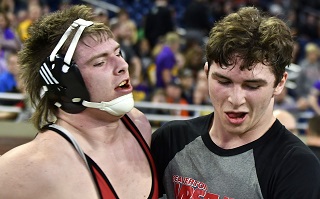
They eventually won Division 4 titles together. At last winter’s Finals at Ford Field, Kyle defeated TJ Rizor of Leroy Pine River 8-1 in the 189-pound final, while Eric followed with a 4-0 win against Chase Gibson of Bronson at 215.
“There will never be a way, honestly, to describe what happened,” Bryan said. “I couldn’t talk. I was having a hard time coping with it, to be honest with you. It’s hard to become a state champion. It was the culmination of the years and years of hard work and the passion they put into it. They continued to work, and they got paid in the end.”
Kyle said his championship wouldn’t have meant nearly as much had his brother not won. It’s something they’ll be able to talk about when they’re 40, he said.
But there’s more work to do for all of the Cassidays and the program as a whole. Eric, who is now a freshman at Saginaw Valley State University, comes back home to help his dad coach. Kyle is looking to repeat as a Finals champ, and Jacob wants to take the next step at Ford Field and make his way onto the podium.
The program itself has more building to do, but it does have a solid core heading into this year as Cameron Austin and Jack Owens (fifth last season at 171) join the younger Cassidays as returning Finals qualifiers. For now, the top priority, Bryan Cassiday said, is improving every day.
In just four years, Beaverton wrestling has started to make a name for itself. Growing that name, Kyle Cassiday said, would be an even greater accomplishment that the incredible end to last season.
“I’d be more proud of building a successful program than a championship because it’s an end result,” he said. “It will be creating something for more than just me. It would be for a lot of different people.”
 Paul Costanzo served as a sportswriter at The Port Huron Times Herald from 2006-15, including three years as lead sportswriter, and prior to that as sports editor at the Hillsdale Daily News from 2005-06. He can be reached at [email protected] with story ideas for Genesee, Lapeer, St. Clair, Sanilac, Huron, Tuscola, Saginaw, Bay, Arenac, Midland and Gladwin counties.
PHOTOS: (Top) Kyle Cassiday celebrates as he’s signaled the winner of last season’s Division 4 championship match at 189 pounds. (Middle) Eric and Kyle Cassiday share an embrace after Eric followed up with the win at 215 at Ford Field. (Click to see more from HighSchoolSportsScene.com.)