


Classes Still Create Hoosier Hysteria
July 27, 2017
By Rob Kaminski
MHSAA benchmarks editor
This is the fourth part in a series on MHSAA tournament classification, past and present, that will be published over the next two weeks. This series originally ran in this spring's edition of MHSAA benchmarks.
Twenty years ago, Bloomington North High School won the Indiana High School Athletic Association boys basketball championship, defeating Delta 75-54 at the RCA Dome in Indianapolis.
The date, March 22, 1997, is at the same time revered and disdained by traditionalists in the state who saw it as the last schoolboy championship game the state would ever host.
That’s how devout the game of basketball, particularly interscholastic basketball, had become in the Hoosier state during the 87 years a state champion – one state champion, to be precise – was crowned.
Following that 1997 season, the IHSAA moved to a four-class system for its roundball tournaments, like so many of its state association counterparts had done years earlier.
It would be shocking to find more than a small percentage of current high school basketball players around the country unfamiliar with the iconic movie Hoosiers, even though the film is now more than 30 years old.
And, the storyline for that blockbuster unfolded more than 30 years prior to its release, when small-town, undermanned Milan High School defeated Muncie Central High School 32-30 in the 1954 IHSAA title game.
Perhaps it’s because of the David vs Goliath notion, or the fame of the movie that replaced Milan with the fictional Hickory and real-life star Bobby Plump with Hollywood hero Jimmy Chitwood, or the simple fact that Indiana had something other states didn’t.
Whatever the reason, plenty of opposition remains to this day to basketball classification in the state.
The fact is, the small rural schools were regularly being beaten handily by the much larger suburban and city schools as the tournament progressed each season.
Small schools also were closing at a rapid rate following the state’s School Reorganization Act in 1959, as students converged on larger, centralized county schools. From 1960 to 2000, the number of schools entering the tournament dropped from 694 to 381, and in 1997 a total of 382 schools and 4,584 athletes began competition at the Sectional level (the first level of the IHSAA Basketball Tournament).
It was at the entry level of the tournament where school administrators felt the pain of the new class system, but not necessarily for the same nostalgic reasons as the fans who either attended or boycotted the tournament.
At the Sectional round of the tournament, the IHSAA was culling just 2 percent of the revenue, with the participating schools splitting the balance. So, when Sectional attendance dropped by 14 percent in that first year of class basketball, many schools realized a financial loss. It was money they had grown to count on in prior years to help fund various aspects of the department.
Schools cumulatively received more than $900,000 from Sectional competition in 1998, but that total was down from more than $1 million in the last year of the single-class tournament.
Yet, the current format provides a great deal more opportunity and realistic chances at championship runs for schools of all enrollments.
To date, 60 additional teams have championship or runner-up trophies on display in school trophy cases around Indiana.
That was the mission in front of then-IHSAA commissioner Bob Gardner (now National Federation executive director) once the board made its decision: to give thousands more student-athletes the opportunity for once-in-a-lifetime experiences.
As any statistician knows, figures can be manipulated to tell any side of a story. Declining attendance in year one of class basketball is such a number.
The truth is tournament attendance had been on a steady downward spiral since its peak of just over 1.5 million in 1962. By the last single-class event in 1997, the total attendance was half that.
The challenge then and today, as it is for all state associations, is to find that delicate balance for those holding onto tradition, those holding onto trophies, and the number of trophies to hand out.
Editor’s Note: Stories from the Fort Wayne Journal Gazette in 1998 and from a 2007 issue of Indianapolis Monthly provided facts in this article.
'Lights Out' D Keys DeLaSalle's D2 Repeat
By
Tom Markowski
Special for Second Half
November 23, 2018
DETROIT – Not once had Muskegon Mona Shores been held under 33 points this season. Keeping opponents off-balance with their veer option attack, the Sailors averaged 45.6 over 13 games leading up to Saturday’s Division 2 Final, and 47.5 per game during the playoffs.
But Mona Shores hadn’t faced a defense like the one Warren DeLaSalle brought to Ford Field.
Since allowing 36 points to Muskegon in its opener, DeLaSalle’s defense has been as formidable as any in the state – and the Pilots demonstrated that once again on the big stage.
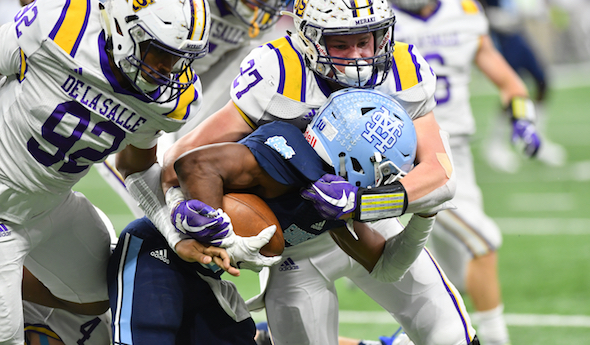
Led by senior linebackers Jacob Dobbs and Devon Campbell, DeLaSalle held Mona Shores to 217 yards in defeating the Sailors, 29-16.
Yes Bear Bryant, defense does indeed win championships (the iconic college football coach is considered to have been the first to make that statement). The Pilots (12-2) held their five playoff opponents to a combined 36 points on the way to not only repeating as Division 2 champions but winning their third title in five seasons.
“Our defense was lights out,” DeLaSalle coach Mike Giannone said. “They’ve been that way all year, and I want to compliment them on it.
“Offensively, we did what we had to do.”
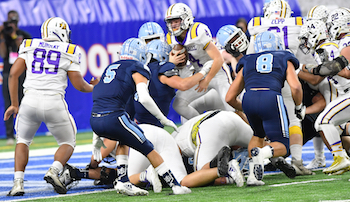
The Pilots set the tone on the first series when Dobbs and safety Derek Roskopp stopped running back Sincere Dent for a four-yard loss on a 4th-and-1 from the Mona Shores 35. The Sailors also went for it on a 4th-and-1 on their next series and were stopped short. The latter stop led to DeLaSalle’s first touchdown, a Nolan Schultz one-yard sneak to give the Pilots a 7-0 lead.
Mona Shores (12-2) tied the game with 1:26 left in the half on a two-yard run by quarterback Casen Boersma. The Sailors had but one first down before their scoring drive, and they received a boost when Dent, a 5-foot-11, 217-pound senior, busted loose for a 24-yard run. Boersma then ran 17 yards to set up his score.
It was a ragged first half as each team gained three first downs, punted four times and combined for 183 yards.
Each team scored on each of its first two possessions to begin the second half, and Schultz’s second one-yard touchdown run gave the Pilots a 21-10 lead with 10:44 remaining.
Mona Shores answered with an eight-play, 63-yard drive that ended with Boersma’s 14-yard touchdown pass to Da’Varius Carter with 7:26 left.
The Pilots put the game away with their best drive, which took 5:29 off the clock and ended with Schultz’s third one-yard sneak for a touchdown. The 12-play drive went 65 yards, and DeLaSalle used 11 running plays, eight by running back Evan Vaillancourt. Vaillancourt gained 24 yards on the drive and had 52 for the game on 18 carries.
 Roskopp ended Mona Shores’ last drive with an interception with 31 seconds left.
“Hats off to DeLaSalle,” Mona Shores coach Matt Koziak said. “Defensively, they are tough. I thought our defense did well matching up with their physicality. Then it became a possession game. They wanted to run the clock, and that’s what they did.”
Yes, it was a team effort by the Pilots – but two players stood out: Dobbs and Schultz.
Schultz, a senior, was third on the depth chart before the start of the season. Junior Anthony Stepnitz was the starting quarterback, but he suffered an injury in the fourth game against Birmingham Brother Rice, and Schultz took over the following week.
“(Assistant coach) Bob Schroeder called me up after Anthony went down and told me to try Schultz,” Giannone said. “He liked the fact he was a gamer. He was our starting safety, and I didn’t know if I wanted to do that. He started some (at quarterback) on the JV as a sophomore, and we decided to go with him.”
Giannone simplified the offense until Schultz gained confidence. Accounting for 300 yards in total offense against Detroit Catholic Central in a 24-6 victory at Ford Field in the Catholic League championship game did much to build upon that confidence. After a so-so first half against Mona Shores, Schultz was 6-of-7 passing for 132 yards and one touchdown during the second. He also rushed for 41 yards on five carries over the final 24 minutes.
“We’ve been to Ford Field before,” Schultz said. “It wasn’t a big deal for us.”
Dobbs led all players with 16 tackles and forced one fumble. At receiver he had three receptions for 65 yards and one touchdown, a 44-yarder that gave DeLaSalle a 14-7 lead.
“He has a great nose for the ball, and he has great instincts,” Giannone said. “To play with your friends, it means more. These guys have been playing a lot together. It’s more fun.”
Dobbs couldn’t decide which play was more fun, the stop on fourth down or the touchdown catch.
“Everybody did their job,” Dobbs said. “Our defense is amazing. It’s all you can asked for.
“We didn’t see any weaknesses on film (of Mona Shores). They have a big running back. They have a good quarterback, and they have two good receivers. We knew they wanted to run the midline and the veer. Our coaches prepared us for that.”
Campbell had 10 tackles to support Dobbs’ play, and Dent had 10 tackles from his linebacker spot.
Giannone completed his third season at DeLaSalle after spending 15 at Macomb Dakota, where he led the Cougars to two MHSAA Division 1 titles. Much of the credit for the play of his defense goes to Brandon Bush, a starter on the second Dakota championship team (2007), and he’s been Giannone’s defensive coordinator all three seasons at DeLaSalle.
“He was coaching the freshmen at Dakota,” Giannone said. “I saw in him somebody I could trust. It’s all continuity. At Dakota we had the same staff for 15 years. We try to pay it back.”
PHOTOS: (Top) Warren DeLaSalle’s Jacob Dobbs brings down a Mona Shores ball carrier Friday at Ford Field. (Middle) Pilots quarterback Nolan Schultz pushes for one of his touchdown sneaks.