


Classes Still Create Hoosier Hysteria
July 27, 2017
By Rob Kaminski
MHSAA benchmarks editor
This is the fourth part in a series on MHSAA tournament classification, past and present, that will be published over the next two weeks. This series originally ran in this spring's edition of MHSAA benchmarks.
Twenty years ago, Bloomington North High School won the Indiana High School Athletic Association boys basketball championship, defeating Delta 75-54 at the RCA Dome in Indianapolis.
The date, March 22, 1997, is at the same time revered and disdained by traditionalists in the state who saw it as the last schoolboy championship game the state would ever host.
That’s how devout the game of basketball, particularly interscholastic basketball, had become in the Hoosier state during the 87 years a state champion – one state champion, to be precise – was crowned.
Following that 1997 season, the IHSAA moved to a four-class system for its roundball tournaments, like so many of its state association counterparts had done years earlier.
It would be shocking to find more than a small percentage of current high school basketball players around the country unfamiliar with the iconic movie Hoosiers, even though the film is now more than 30 years old.
And, the storyline for that blockbuster unfolded more than 30 years prior to its release, when small-town, undermanned Milan High School defeated Muncie Central High School 32-30 in the 1954 IHSAA title game.
Perhaps it’s because of the David vs Goliath notion, or the fame of the movie that replaced Milan with the fictional Hickory and real-life star Bobby Plump with Hollywood hero Jimmy Chitwood, or the simple fact that Indiana had something other states didn’t.
Whatever the reason, plenty of opposition remains to this day to basketball classification in the state.
The fact is, the small rural schools were regularly being beaten handily by the much larger suburban and city schools as the tournament progressed each season.
Small schools also were closing at a rapid rate following the state’s School Reorganization Act in 1959, as students converged on larger, centralized county schools. From 1960 to 2000, the number of schools entering the tournament dropped from 694 to 381, and in 1997 a total of 382 schools and 4,584 athletes began competition at the Sectional level (the first level of the IHSAA Basketball Tournament).
It was at the entry level of the tournament where school administrators felt the pain of the new class system, but not necessarily for the same nostalgic reasons as the fans who either attended or boycotted the tournament.
At the Sectional round of the tournament, the IHSAA was culling just 2 percent of the revenue, with the participating schools splitting the balance. So, when Sectional attendance dropped by 14 percent in that first year of class basketball, many schools realized a financial loss. It was money they had grown to count on in prior years to help fund various aspects of the department.
Schools cumulatively received more than $900,000 from Sectional competition in 1998, but that total was down from more than $1 million in the last year of the single-class tournament.
Yet, the current format provides a great deal more opportunity and realistic chances at championship runs for schools of all enrollments.
To date, 60 additional teams have championship or runner-up trophies on display in school trophy cases around Indiana.
That was the mission in front of then-IHSAA commissioner Bob Gardner (now National Federation executive director) once the board made its decision: to give thousands more student-athletes the opportunity for once-in-a-lifetime experiences.
As any statistician knows, figures can be manipulated to tell any side of a story. Declining attendance in year one of class basketball is such a number.
The truth is tournament attendance had been on a steady downward spiral since its peak of just over 1.5 million in 1962. By the last single-class event in 1997, the total attendance was half that.
The challenge then and today, as it is for all state associations, is to find that delicate balance for those holding onto tradition, those holding onto trophies, and the number of trophies to hand out.
Editor’s Note: Stories from the Fort Wayne Journal Gazette in 1998 and from a 2007 issue of Indianapolis Monthly provided facts in this article.
On Last Race's Last Leg, Mercy Pulls Thru
November 17, 2018
By Jason Schmitt
Special for Second Half
YPSILANTI – The look on the faces of Farmington Hills Mercy’s 200-yard medley relay team pretty much said it all.
And what was not said with facial expressions was very clearly communicated by the Marlins’ coaches as the opening race ended.
The reigning Division 1 champions needed to pick it up.
Unlike years past, this version wasn’t top heavy with individual event favorites. But it was extremely deep.
And on Saturday, the Marlins used that depth to best the field, rallying past Brighton on the last leg of the 400 freestyle relay to break a tie with the Bulldogs and capture their second consecutive Lower Peninsula Division 1 championship at the Jones Natatorium on the campus of Eastern Michigan University.
“These are the kinds of moments you live for,” said Mercy coach Michael Venos, whose team shared first place with Brighton entering the final event of the meet. “Every little kid, in their backyard, is trying to make that last-second shot. And every swimmer grows up wanting to anchor that relay, or have the meet come down to the last relay. And these girls got to live that out today.”
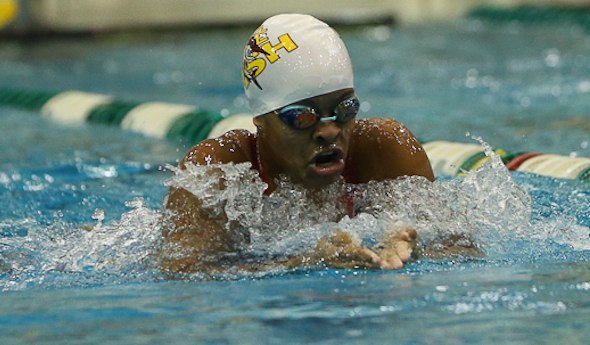
Mercy was seeded fourth entering the race, with Brighton coming in as the seventh seed. But the Bulldogs got off to a good start thanks to a 51.26 opening leg by senior Chloe Reed. The Marlins kept their poise, and cut into that lead with strong second and third legs by senior Courtney Connolly and junior Julia Coffman. That set the stage for a little “backyard” magic by sophomore anchor Greta Gidley, who swam a 50.26 – the third-fastest leg of any competitor in the race – to help her team to a third-place finish and enough points to beat the Bulldogs, 211 to 209.
“I was trying to focus on my own race, stay in my own lane,” said Gidley, who rallied from more than two seconds back to help her team top Brighton. “I couldn’t see Brighton, so I had no idea where they were, but I could see the girl next to me from Saline, and I was catching up to her, so I just put my head down and finished as strong as I could.”
Everyone outside of the pool knew exactly what was happening, and the entire contingent from Mercy erupted in celebration when the times shot up on the big scoreboard.
The Marlins had struggled out of the gate, but slowly but surely crept closer and closer to the leaders. They scored 34 points in the 500 freestyle, as senior Annette Domkowski (13 points), junior Kylie Goit (12) and junior Lindsey Case (9) all finished top-nine to vault their team past Rockford with just four events left.
“We talk all the time that it’s never about winning,” said Venos, whose team did not finish top-3 in any individual event, let alone take an event victory. “It’s about being the best, and if they come here and they focus on what they need to do to go fast, they’re going to walk out successful.”
Brighton didn’t win an event either, with its highest finish a second in the 200 freestyle relay. Seniors Maddie Mince, Julianne Libler and Reed, along with freshman Drue Thielking, finished second to Harrison-Farmington. Bulldogs coach Jason Black said though it was a little disappointing to finish a close second at the Finals, he couldn’t be happier with his team’s performance.
“They fought, all day,” Black said. “All three relays earned all-state honors. Looks like we have a couple all-American consideration times. I’m happy, I really am.”
 Another program making a little history – or at least matching it – was Harrison-Farmington. The Thunderbirds finished third overall with 199 points. They finished third a year ago, but a distant third. Coach Kyle Kinyon’s team won both the 200- and 400-yard freestyle relays, and senior Ashley Turak capped off a stellar career winning both the 50- and 100-yard freestyle events, both in record-setting fashion. She won the 50-yard race in a time of 22.20, breaking her own meet record, set in Friday’s preliminary round. Her time of 48.72 in the 100-yard final smashed her own meet record as well, also set Friday at 49.18.
She teamed up with junior Lia Munson, senior Emma Inch and sophomore Madeline Greaves to win the 200-yard freestyle relay in a time of 1:33.34 – also a Division 1 meet record. The same foursome set an all-class/division Finals record in the 400 freestyle relay. Needless to say, Turak was more than pleased with how the day unfolded.
“Last year we went into the state meet and didn’t have high expectations,” said Turak, who earned the meet’s “swimmer of the year” honor for the second straight from the state coaches association. “This year I was going into this meet with a different mindset. I was going for a 21 (in the 50 freestyle), so after that race I wasn’t all that happy. But after each swim I raced, I got happier and happier. That 48 in the 100 free, that was one of my goals.”
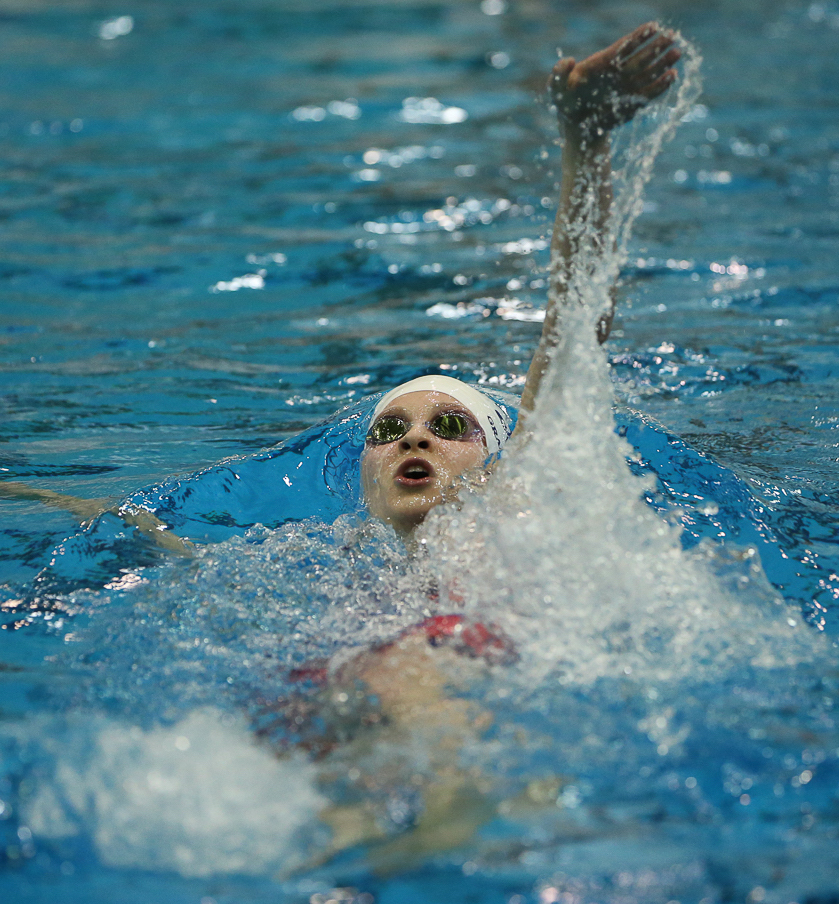
Turak wasn’t the only swimmer setting records Saturday. Grand Haven junior Kathryn Ackerman crushed the field in the 200 individual medley, setting an all-class/division record of 1:57.25. The verbally-committed University of Michigan prospect also won the 100-yard butterfly in a time of 54.42, edging Rockford’s Morgan Kraus (54.52).
“I put in a lot of work this year, so I came in wanting to defend my (200 IM) title and be somewhere around my state record time,” Ackerman said. “That’s what I did today, so I’m real happy about it.”
Grand Ledge junior Lola Mull repeated in the 500-yard freestyle, falling just short of her own meet record time in the process. She swam 4:44.93, less than a half-second slower than she did at last year’s Finals. She was less than two tenths of a second off the pool record.
“My goal was to swim under 4:40,” Mull said. “I had my splits on my wall, looking at them every night. I was ready to break it. But I didn’t have a full taper heading into this meet. So I thought I would save it for junior nationals, but if I could do it today, I was going to go for it.”
Mull finished second in the 200 freestyle to Saline’s Maddie Luther, who won in a time of 1:49.14. The Hornets finished fifth as a team, with 186 points.
Rockford, which won the 200 medley relay behind the efforts of sophomore Sara Kraus, junior Masy Folcik, Morgan Kraus and freshman Ashley Lund, was fourth with 191 points.
Ann Arbor Skyline was sixth overall with 184, followed by Ann Arbor Pioneer (172), Northville (123), Hudsonville (105) and Grand Haven (96) in the top 10.
Individually, Skyline senior Zain Smith repeated in the 1-meter diving competition, beating out Ann Arbor Huron sophomore Annie Costello. Smith’s teammate, junior Casey Chung, also won a second straight championship, that coming in the 100 backstroke.
Hudsonville junior Claire Tuttle was also a repeat champion, winning the 100 breaststroke.
PHOTOS: (Top) Farmington Hills Mercy's Courtney Connolly played a key role in her team's meet-winning relay performance Saturday. (Middle) Grand Haven's Kathryn Ackerman swims to one of her multiple individual championships. (Click to see more from HighSchoolSportsScene.com.)