


Classes Still Create Hoosier Hysteria
July 27, 2017
By Rob Kaminski
MHSAA benchmarks editor
This is the fourth part in a series on MHSAA tournament classification, past and present, that will be published over the next two weeks. This series originally ran in this spring's edition of MHSAA benchmarks.
Twenty years ago, Bloomington North High School won the Indiana High School Athletic Association boys basketball championship, defeating Delta 75-54 at the RCA Dome in Indianapolis.
The date, March 22, 1997, is at the same time revered and disdained by traditionalists in the state who saw it as the last schoolboy championship game the state would ever host.
That’s how devout the game of basketball, particularly interscholastic basketball, had become in the Hoosier state during the 87 years a state champion – one state champion, to be precise – was crowned.
Following that 1997 season, the IHSAA moved to a four-class system for its roundball tournaments, like so many of its state association counterparts had done years earlier.
It would be shocking to find more than a small percentage of current high school basketball players around the country unfamiliar with the iconic movie Hoosiers, even though the film is now more than 30 years old.
And, the storyline for that blockbuster unfolded more than 30 years prior to its release, when small-town, undermanned Milan High School defeated Muncie Central High School 32-30 in the 1954 IHSAA title game.
Perhaps it’s because of the David vs Goliath notion, or the fame of the movie that replaced Milan with the fictional Hickory and real-life star Bobby Plump with Hollywood hero Jimmy Chitwood, or the simple fact that Indiana had something other states didn’t.
Whatever the reason, plenty of opposition remains to this day to basketball classification in the state.
The fact is, the small rural schools were regularly being beaten handily by the much larger suburban and city schools as the tournament progressed each season.
Small schools also were closing at a rapid rate following the state’s School Reorganization Act in 1959, as students converged on larger, centralized county schools. From 1960 to 2000, the number of schools entering the tournament dropped from 694 to 381, and in 1997 a total of 382 schools and 4,584 athletes began competition at the Sectional level (the first level of the IHSAA Basketball Tournament).
It was at the entry level of the tournament where school administrators felt the pain of the new class system, but not necessarily for the same nostalgic reasons as the fans who either attended or boycotted the tournament.
At the Sectional round of the tournament, the IHSAA was culling just 2 percent of the revenue, with the participating schools splitting the balance. So, when Sectional attendance dropped by 14 percent in that first year of class basketball, many schools realized a financial loss. It was money they had grown to count on in prior years to help fund various aspects of the department.
Schools cumulatively received more than $900,000 from Sectional competition in 1998, but that total was down from more than $1 million in the last year of the single-class tournament.
Yet, the current format provides a great deal more opportunity and realistic chances at championship runs for schools of all enrollments.
To date, 60 additional teams have championship or runner-up trophies on display in school trophy cases around Indiana.
That was the mission in front of then-IHSAA commissioner Bob Gardner (now National Federation executive director) once the board made its decision: to give thousands more student-athletes the opportunity for once-in-a-lifetime experiences.
As any statistician knows, figures can be manipulated to tell any side of a story. Declining attendance in year one of class basketball is such a number.
The truth is tournament attendance had been on a steady downward spiral since its peak of just over 1.5 million in 1962. By the last single-class event in 1997, the total attendance was half that.
The challenge then and today, as it is for all state associations, is to find that delicate balance for those holding onto tradition, those holding onto trophies, and the number of trophies to hand out.
Editor’s Note: Stories from the Fort Wayne Journal Gazette in 1998 and from a 2007 issue of Indianapolis Monthly provided facts in this article.
The Official View: All in This Together
By
Brent Rice
MHSAA Assistant Director
November 5, 2018
By Brent Rice
MHSAA Assistant Director
“The Official View” has received significant positive feedback, from both officials and non-officials – and we thank you for your interest in learning more about this essential avocation.
 This week, we discuss a promising effort to recruit Legacy officials and another “get-to-know-you” opportunity at MHSAA Sportsmanship Summits, plus dive into rules scenarios in volleyball and swimming.
It’s Official!
MHSAA officials will be presenting over the coming weeks at the annual Sportsmanship Summits held around the state. Renewed focus will be concentrated on the effect that poor sportsmanship has on the challenge of recruiting and retaining officials. Discussions will be led by noted officials in those areas to allow students to discuss the concerns and solutions to these issues.
Improving sportsmanship is a priority of the MHSAA Officials Program, and officials should be looking for new initiatives to support this goal. They include new policies on protecting officials, providing schools with framework to institute a Game Day Ambassadors Program, “Official Thanks” nights and several others.
Some efforts already have proven successful. “The Official View” continues to serve its purpose in humanizing the folks that officiate MHSAA contests. On that note, keep sending those photos and stories to [email protected] for features in The Official View. Ideally, submissions will be for in-season sports and include photo(s). Don’t forget to add the who, what, where, and when.
Rule of the Week
VOLLEYBALL As A1 tosses the ball in the air to serve, she realizes she is the improper server and catches the ball in attempt to force a re-serve. The proper server (A2) then immediately takes her place and makes a legal serve, scoring a point. A2’s toss for her second serve is bad and she catches the ball.
Ruling: This is an illegal serve and loss of rally/point. The re-serve privilege was used up by A1 since this was during A2’s term of service.
It’s Your Call
SWIMMING In the clip, the swimmer in Lane 5 begins to stray in her backstroke and ends up incidentally contacting the lane divider. She ultimately continues and wins the race. What’s the call?
Last Week’s IYC Ruling: In the clip, as the attacker and the keeper approach the ball, the attacker strikes the keeper’s ear. Since this is outside of the penalty area, a direct free kick would be awarded and the attacker would be assessed a yellow card. (Click to see last week's video.)
Official View: We’re All in This Together
The MHSAA Legacy Program has produced some terrific officials since its inception in 1992, many of whom are still officials today. We feel that recruiting eager and qualified officials is a collective partnership between the MHSAA, schools and officials associations around the state.
 For our part, the MHSAA offers a reduced registration fee for enrolled-student officials to get them started into officiating. We suggest that the schools and associations further alleviate these new officials from their startup costs by taking on this reduced fee. Schools benefit because they can then utilize these officials’ services at middle school and junior high school contests, and associations benefit because they are able to add a new official to their rosters for years to come.
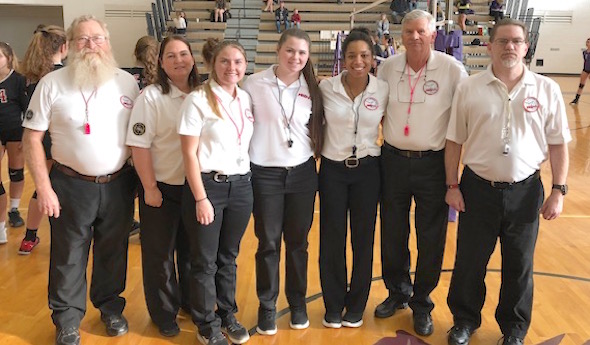
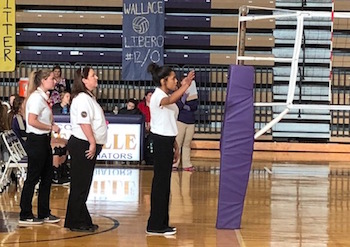
Fowlerville has taking the lead in this area by recently hosting a Legacy clinic where veteran officials were paired with newly registered (paid for by Fowlerville Schools) Legacy officials and assigned to a volleyball match with local middle school Red Cedar League teams. This event allowed experienced mentor officials to provide on-the-spot constructive feedback in live game scenarios.
Other schools are following suit by hosting clinics and other events to draw new officials into the fold, including adding curriculum in officiating to next year’s course load. Schools interested in adding officiating to their curriculum can contact Brent Rice of the MHSAA for a curriculum outline and guides to make it a success.
PHOTOS: (Top) Fowlerville Legacy officials and mentors work a recent middle school volleyball match; left to right: John Garrison, Kelli Hart, Lindsey Darby, Jackie Jarvis, Dalaija Franklin, Rodney Horton and Tyler Hover. (Middle) Hart (mentor) instructs Franklin, far right, while Darby shadows. (Photos courtesy of the Fowlerville athletic department.)