


Classes Still Create Hoosier Hysteria
July 27, 2017
By Rob Kaminski
MHSAA benchmarks editor
This is the fourth part in a series on MHSAA tournament classification, past and present, that will be published over the next two weeks. This series originally ran in this spring's edition of MHSAA benchmarks.
Twenty years ago, Bloomington North High School won the Indiana High School Athletic Association boys basketball championship, defeating Delta 75-54 at the RCA Dome in Indianapolis.
The date, March 22, 1997, is at the same time revered and disdained by traditionalists in the state who saw it as the last schoolboy championship game the state would ever host.
That’s how devout the game of basketball, particularly interscholastic basketball, had become in the Hoosier state during the 87 years a state champion – one state champion, to be precise – was crowned.
Following that 1997 season, the IHSAA moved to a four-class system for its roundball tournaments, like so many of its state association counterparts had done years earlier.
It would be shocking to find more than a small percentage of current high school basketball players around the country unfamiliar with the iconic movie Hoosiers, even though the film is now more than 30 years old.
And, the storyline for that blockbuster unfolded more than 30 years prior to its release, when small-town, undermanned Milan High School defeated Muncie Central High School 32-30 in the 1954 IHSAA title game.
Perhaps it’s because of the David vs Goliath notion, or the fame of the movie that replaced Milan with the fictional Hickory and real-life star Bobby Plump with Hollywood hero Jimmy Chitwood, or the simple fact that Indiana had something other states didn’t.
Whatever the reason, plenty of opposition remains to this day to basketball classification in the state.
The fact is, the small rural schools were regularly being beaten handily by the much larger suburban and city schools as the tournament progressed each season.
Small schools also were closing at a rapid rate following the state’s School Reorganization Act in 1959, as students converged on larger, centralized county schools. From 1960 to 2000, the number of schools entering the tournament dropped from 694 to 381, and in 1997 a total of 382 schools and 4,584 athletes began competition at the Sectional level (the first level of the IHSAA Basketball Tournament).
It was at the entry level of the tournament where school administrators felt the pain of the new class system, but not necessarily for the same nostalgic reasons as the fans who either attended or boycotted the tournament.
At the Sectional round of the tournament, the IHSAA was culling just 2 percent of the revenue, with the participating schools splitting the balance. So, when Sectional attendance dropped by 14 percent in that first year of class basketball, many schools realized a financial loss. It was money they had grown to count on in prior years to help fund various aspects of the department.
Schools cumulatively received more than $900,000 from Sectional competition in 1998, but that total was down from more than $1 million in the last year of the single-class tournament.
Yet, the current format provides a great deal more opportunity and realistic chances at championship runs for schools of all enrollments.
To date, 60 additional teams have championship or runner-up trophies on display in school trophy cases around Indiana.
That was the mission in front of then-IHSAA commissioner Bob Gardner (now National Federation executive director) once the board made its decision: to give thousands more student-athletes the opportunity for once-in-a-lifetime experiences.
As any statistician knows, figures can be manipulated to tell any side of a story. Declining attendance in year one of class basketball is such a number.
The truth is tournament attendance had been on a steady downward spiral since its peak of just over 1.5 million in 1962. By the last single-class event in 1997, the total attendance was half that.
The challenge then and today, as it is for all state associations, is to find that delicate balance for those holding onto tradition, those holding onto trophies, and the number of trophies to hand out.
Editor’s Note: Stories from the Fort Wayne Journal Gazette in 1998 and from a 2007 issue of Indianapolis Monthly provided facts in this article.
Wooer Leads Kingsley's Return to Power
November 1, 2018
By Chris Dobrowolski
Special for Second Half
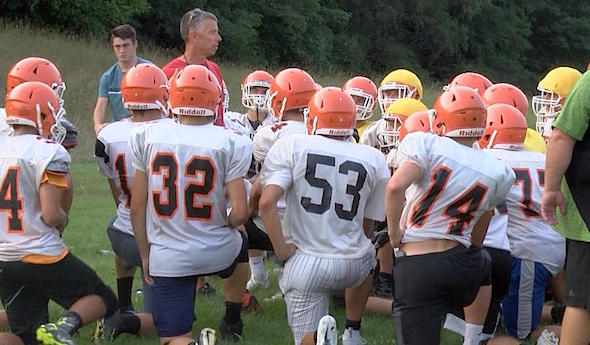
KINGSLEY — Tim Wooer does not have the ability to wave a wand and make victories on the football field appear out of thin air.
 The Kingsley football program is certainly grateful for the magic Wooer has brought back to the gridiron in no time at all, however.
After going 1-8 at year ago, Kingsley has had a remarkable turnaround in the first year of Wooer’s second tenure as Stags varsity head coach, going 9-1, including last week’s 62-22 Division 6 District playoff win over Tawas.
“The bottom line is — people have asked me how did this happen? I can only give you one answer, and it is the kids,” said Wooer.
It’s a group of players who have endured a lot the past few seasons. The once-proud program had fallen on hard times, seeing a decline in wins after a 6-4 playoff season in 2014. The Stags went 5-4, 5-4, 3-6 and bottomed out with one win during a tumultuous 2017 campaign that saw the previous head coach placed on administrative leave in the middle of the season before he later resigned. Interim coach Jamie Mullen finished out the fall. Needless to say, Kingsley’s players didn’t find many good, positive memories from the season.
“I didn’t even want to play anymore. I was just happy for (the season) to be over,” said Kingsley senior captain Dylan Case.
Wooer noticed the apathy, lack of energy and complacency that seemed to be common among many of the male athletes at his alma mater not long after he came on as a long-term substitute teacher at Kingsley just months after retiring from education. He also was in his 10th year as the head coach at Traverse City West and was enjoying his best year yet with the Titans, who finished 9-2 and won their first playoff game since Wooer arrived in 2008.
But while he was subbing, Wooer was able to drive his two daughters, Lauren and Sarah, to school every morning. He realized then how precious the moments with them and his son, Tyler, had become. So, when Wooer was approached about taking over the Stags in January, he didn’t need much time to make a decision.
“From a football standpoint it was a very poor decision at the time,” said Wooer. “We thought we had things going at West. We were 8-1, had a good nucleus coming back. Our numbers at the middle school were great. It was really kind of self-sustaining at that point. We had a really good thing going. But all the other factors made it a quite simple decision. It was family and obviously my love for Kingsley and the community of Kingsley.”
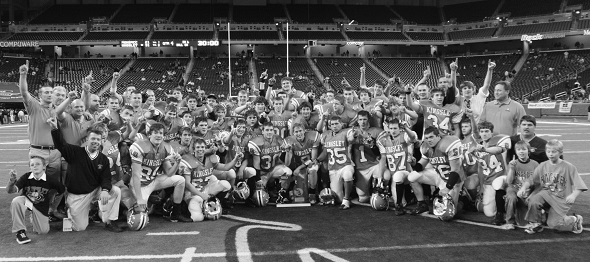
There was good reason for people in Kingsley to yearn for Wooer to come back. When he left after nine years, he had compiled a record of 68-29 and, most notably, guided the Stags to the 2005 Division 6 championship. A few of the oldest players on Kingsley’s current team were in kindergarten during that season. Many others had not started school. But many knew of Wooer. Parents, older siblings, cousins and community members alike had talked fondly of the 2005 title team, and a picture documenting the championship hangs prominently in the school. It gave Wooer instant credibility.
“He led Kingsley to a state championship,” said Case. “We knew he knew what he was talking about and that he wanted what was best for us.”
Coming off a 1-8 season, the players were more than willing to buy in to what Wooer was selling — winning football.
“You don’t really question it because we went 1-8,” said senior Jake Radtke, another senior captain. “We were like, ‘OK, this doesn’t work.’ Just trust the process and believe what he’s saying and buy in. He bleeds Black and Orange, and I love it. He knows we bleed Black and Orange, and he’s part of our family.”
Wooer surrounded himself with a staff of coaches who are mostly Kingsley alums and former players. Dan Goethels played on the team in 1997. Al Olds, Ryan Zenner and Dave Zenner all played for Wooer on the 2002 Kingsley squad. Mullin and Ron Hessem were three years behind Wooer in school in the late ‘80s. Ray Fisher, whose son Jake plays for the Cincinnati Bengals after starring for Wooer at West, has followed Wooer from Kingsley, to West, and now is back with the Stags.
 “We’ve surrounded ourselves with some really good people who have a love for Kingsley and understand the system and what we want to do,” Wooer said of his assistants.
Wooer laid down the law at his first meeting with the team last winter. He talked about bringing discipline to the program and set his expectations for players in preparation for the season, particularly getting better participation in the weight room. More than 40 players in the high school took that to heart and had perfect attendance in lifting over the summer.
“There were lots of expectations,” said senior lineman Nathan Ames. “You could tell from his speech that it was going to be a lot of work. From the first second of team camp everybody bought in. After team camp, I definitely knew what was going to happen.”
Wooer still might not have been so sure how much success he would have with the Stags right away. He thought his team played poorly in its first preseason scrimmage at Manton. Even after an improved showing against the likes of Harrison, North Muskegon and Mason County Central in a second scrimmage, Wooer still wasn’t convinced his team was ready to compete when it met McBain in the first week of the regular season.
“I can still remember driving down to McBain — I was terrified,” said Wooer. “I’m on the bus thinking we are so unprepared. We couldn’t make an adjustment outside of a timeout. It was timeouts and quarters where you had to throw as much information at them as you could, hoping they could make those adjustments. It took two or three weeks before we could. We were making adjustments on the fly. I was yelling stuff out on the field.”
The Stags ended up pulling out a 24-20 victory over a good McBain squad. People were already half-joking that the team had equaled its win total from the previous season.
“That was a huge turnaround,” said Ames. “We all just kind of looked at each other after that win and said this is it.”
Wins over Ogemaw Heights and Grayling followed. Though the Stags fell to Traverse City St. Francis in the fourth week, they rebounded with five straight victories to finish the regular season.
With the wins have also come some individual accolades. Six players were named to the all-Northern Michigan Football League Legends division first team — running back Ayden Mullin, who was the league’s Offensive Player of the Year, along with Ames at defensive tackle, Radtke at guard, tight end Ian Sousa, outside linebacker Devon Hager and defensive back Owen Graves.
“It was very refreshing to have kids who want to be coached and want to be pushed,” said Wooer. “That’s not common in today’s world.
“It has not been an easy process. There were some chewings and some tough times, but they didn’t flinch once. Once they saw the success they received for their efforts, and everything did work as it was planned, it kind of fell into place. I just can’t say enough about the kids. It’s all about every one of the kids in our program.”
 Chris Dobrowolski has covered northern Lower Peninsula sports since 1999 at the Ogemaw County Herald, Alpena News, Traverse City Record-Eagle and currently as sports editor at the Antrim Kalkaska Review since 2016. He can be reached at [email protected] with story ideas for Manistee, Wexford, Missaukee, Roscommon, Ogemaw, Iosco, Alcona, Oscoda, Crawford, Kalkaska, Grand Traverse, Benzie, Leelanau, Antrim, Otsego, Montmorency, Alpena, Presque Isle, Cheboygan, Charlevoix and Emmet counties.
PHOTOS: (Top) Kingsley football coach Tim Wooer addresses his team during practice this fall. (Middle) Wooer, bottom left, celebrates with his team after the Stags won the 2005 Division 6 title at Pontiac Silverdome. (Top photo courtesy of WPBN.)