


Classes Still Create Hoosier Hysteria
July 27, 2017
By Rob Kaminski
MHSAA benchmarks editor
This is the fourth part in a series on MHSAA tournament classification, past and present, that will be published over the next two weeks. This series originally ran in this spring's edition of MHSAA benchmarks.
Twenty years ago, Bloomington North High School won the Indiana High School Athletic Association boys basketball championship, defeating Delta 75-54 at the RCA Dome in Indianapolis.
The date, March 22, 1997, is at the same time revered and disdained by traditionalists in the state who saw it as the last schoolboy championship game the state would ever host.
That’s how devout the game of basketball, particularly interscholastic basketball, had become in the Hoosier state during the 87 years a state champion – one state champion, to be precise – was crowned.
Following that 1997 season, the IHSAA moved to a four-class system for its roundball tournaments, like so many of its state association counterparts had done years earlier.
It would be shocking to find more than a small percentage of current high school basketball players around the country unfamiliar with the iconic movie Hoosiers, even though the film is now more than 30 years old.
And, the storyline for that blockbuster unfolded more than 30 years prior to its release, when small-town, undermanned Milan High School defeated Muncie Central High School 32-30 in the 1954 IHSAA title game.
Perhaps it’s because of the David vs Goliath notion, or the fame of the movie that replaced Milan with the fictional Hickory and real-life star Bobby Plump with Hollywood hero Jimmy Chitwood, or the simple fact that Indiana had something other states didn’t.
Whatever the reason, plenty of opposition remains to this day to basketball classification in the state.
The fact is, the small rural schools were regularly being beaten handily by the much larger suburban and city schools as the tournament progressed each season.
Small schools also were closing at a rapid rate following the state’s School Reorganization Act in 1959, as students converged on larger, centralized county schools. From 1960 to 2000, the number of schools entering the tournament dropped from 694 to 381, and in 1997 a total of 382 schools and 4,584 athletes began competition at the Sectional level (the first level of the IHSAA Basketball Tournament).
It was at the entry level of the tournament where school administrators felt the pain of the new class system, but not necessarily for the same nostalgic reasons as the fans who either attended or boycotted the tournament.
At the Sectional round of the tournament, the IHSAA was culling just 2 percent of the revenue, with the participating schools splitting the balance. So, when Sectional attendance dropped by 14 percent in that first year of class basketball, many schools realized a financial loss. It was money they had grown to count on in prior years to help fund various aspects of the department.
Schools cumulatively received more than $900,000 from Sectional competition in 1998, but that total was down from more than $1 million in the last year of the single-class tournament.
Yet, the current format provides a great deal more opportunity and realistic chances at championship runs for schools of all enrollments.
To date, 60 additional teams have championship or runner-up trophies on display in school trophy cases around Indiana.
That was the mission in front of then-IHSAA commissioner Bob Gardner (now National Federation executive director) once the board made its decision: to give thousands more student-athletes the opportunity for once-in-a-lifetime experiences.
As any statistician knows, figures can be manipulated to tell any side of a story. Declining attendance in year one of class basketball is such a number.
The truth is tournament attendance had been on a steady downward spiral since its peak of just over 1.5 million in 1962. By the last single-class event in 1997, the total attendance was half that.
The challenge then and today, as it is for all state associations, is to find that delicate balance for those holding onto tradition, those holding onto trophies, and the number of trophies to hand out.
Editor’s Note: Stories from the Fort Wayne Journal Gazette in 1998 and from a 2007 issue of Indianapolis Monthly provided facts in this article.
Understudy Shines as Shores' Lead Receiver
By
Tom Kendra
Special for MHSAA.com
October 31, 2018
The understudy has become the star for the Muskegon Mona Shores football team.
 James Gilbert was supposed to be “the other guy” this season, the receiver on the opposite side from Division I recruit Damari Roberson, who has committed to Western Michigan University.
But the cast list changed in June when Roberson, a 3.6 GPA student who at one time had more than 17 college football scholarship offers, tore the ACL in his left knee for the second time in nine months during a non-contact drill.
“That’s when everything changed,” explained Gilbert, who always had considered himself a basketball player on the football field. “The coaches and Damari sat me down and told me that I had to be the man, that I was the only one with the same type of ability that could take his place. They basically challenged me.”
Shores coach Matt Koziak said Gilbert, a 6-foot-2, 181-pound senior, has always had the physical skills. But since Roberson went down this summer, he has been focused, motivated and driven like never before.
The result has been an incredible senior season for Gilbert, who has 51 catches for 1,172 yards and 10 touchdowns. His emergence as one of the top receivers in the state enabled the Sailors to climb all the way to No. 1 in Division 2 in the final Associated Press state rankings.
Mona Shores (9-1) will put its top ranking to the test Friday night in the MHSAA District championship game against visiting Ottawa-Kent Conference Black rival Jenison (7-3). The two teams engaged in a shootout just three weeks ago, with the visiting Sailors escaping with a 49-42 victory.
Gilbert played a huge role in that win, with six catches for 93 yards and a touchdown, coming up big once again when his team needed it most.
“JG has been unbelievable all year,” said Koziak, who has a 60-26 record in eight years as the Sailors’ coach, highlighted by a run to the Division 2 title game in 2014. “With all of the injuries we’ve had, he’s kind of been the one constant. When we’re scratching our heads, we can always throw it up to James.”
Coming into the season, Koziak knew he had senior battering ram running back Sincere Dent (5-11, 217), who has delivered with 118 carries for 1,082 yards and 20 touchdowns. The problem is that Dent has played in only seven games and his playing time was reduced in several others due to shoulder and ankle injuries.
Junior quarterback Caden Broersma (6-3, 206) also has been outstanding, completing 81-of-112 passes (72 percent) for 1,547 yard and 13 touchdowns, with just one interception. He also has rushed for 621 yards and 12 touchdowns.
The most surprising statistic for Mona Shores is that Gilbert has accounted for 76 percent of the Sailors’ receiving yards.
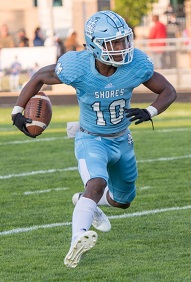 “I’m not surprised, because he’s always had it in him,” said Roberson, who has remained a key part of the team, attending every practice and serving as another assistant coach for Koziak. “I always learned from him in basketball, and I taught him everything he knows about football. With me being out, he’s had more of a chance to show what he can do.”
Gilbert is starting to garner more and more interest from college football programs, with Saginaw Valley State, Ferris, Davenport and Mount Union (Ohio) showing the most thus far.
Gilbert wasted no time proving he would be “the man,” showing his big-play ability with five catches for 159 yards (32 yards per catch) and a touchdown in a big 48-38 win over East Kentwood in the season-opening Gridiron Classic at Grand Valley State University. East Kentwood hasn’t lost a game since.
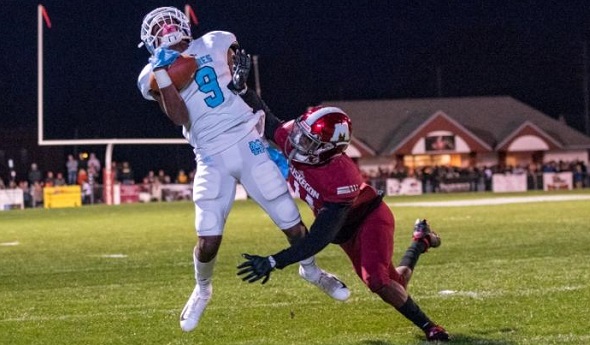
He also came up big in the cross-town showdown Oct. 12 against unbeaten Muskegon, which is ranked No. 1 in Division 3. Gilbert caught six passes for 118 yards, including a one-handed, 28-yard touchdown grab. He also threw a 31-yard touchdown pass to Andrew Swick on a trick play in that 55-35 loss.
And Gilbert was at it again in last week’s narrow 34-28 District win over Grand Rapids Forest Hills Central, catching five passes for 120 yards and a touchdown. He sealed the win with an interception as the Rangers were driving for a potential game-winning score in the final minute.
“It’s been fun, but we know we still have a lot of work to do,” said Gilbert, who has impressed opposing coaches with his ability to come down with big catches in traffic. “Damari and I have been playing with each other and against each other since Little League, so I kind of feel that I’m playing for him this season.”
As for Roberson, he still believes that a season that began with a nightmare injury could have a storybook ending – both for the team and himself.
Roberson (6-2, 194) said his rehabilitation is going great and his possible return date from the injury is during the week of the MHSAA Semifinals. So there remains the possibility, if the team keeps winning, that Roberson and Gilbert could line up as opposite wideouts, like the original plan.
“Stay tuned,” said Roberson, who is on pace to graduate early in December and then enroll at WMU in January. “After all that this team has been through, with all of the injuries, that would be the perfect ending.”
 Tom Kendra worked 23 years at The Muskegon Chronicle, including five as assistant sports editor and the final six as sports editor through 2011. E-mail him at [email protected] with story ideas for Muskegon, Oceana, Mason, Lake, Oceola, Mecosta and Newaygo counties.
PHOTOS: (Top) Mona Shores senior James Gilbert makes a one-handed catch for a 28-yard touchdown on a pass from Caden Broersma early in the second quarter Oct. 12 at Muskegon. (Middle) Damari Roberson returns a punt last year as a junior against Reeths-Puffer. Roberson has not played this season due to a knee injury. (Photos by Eric Sturr.)