


Classes Still Create Hoosier Hysteria
July 27, 2017
By Rob Kaminski
MHSAA benchmarks editor
This is the fourth part in a series on MHSAA tournament classification, past and present, that will be published over the next two weeks. This series originally ran in this spring's edition of MHSAA benchmarks.
Twenty years ago, Bloomington North High School won the Indiana High School Athletic Association boys basketball championship, defeating Delta 75-54 at the RCA Dome in Indianapolis.
The date, March 22, 1997, is at the same time revered and disdained by traditionalists in the state who saw it as the last schoolboy championship game the state would ever host.
That’s how devout the game of basketball, particularly interscholastic basketball, had become in the Hoosier state during the 87 years a state champion – one state champion, to be precise – was crowned.
Following that 1997 season, the IHSAA moved to a four-class system for its roundball tournaments, like so many of its state association counterparts had done years earlier.
It would be shocking to find more than a small percentage of current high school basketball players around the country unfamiliar with the iconic movie Hoosiers, even though the film is now more than 30 years old.
And, the storyline for that blockbuster unfolded more than 30 years prior to its release, when small-town, undermanned Milan High School defeated Muncie Central High School 32-30 in the 1954 IHSAA title game.
Perhaps it’s because of the David vs Goliath notion, or the fame of the movie that replaced Milan with the fictional Hickory and real-life star Bobby Plump with Hollywood hero Jimmy Chitwood, or the simple fact that Indiana had something other states didn’t.
Whatever the reason, plenty of opposition remains to this day to basketball classification in the state.
The fact is, the small rural schools were regularly being beaten handily by the much larger suburban and city schools as the tournament progressed each season.
Small schools also were closing at a rapid rate following the state’s School Reorganization Act in 1959, as students converged on larger, centralized county schools. From 1960 to 2000, the number of schools entering the tournament dropped from 694 to 381, and in 1997 a total of 382 schools and 4,584 athletes began competition at the Sectional level (the first level of the IHSAA Basketball Tournament).
It was at the entry level of the tournament where school administrators felt the pain of the new class system, but not necessarily for the same nostalgic reasons as the fans who either attended or boycotted the tournament.
At the Sectional round of the tournament, the IHSAA was culling just 2 percent of the revenue, with the participating schools splitting the balance. So, when Sectional attendance dropped by 14 percent in that first year of class basketball, many schools realized a financial loss. It was money they had grown to count on in prior years to help fund various aspects of the department.
Schools cumulatively received more than $900,000 from Sectional competition in 1998, but that total was down from more than $1 million in the last year of the single-class tournament.
Yet, the current format provides a great deal more opportunity and realistic chances at championship runs for schools of all enrollments.
To date, 60 additional teams have championship or runner-up trophies on display in school trophy cases around Indiana.
That was the mission in front of then-IHSAA commissioner Bob Gardner (now National Federation executive director) once the board made its decision: to give thousands more student-athletes the opportunity for once-in-a-lifetime experiences.
As any statistician knows, figures can be manipulated to tell any side of a story. Declining attendance in year one of class basketball is such a number.
The truth is tournament attendance had been on a steady downward spiral since its peak of just over 1.5 million in 1962. By the last single-class event in 1997, the total attendance was half that.
The challenge then and today, as it is for all state associations, is to find that delicate balance for those holding onto tradition, those holding onto trophies, and the number of trophies to hand out.
Editor’s Note: Stories from the Fort Wayne Journal Gazette in 1998 and from a 2007 issue of Indianapolis Monthly provided facts in this article.
The Official View: Steps Away, Starts Anew
By
Brent Rice
MHSAA Assistant Director
October 29, 2018
By Brent Rice
MHSAA Assistant Director
As “Official View” returns this week, we say good-bye and a big thank you to a longtime football official – but only for the fall as he’ll be continuing to serve on basketball courts in southwestern Michigan.
 We also consider a few soccer scenarios and explain changes on the way at MHSAA.com designed in part to provide more resources for officials.
It’s Official!
The use of regular bulletins for officials in each sport was rolled out for this past fall season in football, soccer and volleyball. Each of these weekly bulletins provides readers with a few topical items (rules and mechanics) which includes common issues observed, points of emphasis or tips, and hints. It also provides a rules challenge and other tidbits of beneficial information in the specific sport. Full implementation of this tool will be started this winter in basketball, competitive cheer, gymnastics, hockey, swimming and wrestling.
Expect to see some changes in the coming weeks to the Officials page of the MHSAA website. The primary goal of this revamp is to reduce redundancy, separate and organize general officials information from sport-specific information and provide a new resource area for each sport’s officials to receive bulletins, approved rulings and interpretations and to access the new video rules library currently in development. If there are specific things you would like to see included, please let assistant director Brent Rice know.
Rule of the Week
SOCCER During A1’s throw-in, the ball first hits the touchline and then continues immediately out of play.
Ruling: This is a legal throw-in and Team B will be awarded a throw-in at the spot at which the ball left play.
It’s Your Call
SOCCER This week’s clip has the attacker in white and defender in blue racing to retrieve a ball headed near (but just outside) the penalty area. The goalkeeper charges and both he and the attacker attempt to make a play on the ball. What’s the call?
Last Week’s IYC Ruling: Last week we were presented with a prime example of how not to run the “Swinging Gate” formation from scrimmage. The play had a number of potential fouls – let’s run through them (click to see the video):
• Illegal formation – Snapper’s shoulders must be squared to the line of scrimmage.
• Illegal formation – It appears only the snapper is on the line of scrimmage. This leaves 10 in the backfield.
• Illegal shift – While the cluster of players are attempting to get set, the near receiver goes in motion. The ball is snapped without having all 11 set for at least one second.
• False start – The back that receives the snap starts to move before the snap.
Official View: A Step Back
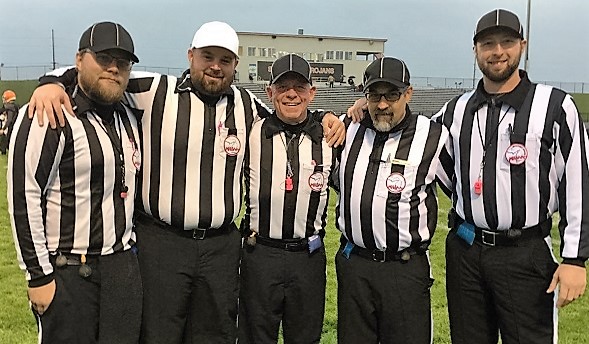
 For the last 42 years, Wayne Patterson has roamed the high school gridirons serving as a strong, hardworking and dependable official, crewmate and mentor to young officials. Patterson has decided that after years and years of fall Fridays blocked on the calendar, it’s time to spend more time with his family and allow other officials to take his place.
It’s not a step out though, only a step back. He will continue to officiate both boys and girls basketball in the winter, working alongside his daughter.
In the adjacent photo, Patterson sits with his regular crew for a postgame meal and discussion. The crew took the top photo together during his final career football game, at Sturgis High School. (Top photo, from left: Mitch Reynolds, Pete VanGeisen, Wayne Patterson, Tim Latta and Mike McKenzie).