


Classes Still Create Hoosier Hysteria
July 27, 2017
By Rob Kaminski
MHSAA benchmarks editor
This is the fourth part in a series on MHSAA tournament classification, past and present, that will be published over the next two weeks. This series originally ran in this spring's edition of MHSAA benchmarks.
Twenty years ago, Bloomington North High School won the Indiana High School Athletic Association boys basketball championship, defeating Delta 75-54 at the RCA Dome in Indianapolis.
The date, March 22, 1997, is at the same time revered and disdained by traditionalists in the state who saw it as the last schoolboy championship game the state would ever host.
That’s how devout the game of basketball, particularly interscholastic basketball, had become in the Hoosier state during the 87 years a state champion – one state champion, to be precise – was crowned.
Following that 1997 season, the IHSAA moved to a four-class system for its roundball tournaments, like so many of its state association counterparts had done years earlier.
It would be shocking to find more than a small percentage of current high school basketball players around the country unfamiliar with the iconic movie Hoosiers, even though the film is now more than 30 years old.
And, the storyline for that blockbuster unfolded more than 30 years prior to its release, when small-town, undermanned Milan High School defeated Muncie Central High School 32-30 in the 1954 IHSAA title game.
Perhaps it’s because of the David vs Goliath notion, or the fame of the movie that replaced Milan with the fictional Hickory and real-life star Bobby Plump with Hollywood hero Jimmy Chitwood, or the simple fact that Indiana had something other states didn’t.
Whatever the reason, plenty of opposition remains to this day to basketball classification in the state.
The fact is, the small rural schools were regularly being beaten handily by the much larger suburban and city schools as the tournament progressed each season.
Small schools also were closing at a rapid rate following the state’s School Reorganization Act in 1959, as students converged on larger, centralized county schools. From 1960 to 2000, the number of schools entering the tournament dropped from 694 to 381, and in 1997 a total of 382 schools and 4,584 athletes began competition at the Sectional level (the first level of the IHSAA Basketball Tournament).
It was at the entry level of the tournament where school administrators felt the pain of the new class system, but not necessarily for the same nostalgic reasons as the fans who either attended or boycotted the tournament.
At the Sectional round of the tournament, the IHSAA was culling just 2 percent of the revenue, with the participating schools splitting the balance. So, when Sectional attendance dropped by 14 percent in that first year of class basketball, many schools realized a financial loss. It was money they had grown to count on in prior years to help fund various aspects of the department.
Schools cumulatively received more than $900,000 from Sectional competition in 1998, but that total was down from more than $1 million in the last year of the single-class tournament.
Yet, the current format provides a great deal more opportunity and realistic chances at championship runs for schools of all enrollments.
To date, 60 additional teams have championship or runner-up trophies on display in school trophy cases around Indiana.
That was the mission in front of then-IHSAA commissioner Bob Gardner (now National Federation executive director) once the board made its decision: to give thousands more student-athletes the opportunity for once-in-a-lifetime experiences.
As any statistician knows, figures can be manipulated to tell any side of a story. Declining attendance in year one of class basketball is such a number.
The truth is tournament attendance had been on a steady downward spiral since its peak of just over 1.5 million in 1962. By the last single-class event in 1997, the total attendance was half that.
The challenge then and today, as it is for all state associations, is to find that delicate balance for those holding onto tradition, those holding onto trophies, and the number of trophies to hand out.
Editor’s Note: Stories from the Fort Wayne Journal Gazette in 1998 and from a 2007 issue of Indianapolis Monthly provided facts in this article.
Seeing Need, New SE Officials Work to Fill It
October 26, 2018
By Doug Donnelly
Special for Second Half
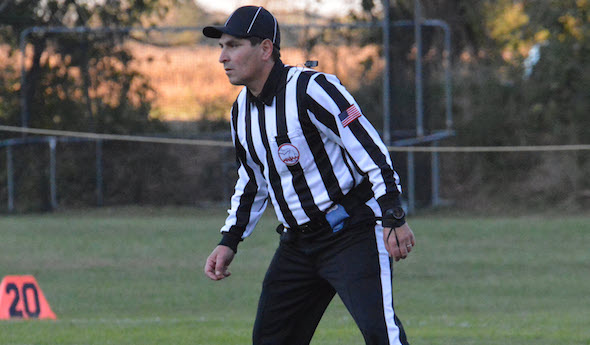
TEMPERANCE – Clyde Canales says his life experiences have prepared him for this. Bryant Moore says his new role as a football referee has taught him a new respect for the game. And Herb Bertz says he signed up to stay part of a game that has meant so much to his family the last several years.
The three southeast Michigan men are among new high school football officiating recruits for the Michigan High School Athletic Association. And they are a welcome addition to the ranks.
More and more, the lack of high school officials is starting to take its toll, forcing game times to be shifted and leaving athletic directors scrambling to fill crews for sub-varsity and even varsity games.
The shortage has hit southeast Michigan particularly hard. Earlier this season, multiple Tri-County Conference and Lenawee County Athletic Association games were moved from the traditional Friday night under lights start time to Saturday morning. There are several reasons contributing to this shortage – among them officials retiring, some leagues moving toward seven-man crews instead of five and the lack of sportsmanship being shown by adults.
Bertz has watched his sons play the last several years for Ottawa Lake Whiteford. He’s been on the chain gang for much of that time, volunteering his time and getting an on-the-field view of the games. He became a referee just this year.
“I wasn’t ready to give up the game,” he said. “I love football.”
Bertz said he’s worked about 40 games this fall, at all levels, and is already putting together a schedule for next year with a crew made up of all second-year officials. He said his experience has been great. The players, he said, are for the most part very respectful of officials. If the adults are yelling from the stands, he says, he’s able to tune them out.
“I don’t let any of that bother me; I just don’t,” Bertz said. “If you understand that football is an emotional game and emotions are going to run high out there, you won’t let that stuff bother you. Some people are rude, sure, but that doesn’t bother me. If it does bother you, you probably shouldn’t be a ref.”
Two years ago, Moore was a two-way starter for the Sand Creek football team. The only time he worried about the referees was when he’d spot a yellow flag on the field. Now, he’s carrying the flag around and throwing it when necessary.
“Most of the experience has been good,” he said. “Coaches for the most part are supportive, but they’ll let you know when you screw up. You have to be thick-skinned, that’s for sure. It gives you a new perspective and respect for the referee. As a player, you think it would be easy to step into their shoes. It’s not easy being a referee.”
The shortage, he said, is real. He has received text messages and calls on game days asking if he is available. Most of his weeks are filled with football nights, something he is juggling around attending Adrian College. The money he’s earned helps pay the bills, he said, and he’s learned a lot about the sport and interacting with others.
“The more you go out there and do it, the more comfortable you get,” he said. “I’ve been busy every week. They definitely need us.”
Canales was a member of Erie Mason’s 1987 Class C championship football team. He’s worked several jobs since then, from being in the restaurant business to probation officer. He signed up to be an official this year for the first time. He’s working games almost every day of the week, from youth games to varsity competition. And, he said, it’s been an eye-opening ride.
“The first few times, I felt bad taking their money,” Canales said. “I felt like I was out there to give back and these organizations needed the money. After a while, though, for all you have to go through, I don’t mind taking the money.”
For the most part, Canales said, it’s been a positive experience becoming a registered MHSAA official. He researched the rules, took online tests and went through a training period. He had the idea to become a referee because of a shortage of officials that has hit the region, state and, really, the country.
“This is my first year, so it’s good to have a lot of things thrown at me,” said Canales, 49. “Everyone thinks they can make the right call from the stands. It’s not that easy. But, I’m doing this now. I’m enjoying it. I think I’ve made it through the rough times.”
If he and the others do continue being a referee, that’s good news to the MHSAA. Once a referee has been working games for three years, officials say, they tend to stay with it.
The reasons officials cite most when they leave the sport is they are getting older and don’t feel they can continue to perform at the level they want, work or family changes and adult sportsmanship.
The MHSAA held an in-service for athletic directors this month and one of the topics was the situation with officials.
“In 2006-07, there were 12,000 officials; today there are 10,000,” said Whiteford athletic director Jason Mensing. “The numbers are going down. If we want to continue playing games, we need to have people that are willing to step up and do those jobs.”
Mensing said new guys like Canales, Bertz and Moore need to be welcomed.
“Our goal as an athletic department is to show them more gratitude if we can,” he said. “We’ll continue to work with our coaches and our community to make sure we are showing them great respect. They aren’t making a lot of money, but they are giving back to the game. It’s something we should be appreciative of.”
The MHSAA has a new executive director and director of officials. They have worked on initiatives to bring attention to the issue and recruit more officials to the avocation, while also developing strategies to retain those currently taking part.
Blissfield athletic director Steve Babbitt cautioned it’s not just football affected by the high school officials shortage. He’s had soccer matches this year forced to go with two instead of three referees.
“There is still a shortage in all sports,” he said. “We had three scheduled for one of our soccer matches, but due to a shortage one was pulled to fill in another match. This is not just a Michigan issue, as there are stories across the country about the same issue.”
Babbitt said if everyone showed a little more respect for the game and officials, the situation likely would improve.
“Officiating is one of the few professions where you are expected to be perfect on day one,” he said, “and get better from there.”
The MHSAA and National Association of Sports Officials (NASO) encourage all interested to consider becoming an official. Click to check out MHSAA resources and the NASO's "Say Yes to Officiating" website.
PHOTO: Clyde Canales officiates a game this season. (Photo by Cari Hayes.)