


Classes Still Create Hoosier Hysteria
July 27, 2017
By Rob Kaminski
MHSAA benchmarks editor
This is the fourth part in a series on MHSAA tournament classification, past and present, that will be published over the next two weeks. This series originally ran in this spring's edition of MHSAA benchmarks.
Twenty years ago, Bloomington North High School won the Indiana High School Athletic Association boys basketball championship, defeating Delta 75-54 at the RCA Dome in Indianapolis.
The date, March 22, 1997, is at the same time revered and disdained by traditionalists in the state who saw it as the last schoolboy championship game the state would ever host.
That’s how devout the game of basketball, particularly interscholastic basketball, had become in the Hoosier state during the 87 years a state champion – one state champion, to be precise – was crowned.
Following that 1997 season, the IHSAA moved to a four-class system for its roundball tournaments, like so many of its state association counterparts had done years earlier.
It would be shocking to find more than a small percentage of current high school basketball players around the country unfamiliar with the iconic movie Hoosiers, even though the film is now more than 30 years old.
And, the storyline for that blockbuster unfolded more than 30 years prior to its release, when small-town, undermanned Milan High School defeated Muncie Central High School 32-30 in the 1954 IHSAA title game.
Perhaps it’s because of the David vs Goliath notion, or the fame of the movie that replaced Milan with the fictional Hickory and real-life star Bobby Plump with Hollywood hero Jimmy Chitwood, or the simple fact that Indiana had something other states didn’t.
Whatever the reason, plenty of opposition remains to this day to basketball classification in the state.
The fact is, the small rural schools were regularly being beaten handily by the much larger suburban and city schools as the tournament progressed each season.
Small schools also were closing at a rapid rate following the state’s School Reorganization Act in 1959, as students converged on larger, centralized county schools. From 1960 to 2000, the number of schools entering the tournament dropped from 694 to 381, and in 1997 a total of 382 schools and 4,584 athletes began competition at the Sectional level (the first level of the IHSAA Basketball Tournament).
It was at the entry level of the tournament where school administrators felt the pain of the new class system, but not necessarily for the same nostalgic reasons as the fans who either attended or boycotted the tournament.
At the Sectional round of the tournament, the IHSAA was culling just 2 percent of the revenue, with the participating schools splitting the balance. So, when Sectional attendance dropped by 14 percent in that first year of class basketball, many schools realized a financial loss. It was money they had grown to count on in prior years to help fund various aspects of the department.
Schools cumulatively received more than $900,000 from Sectional competition in 1998, but that total was down from more than $1 million in the last year of the single-class tournament.
Yet, the current format provides a great deal more opportunity and realistic chances at championship runs for schools of all enrollments.
To date, 60 additional teams have championship or runner-up trophies on display in school trophy cases around Indiana.
That was the mission in front of then-IHSAA commissioner Bob Gardner (now National Federation executive director) once the board made its decision: to give thousands more student-athletes the opportunity for once-in-a-lifetime experiences.
As any statistician knows, figures can be manipulated to tell any side of a story. Declining attendance in year one of class basketball is such a number.
The truth is tournament attendance had been on a steady downward spiral since its peak of just over 1.5 million in 1962. By the last single-class event in 1997, the total attendance was half that.
The challenge then and today, as it is for all state associations, is to find that delicate balance for those holding onto tradition, those holding onto trophies, and the number of trophies to hand out.
Editor’s Note: Stories from the Fort Wayne Journal Gazette in 1998 and from a 2007 issue of Indianapolis Monthly provided facts in this article.
Chelsea Coach Back 'To See This Through'
October 26, 2018
By Doug Donnelly
Special for Second Half
CHELSEA – Is anyone more excited about the start of prep basketball season than Josh Tropea?
With the calendar turning to November soon, we are only days away from the first boys basketball practice of the 2018-19 season. One of the biggest hardwood stories in southeast Michigan is that Tropea is back at Chelsea High School for his second stint as the head varsity coach there.
 He wasn’t gone long – he stepped away for just two years to coach at Spring Arbor University – but Tropea has brought his high energy and passion for basketball, and his whole family, back to the high school ranks.
“I’m thrilled to be back,” Tropea said. “I love being in a packed gymnasium on a Friday night. I’m so looking forward to battles with Dexter and playing Ypsilanti and going on the road for games. I love it.”
Tropea said he stepped away from the college job for several reasons – including the time he was spending away from his family on the weekends and because the timing was right to come back. Mark Moundros resigned after two years when he moved from the area. Tropea said he wanted to ensure the program continued its upward path.
“I have two sons at Chelsea,” he said. “If Mark had stayed I would not be here. But, when Mark left, and they didn’t have a viable candidate at the time, I felt like I didn’t want to let my two years here, the two years I had invested before leaving, to fall apart. Mark did a great job. I’d love it if he stayed, but I felt like I owed it to the kids to come back and see this through.”
The college experience has changed his approach to the game.
“I loved my college experience – loved it. Absolutely no regrets,” Tropea said. “But, I tell you, they have a much better version of me now. My temperament is better. I think I see the bigger picture better. Spring Arbor is all about being the best person you can be. I think I’m better now, not just in the Xs and Os, but as a person, as a coach.”
Tropea was already pretty good.
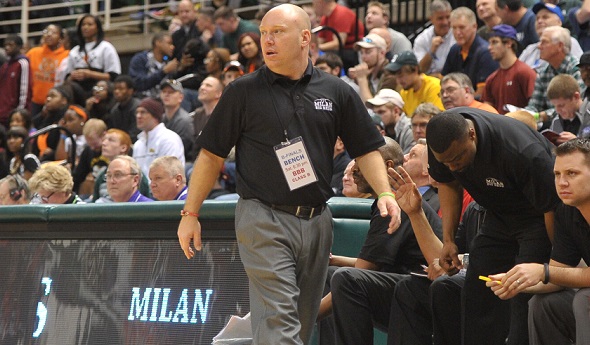
A South Lyon native, he’s been a basketball junkie for years. He got his first high school coaching job at Walled Lake Western while still in college. He made stops at Whitmore Lake and Howell while looking for a permanent teaching job, then landed at Milan in what turned out to be a made-for-each-other job. In short time, he rejuvenated the Milan Big Reds program from two wins the season before he took over the varsity to a surprise run to the Class B championship in 2013-14.
It wasn’t so much of a surprise that the Big Reds won the title that season, but how quickly Tropea built them into a powerhouse. During the summer before the title run, Tropea had his troops playing games all over the state, lining up scrimmages and playing in shootouts and tournaments that exposed the Milan players to some of the other elite.
“We had a lot of kids come from struggling homes or from tough situations,” Tropea said of his time at Milan. “Those kids were not entitled kids. As a family, we were able to make an impact in so many ways. Team dinners were a big deal. That’s what made leaving Milan so hard.
“It was maybe the best five years of my life for my wife and I,” he added. “It was such an exciting time, and we were just so embraced by the community.”
During his time there, the Big Reds went 92-27 and won three Huron League titles. The Class B title run was led by future college players Nick Perkins and Latin Davis. The Big Reds’ state championship was the first in boys basketball in the Monroe County Region in more than 60 years.
Tropea left Milan, he said, because of the teaching and coaching opportunity in Chelsea. Frankly, he said, the job paid more, and, for a young family, that was a big deal.
“It was a very difficult decision, but it was right for my family,” he said. “I was on a pay freeze for five straight years at Milan. Plus, we loved the Chelsea community. My wife wanted to come here.”
Although he was there just two seasons, Chelsea’s basketball program also came a long way in a short time.
The Bulldogs improved from 3-18 the year before he was there to 9-13 in 2014-15 and 16-6 in 2015-16, tying for second place in the Southeastern Conference White his second season. More importantly, Tropea laid the groundwork for the future. He started by getting into the lower levels of the school and teaching basketball to the younger students – and trying to let his passion for the game pass on to them.
“It’s rolling now,” he said. “The first year I had a summer camp, we had 17 kids. This past summer, we had 121. Everybody knows you have to have a youth program.
“We won 16 games my last year here, we won a District title two years ago and the team went 12-8 last year,” he said. “The program is in great shape.”
Tropea never has been afraid to adapt his game or the way he interacts with his players. He draws on his experiences working with other coaches every chance he gets.
“The game is constantly changing, and so are the kids,” he said. “You have to. You have to change.”
In today’s world that means using social media, such as Twitter, to set the tone of the program.
The @ChelseaBoysHoop Twitter feed, for example, regularly includes messages about workouts, inspirational quotes from some of game’s great players and encouragement to other Bulldogs athletes.
Great turnout at the meeting this morning! #BringtheJuice #GreaterThan #WePlayForMarch pic.twitter.com/ePCMjmAJdU
— ChelseaBoysHoop (@ChelseaBoysHoop) October 23, 2018
“I feel it can be a great tool if it is done right and positive,” he said of Twitter.
His wife, Alicia, is an integral part of the program, as are his children, Luke and Zack.
“This is definitely a family deal,” he said. “We are all in. I know no matter what, my wife will be in the third row and she’s so supportive. She’s all-in all the time. She supports me and my passion. You have to have that.”
Years from now, he said he might get back into the college game. But for now, being back at the high school level fits more his love of teaching the game.
“I’m a teacher at heart,” he said. “I love teaching the game. I love the four-player workouts and teaching the kids footwork and the importance of passing the ball with the seam. That’s what it’s all about – making an impact on the kids’ lives.”
The SEC can be a brutally tough league, and this year it’s only going to be stronger with the addition of Jackson to the division. With boys basketball season starting a week earlier this year and Chelsea’s football team alive in the MHSAA Playoffs, Tropea is employing somewhat of a different strategy than normal. The emphasis on the season, he said, will be to get his team ready for the Class B tournament come late February. He doesn’t want the players to peak too soon.
“We have one game before December 15,” he said. “We back-loaded the heck out of our schedule. I don’t care how good we are in November and December. I want to be playing our best basketball in March. We’re playing for March.”
Chelsea will have seven or eight seniors and five or six juniors on this year’s squad, Tropea said. Many of those seniors were part of a group that went 20-0 as freshmen and won 16 games as sophomores.
“We have some experience, and not just athletes but basketball players,” he said. “They are leaders. I’m so excited for this season. I’m happy to be back.”
 Doug Donnelly has served as a sports and news reporter and city editor over 25 years, writing for the Daily Chief-Union in Upper Sandusky, Ohio from 1992-1995, the Monroe Evening News from 1995-2012 and the Adrian Daily Telegram since 2013. He's also written a book on high school basketball in Monroe County and compiles record books for various schools in southeast Michigan. E-mail him at [email protected] with story ideas for Jackson, Washtenaw, Hillsdale, Lenawee and Monroe counties.
PHOTO: Returning Chelsea boys basketball coach leads his Milan team to the Class B championship in 2014 at Breslin Center.