


Classes Still Create Hoosier Hysteria
July 27, 2017
By Rob Kaminski
MHSAA benchmarks editor
This is the fourth part in a series on MHSAA tournament classification, past and present, that will be published over the next two weeks. This series originally ran in this spring's edition of MHSAA benchmarks.
Twenty years ago, Bloomington North High School won the Indiana High School Athletic Association boys basketball championship, defeating Delta 75-54 at the RCA Dome in Indianapolis.
The date, March 22, 1997, is at the same time revered and disdained by traditionalists in the state who saw it as the last schoolboy championship game the state would ever host.
That’s how devout the game of basketball, particularly interscholastic basketball, had become in the Hoosier state during the 87 years a state champion – one state champion, to be precise – was crowned.
Following that 1997 season, the IHSAA moved to a four-class system for its roundball tournaments, like so many of its state association counterparts had done years earlier.
It would be shocking to find more than a small percentage of current high school basketball players around the country unfamiliar with the iconic movie Hoosiers, even though the film is now more than 30 years old.
And, the storyline for that blockbuster unfolded more than 30 years prior to its release, when small-town, undermanned Milan High School defeated Muncie Central High School 32-30 in the 1954 IHSAA title game.
Perhaps it’s because of the David vs Goliath notion, or the fame of the movie that replaced Milan with the fictional Hickory and real-life star Bobby Plump with Hollywood hero Jimmy Chitwood, or the simple fact that Indiana had something other states didn’t.
Whatever the reason, plenty of opposition remains to this day to basketball classification in the state.
The fact is, the small rural schools were regularly being beaten handily by the much larger suburban and city schools as the tournament progressed each season.
Small schools also were closing at a rapid rate following the state’s School Reorganization Act in 1959, as students converged on larger, centralized county schools. From 1960 to 2000, the number of schools entering the tournament dropped from 694 to 381, and in 1997 a total of 382 schools and 4,584 athletes began competition at the Sectional level (the first level of the IHSAA Basketball Tournament).
It was at the entry level of the tournament where school administrators felt the pain of the new class system, but not necessarily for the same nostalgic reasons as the fans who either attended or boycotted the tournament.
At the Sectional round of the tournament, the IHSAA was culling just 2 percent of the revenue, with the participating schools splitting the balance. So, when Sectional attendance dropped by 14 percent in that first year of class basketball, many schools realized a financial loss. It was money they had grown to count on in prior years to help fund various aspects of the department.
Schools cumulatively received more than $900,000 from Sectional competition in 1998, but that total was down from more than $1 million in the last year of the single-class tournament.
Yet, the current format provides a great deal more opportunity and realistic chances at championship runs for schools of all enrollments.
To date, 60 additional teams have championship or runner-up trophies on display in school trophy cases around Indiana.
That was the mission in front of then-IHSAA commissioner Bob Gardner (now National Federation executive director) once the board made its decision: to give thousands more student-athletes the opportunity for once-in-a-lifetime experiences.
As any statistician knows, figures can be manipulated to tell any side of a story. Declining attendance in year one of class basketball is such a number.
The truth is tournament attendance had been on a steady downward spiral since its peak of just over 1.5 million in 1962. By the last single-class event in 1997, the total attendance was half that.
The challenge then and today, as it is for all state associations, is to find that delicate balance for those holding onto tradition, those holding onto trophies, and the number of trophies to hand out.
Editor’s Note: Stories from the Fort Wayne Journal Gazette in 1998 and from a 2007 issue of Indianapolis Monthly provided facts in this article.
The Official View: A Shining Example
By
Brent Rice
MHSAA Assistant Director
October 15, 2018
By Brent Rice
MHSAA Assistant Director
This week we honor our first “Official of the Month” – Rockford’s Lyle Berry – and offer a reminder on postseason invitations while also taking a look at a few situations officials may encounter in volleyball and football.
It’s Official!
Postseason tournament officiating invitations have been released in all of our fall sports. Make sure if you were selected to get your acceptance/declination confirmations in as soon as possible. If we fail to receive an acceptance for the position, we will have to remove your name from the consideration list for this season.
Rule of the Week
VOLLEYBALL Team R’s first contact is an overpass that lands on top of the net and settles briefly. Team R’s backrow setter, while still standing on the floor, reaches up and taps the ball to the floor on Team S’s side of the court.
Ruling: Back-row attack, point for Team S.
It’s Your Call
FOOTBALL The old Swinging Gate. There are a number of fouls on this play. Which do you see?
Last Week’s IYC Ruling: Player #4 in white commits two fouls on the play. First, he make an illegal block below the waist in order to take out the lead block by the pulling guard. Then, as the running back scrambles to look for more yards, #4 returns to the pile and makes illegal helmet contact (spearing) with the runner. Both are live ball fouls with 15-yard penalties. They both occur at about the 22-yard line where the run ends, so either could be accepted/declined for the same result. (Click to see the video from last week.)
The Official View - Official of the Month
October: Lyle Berry, Rockford
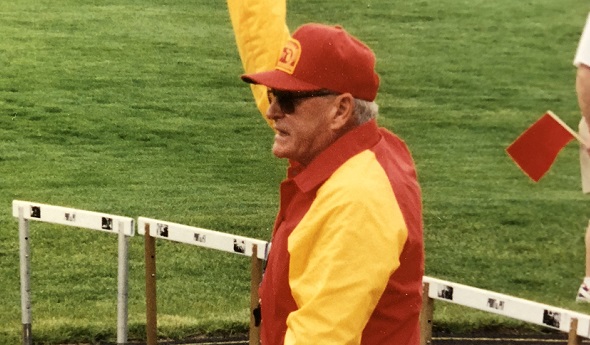
After 59 years as an MHSAA registered official, Lyle Berry says his time wearing the emblem is winding down. “I’ll believe it when I see it,” his wife regularly reminds him.
Even though Lyle hasn’t been on the hardwood serving as a basketball referee since 1988, he has remained a staple in cross country and track & field meets across the state. The 2012 Vern Norris Award winner, Berry has been honored by serving as an official in 17 MHSAA Finals.
“If you’ve never stood at the finish line to watch two athletes give everything within themselves to be the first to cross, you have missed the boat,” said Berry as he provided his best example of the ABC-coined phrase, “The thrill of victory and the agony of defeat.”
 It’s working with young people that has kept him coming back year after year. And not just the competitors – Lyle has had the privilege of starting many officials on their way and enjoyed the thrill of seeing them grow and succeed.
But for all of his officiating accomplishments, they don’t compare to that spring day in 1959 when he married the love of his life, Vonna.
Prior to getting married, Lyle was a seven-time letter earner in three sports while attending Grand Rapids Central High before attending Grand Rapids Junior College. He was the first at that school to earn four letters in one year before moving on to Central Michigan University, where he played baseball. Together, Lyle and Vonna raised three sons who all proved to be good athletes as well. He served as a teacher and coach at four schools until his retirement in 1991. Through it all, Vonna has been at Lyle’s side, encouraging him to reach for his goals in athletics and officiating.
He got his start in officiating by serving in the college intramural program. He learned quickly that it wasn’t easy as he had imagined during his early days of playing sports. He credits his longevity to his love of sports and remaining involved in them. It certainly wasn’t the $1.50 he made in his start in basketball refereeing!
Lyle Berry is a shining example of what the MHSAA looks for in its officials: Dedicated and hardworking men and women who desire to make a positive impact on the next generation of student athletes. The privilege, Lyle said, is one that he “would do most anything to have continue for many years to come.”
It’s our privilege, Lyle, and we wish you many more years of continued success in officiating.
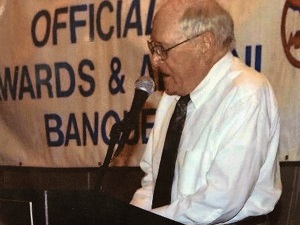
PHOTOS: (Top) Lyle Berry starts a race during a track & field meet. (Middle) Berry speaks at an MHSAA Officials Awards Banquet.