


Classes Still Create Hoosier Hysteria
July 27, 2017
By Rob Kaminski
MHSAA benchmarks editor
This is the fourth part in a series on MHSAA tournament classification, past and present, that will be published over the next two weeks. This series originally ran in this spring's edition of MHSAA benchmarks.
Twenty years ago, Bloomington North High School won the Indiana High School Athletic Association boys basketball championship, defeating Delta 75-54 at the RCA Dome in Indianapolis.
The date, March 22, 1997, is at the same time revered and disdained by traditionalists in the state who saw it as the last schoolboy championship game the state would ever host.
That’s how devout the game of basketball, particularly interscholastic basketball, had become in the Hoosier state during the 87 years a state champion – one state champion, to be precise – was crowned.
Following that 1997 season, the IHSAA moved to a four-class system for its roundball tournaments, like so many of its state association counterparts had done years earlier.
It would be shocking to find more than a small percentage of current high school basketball players around the country unfamiliar with the iconic movie Hoosiers, even though the film is now more than 30 years old.
And, the storyline for that blockbuster unfolded more than 30 years prior to its release, when small-town, undermanned Milan High School defeated Muncie Central High School 32-30 in the 1954 IHSAA title game.
Perhaps it’s because of the David vs Goliath notion, or the fame of the movie that replaced Milan with the fictional Hickory and real-life star Bobby Plump with Hollywood hero Jimmy Chitwood, or the simple fact that Indiana had something other states didn’t.
Whatever the reason, plenty of opposition remains to this day to basketball classification in the state.
The fact is, the small rural schools were regularly being beaten handily by the much larger suburban and city schools as the tournament progressed each season.
Small schools also were closing at a rapid rate following the state’s School Reorganization Act in 1959, as students converged on larger, centralized county schools. From 1960 to 2000, the number of schools entering the tournament dropped from 694 to 381, and in 1997 a total of 382 schools and 4,584 athletes began competition at the Sectional level (the first level of the IHSAA Basketball Tournament).
It was at the entry level of the tournament where school administrators felt the pain of the new class system, but not necessarily for the same nostalgic reasons as the fans who either attended or boycotted the tournament.
At the Sectional round of the tournament, the IHSAA was culling just 2 percent of the revenue, with the participating schools splitting the balance. So, when Sectional attendance dropped by 14 percent in that first year of class basketball, many schools realized a financial loss. It was money they had grown to count on in prior years to help fund various aspects of the department.
Schools cumulatively received more than $900,000 from Sectional competition in 1998, but that total was down from more than $1 million in the last year of the single-class tournament.
Yet, the current format provides a great deal more opportunity and realistic chances at championship runs for schools of all enrollments.
To date, 60 additional teams have championship or runner-up trophies on display in school trophy cases around Indiana.
That was the mission in front of then-IHSAA commissioner Bob Gardner (now National Federation executive director) once the board made its decision: to give thousands more student-athletes the opportunity for once-in-a-lifetime experiences.
As any statistician knows, figures can be manipulated to tell any side of a story. Declining attendance in year one of class basketball is such a number.
The truth is tournament attendance had been on a steady downward spiral since its peak of just over 1.5 million in 1962. By the last single-class event in 1997, the total attendance was half that.
The challenge then and today, as it is for all state associations, is to find that delicate balance for those holding onto tradition, those holding onto trophies, and the number of trophies to hand out.
Editor’s Note: Stories from the Fort Wayne Journal Gazette in 1998 and from a 2007 issue of Indianapolis Monthly provided facts in this article.
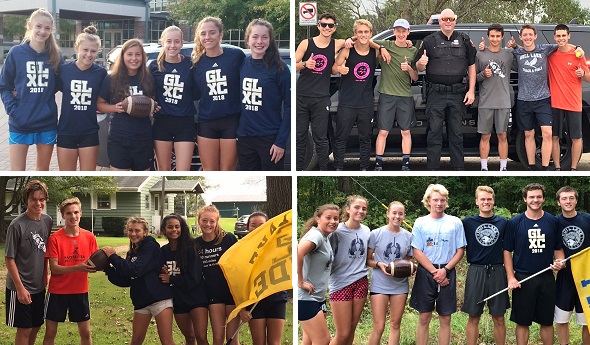
Gull Lake XC Extends Tradition Cross-State
October 4, 2018
By Geoff Kimmerly
Second Half editor
In Randy Hunt’s mind, there was no way Richland Gull Lake’s cross country teams weren’t going to continuing their Homecoming tradition this fall – no matter how much farther they had to run.
Every year since 1993, Gull Lake’s runners have carried a game ball from their football opponent’s school to the Blue Devils’ stadium in advance of the Homecoming game. Previously, the longest trip was 72 miles from Niles.
But this fall, Gull Lake’s varsity didn’t have an opponent lined up for Homecoming until picking up Detroit Country Day – 138 miles to the east.
No problem. Over Thursday and Friday last week, past Farmington Hills, Ann Arbor, Jackson, Battle Creek and more, the Blue Devils again delivered the game ball.
 “Our runners are amazing and up to any challenge,” Gull Lake girls coach Robin Blackburn said. “We originally heard that our opponent this year was Detroit Country Day; we thought our athletic director was joking! No joke, she was serious.
“Next thought, how are we going to make this happen? We had lots of crazy ideas. My favorite was putting a treadmill on a flatbed truck and having them run. Obviously we couldn’t do that, but we knew we had to do this over two days. Once we started planning and mapping the course, everything fell into place.”
Runners filled out cards with whom, when and how far they wanted to run, and then Blackburn and Hunt, the boys coach, built the plan. The first shift left Gull Lake for Country Day at 5:30 a.m. Thursday. Makenzie Wank, Betsy Martens, Sarah Grimes, Kayla Eklund, Grace Foster and Abby Bell – running in pairs in 4-mile increments – tackled the first 35 miles west.
The next shift left from Gull Lake at 10 a.m. headed for Northfield Township, north of Ann Arbor. Joel Blackburn, Nick Dawson, Koby Fraaza, Read Knapp, Nate Krawczyk and Nate Alpers – running 5-mile increments – tackled the next 45-mile leg of the relay and even were questioned by a local police officer as to what they were up to in the middle of nowhere on dirt road.
“Usually we like the ball to be continuous, but obviously with such a distance and safety concerns, we split this one up,” Hunt said. “The kids were excited to do it, and as coaches we knew it would create an awesome memory/story.
“I think the kids liked it because it got them out of school but also for the team bonding. I was impressed with their commitment to the tradition.”
Freshmen Kristian Shyiak and Cameron Perkins took Friday’s first leg from Jackson, a 6.4 mile stretch, followed by 10 more shifts – all planned to exact distance and arrival time, while parents joined in to taxi groups to their starting points and back to the school.
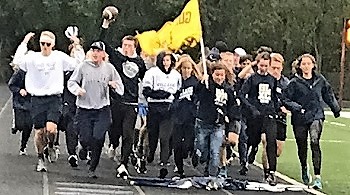 The plan was to finish with nearly a full lap at the track at 6:30 p.m., with the teams’ seniors then delivering the ball to the football officials at the 50-yard line. But with time getting short, the last group of four had to adjust, with each athlete running one mile as hard as he could to get the ball to the stadium and into the officials’ hands by 6:50 – and they made it with time to spare. “It was amazing to see the kids work so hard and do it gratefully,” Hunt said.
Others who took part in the relay were Lainie Scott, Lauren Adams, Sarah Donovan, Ashley Randall, Kaylie Murphy, Luke Larson, Zach Zahrt, Neil Gleason, Simon Hakman, Lilly Weigt, Jayne Flynn, Rachel Grimes, Justin Walker, John Porter, Tyler Ford, David Larson, Ruby Risser, Lija Krasts, Nick Martens, Elly Whitfield, Aelita Klausmeier, Lorelei Hess and Oliver Harnden.
“Cross Country doesn’t get a lot of coverage, but this even got the community involved and following our updates on Facebook and Instagram,” Blackburn said.
“We are about being a family. We do a lot outside of practice to build our unity. This was a special moment in our family – one none of us will forget.”
PHOTOS: (Top) Starting top left at Detroit Country Day, groups of Gull Lake cross country runners take turns carrying the game ball during their nearly 140-mile trek to Richland last week. (Middle) Blue Devils runners take their turn on a country road. (Below) All of the runners join together for the final stretch on Gull Lake’s track. (Photos courtesy of the Gull Lake cross country program.)