


Classes Still Create Hoosier Hysteria
July 27, 2017
By Rob Kaminski
MHSAA benchmarks editor
This is the fourth part in a series on MHSAA tournament classification, past and present, that will be published over the next two weeks. This series originally ran in this spring's edition of MHSAA benchmarks.
Twenty years ago, Bloomington North High School won the Indiana High School Athletic Association boys basketball championship, defeating Delta 75-54 at the RCA Dome in Indianapolis.
The date, March 22, 1997, is at the same time revered and disdained by traditionalists in the state who saw it as the last schoolboy championship game the state would ever host.
That’s how devout the game of basketball, particularly interscholastic basketball, had become in the Hoosier state during the 87 years a state champion – one state champion, to be precise – was crowned.
Following that 1997 season, the IHSAA moved to a four-class system for its roundball tournaments, like so many of its state association counterparts had done years earlier.
It would be shocking to find more than a small percentage of current high school basketball players around the country unfamiliar with the iconic movie Hoosiers, even though the film is now more than 30 years old.
And, the storyline for that blockbuster unfolded more than 30 years prior to its release, when small-town, undermanned Milan High School defeated Muncie Central High School 32-30 in the 1954 IHSAA title game.
Perhaps it’s because of the David vs Goliath notion, or the fame of the movie that replaced Milan with the fictional Hickory and real-life star Bobby Plump with Hollywood hero Jimmy Chitwood, or the simple fact that Indiana had something other states didn’t.
Whatever the reason, plenty of opposition remains to this day to basketball classification in the state.
The fact is, the small rural schools were regularly being beaten handily by the much larger suburban and city schools as the tournament progressed each season.
Small schools also were closing at a rapid rate following the state’s School Reorganization Act in 1959, as students converged on larger, centralized county schools. From 1960 to 2000, the number of schools entering the tournament dropped from 694 to 381, and in 1997 a total of 382 schools and 4,584 athletes began competition at the Sectional level (the first level of the IHSAA Basketball Tournament).
It was at the entry level of the tournament where school administrators felt the pain of the new class system, but not necessarily for the same nostalgic reasons as the fans who either attended or boycotted the tournament.
At the Sectional round of the tournament, the IHSAA was culling just 2 percent of the revenue, with the participating schools splitting the balance. So, when Sectional attendance dropped by 14 percent in that first year of class basketball, many schools realized a financial loss. It was money they had grown to count on in prior years to help fund various aspects of the department.
Schools cumulatively received more than $900,000 from Sectional competition in 1998, but that total was down from more than $1 million in the last year of the single-class tournament.
Yet, the current format provides a great deal more opportunity and realistic chances at championship runs for schools of all enrollments.
To date, 60 additional teams have championship or runner-up trophies on display in school trophy cases around Indiana.
That was the mission in front of then-IHSAA commissioner Bob Gardner (now National Federation executive director) once the board made its decision: to give thousands more student-athletes the opportunity for once-in-a-lifetime experiences.
As any statistician knows, figures can be manipulated to tell any side of a story. Declining attendance in year one of class basketball is such a number.
The truth is tournament attendance had been on a steady downward spiral since its peak of just over 1.5 million in 1962. By the last single-class event in 1997, the total attendance was half that.
The challenge then and today, as it is for all state associations, is to find that delicate balance for those holding onto tradition, those holding onto trophies, and the number of trophies to hand out.
Editor’s Note: Stories from the Fort Wayne Journal Gazette in 1998 and from a 2007 issue of Indianapolis Monthly provided facts in this article.
'Oakridge Family' True in Name & Purpose
October 3, 2018
By Tom Kendra
Special for Second Half
Every football team talks about being a family.
 But at Muskegon Oakridge, it’s more than just a motto.
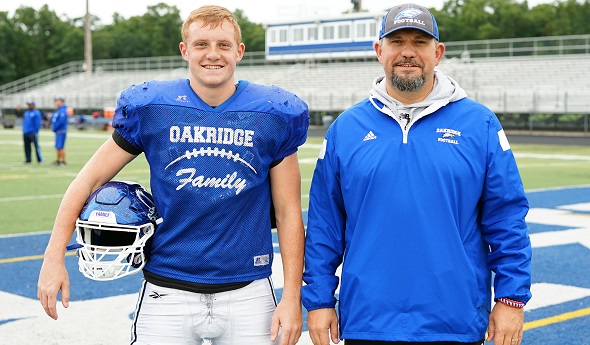
Three of the Oakridge varsity coaches have sons on the team, including head coach Cary Harger with two-way starting senior lineman Cole Harger.
“It does make it extra special, being a senior and playing for my dad,” said Cole Harger of the Eagles’ high-flying start, which has them 6-0 and ranked No. 3 in Division 5 in the latest Associated Press poll.
“The family thing is real out here. This is such a tight-knit community, and we’re just together all the time. We know each other so well and know how to push each other.”
Oakridge faces its toughest test of the season Friday when it hosts conference rival Montague (5-1), which comes in riding a five-game winning streak and ranked No. 10 in Division 5.
Oakridge has been the dominant team for almost 40 years in the West Michigan Conference, a league which has put 14 teams in MHSAA state championship games and celebrated nine Finals winners. Oakridge has made it five times, winning titles in 1997, 2005 and 2008.
Early on in that stretch, the Eagles’ main league rival was North Muskegon, and later Ravenna. In the 2000s, the most competitive rivalries shifted north to the White Lake area in Whitehall and Montague, particularly Montague.
Oakridge is 7-4 against Montague over the past 11 years, with many of those games classic back-and-forth battles that came down to the final minutes (and sometimes, seconds). But the only game that anyone at Oakridge seems to remember is from a year ago, when host Montague pounded Oakridge 40-0 – the most lopsided conference loss in school history.
“We have waited 51 weeks for the opportunity to erase that memory,” said senior linebacker Jaden Parker, whose father, Tim, is the Oakridge defensive coordinator. “We got shell-shocked last year and didn’t fight back. This year we have more seniors, and we won’t let that happen again.”
 This year’s matchup features two of Michigan’s top running backs. Montague senior Bryce Stark, a returning Associated Press all-stater, has gained 542 yards on 74 carries (7.3 per carry), despite being slowed early in the year with a knee injury. Oakridge counters with battering ram junior fullback Leroy Quinn (6-1, 216), the leading rusher in the Greater Muskegon area with 111 carries for 1,119 yards (10.1 average) and 19 touchdowns.
Coach Harger is quick to point out that Stark is just one of many weapons on this Montague team who worries his team.
“The first thing that strikes you about Montague is their athleticism and the number of quality athletes we have to focus on,” said Harger, a 1990 Oakridge graduate. “But they are also big up front, so you have to be concerned with that, as well. We need to play our best game.”
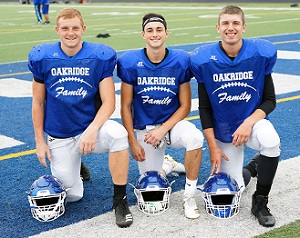
The final father-son connection on the Oakridge varsity staff is offensive coordinator Nate Danicek and his son, Jacob, a sophomore who starts at safety and plays slot receiver on offense when the Eagles break out of their full-house backfield and go with a spread look.
But the Oakridge football family goes far beyond just the coaching staff – it’s a way of life.
After a long practice Tuesday evening, Coach Harger and Coach Parker (whose fathers coached them on an Oakridge youth football team almost 40 years ago) went down the varsity roster and quickly pointed out all of the players whose fathers also played varsity football at Oakridge.
On that list is senior starting quarterback Koleman Wall (6-3, 197), whose father, Scott Wall, was the starting fullback on the 1990 team, the first Oakridge team to reach the MHSAA title game. Other father-son duos are starting running back and linebacker Blake Masterman (father Dan Masterman), starting center Mavrick McLouth (Dude McLouth), Jacob Barber (Nate Barber) and Sander Brott (David Brott).
Sander Brott is also a third-generation Eagle, as his grandfather, Mark Fazakerley, played on the first Oakridge varsity team in 1966.
“We are doing our best to carry on the tradition that Jack Schugars started out here,” said Coach Parker, referencing Schugars, who had a 262-78 record in 31 seasons at Oakridge from 1979 to 2010. “It’s a point of pride that these are all Oakridge kids. We don’t have schools of choice, so almost every one of these kids has been playing together since the youth leagues.”
The Oakridge youth league still boasts more than 150 players and is the starting point for one of the state’s most consistent programs.
 With its six consecutive wins to open the season, Oakridge has qualified for the playoffs for the 15th straight year and 23rd of the past 24. Many believe this team could be good enough to get all the way to Ford Field for the first time since 2008.
The Eagles have an experienced backfield led by Quinn, but also featuring speedy senior Masterman (359 yards) and multi-talented senior Jalen Hughes (315 yards). Wall provides a fourth running threat and has been efficient through the air, completing 28-of-43 passes for 516 yards and 10 touchdowns, with just one interception.
The defense is led by senior tackle Brandon Wilde (5-9, 212), who has 38 tackles on the season with half of those tackles in the backfield for negative yardage, including six sacks. Masterman leads the team with 40 tackles, and senior cornerback Jaxon Fri has three interceptions.
Oakridge could possibly play Montague a second time in the playoffs. Montague has traditionally been a Division 6 playoff team, but with its enrollment up 36 students from last year to 445, it could end up with Oakridge in Division 5.
Another possible Eagles rematch down the road is with top-ranked Saginaw Swan Valley, which beat Oakridge in last year’s MHSAA Regional Final, 48-14.
The “Oakridge family” isn’t looking near that far ahead, but is focused on proving itself after last year’s lopsided loss at Montague.
“The way we played in that game last year was our biggest motivation all offseason,” said Cole Harger. “That wasn’t Oakridge football. I think one of our biggest strengths this year is our togetherness as a team, and we have the opportunity to prove that on Friday night.”
 Tom Kendra worked 23 years at The Muskegon Chronicle, including five as assistant sports editor and the final six as sports editor through 2011. E-mail him at [email protected] with story ideas for Muskegon, Oceana, Mason, Lake, Oceola, Mecosta and Newaygo counties.
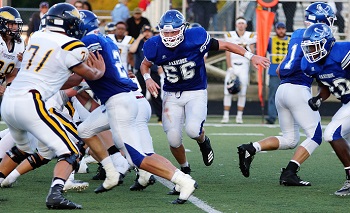
PHOTOS: (Top) Senior Cole Harger and Oakridge coach Cary Harger are one of three sets of fathers and sons on the varsity this season. (Middle) Harger (66), a two-way starting lineman, lines up his block during a Week 2 win over North Muskegon. (Below) Harger, with Jacob Danicek (middle) and Jaden Parker, whose fathers also are on the coaching staff. (Photos by Sherry Wahr.)