


Classes Still Create Hoosier Hysteria
July 27, 2017
By Rob Kaminski
MHSAA benchmarks editor
This is the fourth part in a series on MHSAA tournament classification, past and present, that will be published over the next two weeks. This series originally ran in this spring's edition of MHSAA benchmarks.
Twenty years ago, Bloomington North High School won the Indiana High School Athletic Association boys basketball championship, defeating Delta 75-54 at the RCA Dome in Indianapolis.
The date, March 22, 1997, is at the same time revered and disdained by traditionalists in the state who saw it as the last schoolboy championship game the state would ever host.
That’s how devout the game of basketball, particularly interscholastic basketball, had become in the Hoosier state during the 87 years a state champion – one state champion, to be precise – was crowned.
Following that 1997 season, the IHSAA moved to a four-class system for its roundball tournaments, like so many of its state association counterparts had done years earlier.
It would be shocking to find more than a small percentage of current high school basketball players around the country unfamiliar with the iconic movie Hoosiers, even though the film is now more than 30 years old.
And, the storyline for that blockbuster unfolded more than 30 years prior to its release, when small-town, undermanned Milan High School defeated Muncie Central High School 32-30 in the 1954 IHSAA title game.
Perhaps it’s because of the David vs Goliath notion, or the fame of the movie that replaced Milan with the fictional Hickory and real-life star Bobby Plump with Hollywood hero Jimmy Chitwood, or the simple fact that Indiana had something other states didn’t.
Whatever the reason, plenty of opposition remains to this day to basketball classification in the state.
The fact is, the small rural schools were regularly being beaten handily by the much larger suburban and city schools as the tournament progressed each season.
Small schools also were closing at a rapid rate following the state’s School Reorganization Act in 1959, as students converged on larger, centralized county schools. From 1960 to 2000, the number of schools entering the tournament dropped from 694 to 381, and in 1997 a total of 382 schools and 4,584 athletes began competition at the Sectional level (the first level of the IHSAA Basketball Tournament).
It was at the entry level of the tournament where school administrators felt the pain of the new class system, but not necessarily for the same nostalgic reasons as the fans who either attended or boycotted the tournament.
At the Sectional round of the tournament, the IHSAA was culling just 2 percent of the revenue, with the participating schools splitting the balance. So, when Sectional attendance dropped by 14 percent in that first year of class basketball, many schools realized a financial loss. It was money they had grown to count on in prior years to help fund various aspects of the department.
Schools cumulatively received more than $900,000 from Sectional competition in 1998, but that total was down from more than $1 million in the last year of the single-class tournament.
Yet, the current format provides a great deal more opportunity and realistic chances at championship runs for schools of all enrollments.
To date, 60 additional teams have championship or runner-up trophies on display in school trophy cases around Indiana.
That was the mission in front of then-IHSAA commissioner Bob Gardner (now National Federation executive director) once the board made its decision: to give thousands more student-athletes the opportunity for once-in-a-lifetime experiences.
As any statistician knows, figures can be manipulated to tell any side of a story. Declining attendance in year one of class basketball is such a number.
The truth is tournament attendance had been on a steady downward spiral since its peak of just over 1.5 million in 1962. By the last single-class event in 1997, the total attendance was half that.
The challenge then and today, as it is for all state associations, is to find that delicate balance for those holding onto tradition, those holding onto trophies, and the number of trophies to hand out.
Editor’s Note: Stories from the Fort Wayne Journal Gazette in 1998 and from a 2007 issue of Indianapolis Monthly provided facts in this article.
Undefeated Colon Turning Work into Wins
By
Wes Morgan
Special for MHSAA.com
October 2, 2018
Monday Run Day for the Colon varsity football team is far from a fun day. But the Magi have embraced the burning in their lungs, the cramps and the piercing sound of the next whistle sure to bring on more agony.
 The grueling session of sprints follows study hall and weights. Then position groups work on their particular craft. And as the sun sets, the long day finally ends with a thorough cleaning of the locker room.
As third-year coach Robbie Hattan began the interview for this story Monday, he paused for 30 seconds to survey the grounds surrounding the football field, taking mental notes as to which players stuck around for even more voluntary cardio.
“The biggest thing that was a change in culture for Colon was the work ethic in the offseason,” said Hattan, whose team is 6-0 and ranked No. 2 in the latest Associated Press 8-player poll behind Pickford. “We went from maybe having 10 kids in the weight room two summers ago to no less than 25. These kids are working hard. We’re in Week 7 and these kids are working like they’re in two-a-days.”
It’s paying dividends as the Magi have outscored opponents 122-40 during the second half this year.
“We make sure we get a lot of cardio in and make sure we’re conditioned enough to get to the fourth quarter,” 6-foot-5, 190-pound senior lineman Brenden Shelton said. “We end up running a lot of teams down because they just can’t hang with us. It’s a noticeable difference, especially from the beginning (of the year). What we did today (in practice) we probably wouldn’t have been able to do (at the beginning of the year). When we’re playing in the fourth quarter, you can see it in the other team. They’re gassed, and we’re firing.”
Colon also has earned its first conference championship in school history. The Magi wrapped up at least a share of the Southern Central Athletic Association A division title with last week’s 51-0 win over Camden-Frontier.
Colon made a calculated move to 8-player this year, but not because of dwindling participation numbers. In fact, with 34 players, the program is healthy compared to other small schools still playing 11-player football.
The cost of scheduling opponents all over the state to fill out a nine-game slate, along with the possibility of lower participation in the future, were considered.
“That’s not smart with our taxpayer dollars,” Hattan said of long treks from past seasons. “Now, we still have our identity. We still have games here on Friday nights. Now, with more schools going to 8-man, the competitiveness and the level of play (have improved). If you would have come here and watched Colon versus Bellevue and you would have thought that wasn’t a football game, I would have called you a liar to your face.
“That was a smash-mouth, hard-hitting football game. The more schools you get, you’ll find that middle ground. When 8-man first started, you were getting so many blowouts. You were either really good or you were really bad. We still have our blowouts, but we had that in 11-man. But it’s few and far between now.”
Schematically, Hattan initially overcomplicated the transition, thinking an overhaul of the offense might be in order. Following a conversation with Crystal Falls Forest Park coach Dave Graff at a summer clinic, the plan became simple and clear.
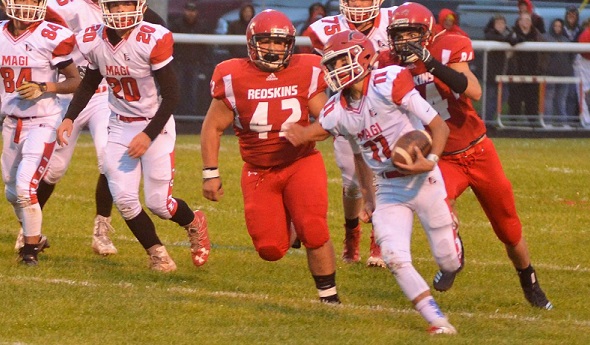
 “He said, ‘Hey, run what you run, but just run it in 8-man.’ We started playing with some stuff with the veer and how we could still be an option school,” Hattan said. “Colon has always been an option school since Coach [Spencer] Henley was here. We know we have some good running backs and some speed, so we just started implementing our option offense. Now we’re getting a little more creative with our options and motions. We’re getting more out of our kids. The option is great because you can leave two guys unblocked every single play and you’re good.”
Sophomore running back Brandon Crawford has racked up 862 rushing yards and 14 touchdowns on 99 carries through six games. Junior quarterback Phillip Alva has added 569 yards and 10 TDs on 64 carries. Junior Jonathan West and freshman Kaleb Johnson have combined for 476 yards and six TDs.
Crawford played as a freshman and finished with just over 600 yards last fall.
“It definitely humbled me. Coming into the season, I thought I was just going to start instantly,” he said. “But seeing how much bigger everyone was made me want to push myself harder.”
Though the Magi certainly don’t focus on the passing game, Alva and West have connected on three touchdowns through the air.
Defensively, senior linebacker John Ruby leads the squad with 59 tackles (six for a loss), Crawford has notched 42 (two for a loss), and Shelton has made 35 stops (14.5 for a loss).
“John Ruby is a stud,” West said. “He can lay a hit and fill a hole. Crawford really gets in there and can lay a hit. Shelly (Brenden Shelton) never lets anyone get outside of him.”
Added Alva: “I believe it’s just buying into the program with Coach Hattan. He’s building a pretty good program from Rocket all the way through high school with the weight room and everything. Every single kid is buying into it. I think that’s why we’re doing as good as we are.”
 Wes Morgan has reported for the Kalamazoo Gazette, ESPN and ESPNChicago.com, 247Sports and Blue & Gold Illustrated over the last 12 years and is the publisher of JoeInsider.com. He can be reached at [email protected] with story ideas for Berrien, Cass, St. Joseph and Branch counties.
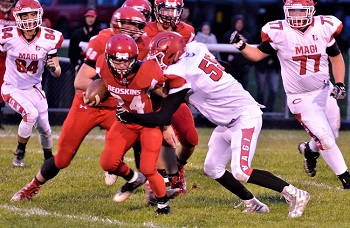
PHOTOS: (Top) Philip Alva gets around the corner during last week’s win over Camden-Frontier. (Middle) Brenden Shelton locks up a Camden-Frontier ball carrier. (Photos by Laura Alva/JoeInsider.com.)