


Classes Still Create Hoosier Hysteria
July 27, 2017
By Rob Kaminski
MHSAA benchmarks editor
This is the fourth part in a series on MHSAA tournament classification, past and present, that will be published over the next two weeks. This series originally ran in this spring's edition of MHSAA benchmarks.
Twenty years ago, Bloomington North High School won the Indiana High School Athletic Association boys basketball championship, defeating Delta 75-54 at the RCA Dome in Indianapolis.
The date, March 22, 1997, is at the same time revered and disdained by traditionalists in the state who saw it as the last schoolboy championship game the state would ever host.
That’s how devout the game of basketball, particularly interscholastic basketball, had become in the Hoosier state during the 87 years a state champion – one state champion, to be precise – was crowned.
Following that 1997 season, the IHSAA moved to a four-class system for its roundball tournaments, like so many of its state association counterparts had done years earlier.
It would be shocking to find more than a small percentage of current high school basketball players around the country unfamiliar with the iconic movie Hoosiers, even though the film is now more than 30 years old.
And, the storyline for that blockbuster unfolded more than 30 years prior to its release, when small-town, undermanned Milan High School defeated Muncie Central High School 32-30 in the 1954 IHSAA title game.
Perhaps it’s because of the David vs Goliath notion, or the fame of the movie that replaced Milan with the fictional Hickory and real-life star Bobby Plump with Hollywood hero Jimmy Chitwood, or the simple fact that Indiana had something other states didn’t.
Whatever the reason, plenty of opposition remains to this day to basketball classification in the state.
The fact is, the small rural schools were regularly being beaten handily by the much larger suburban and city schools as the tournament progressed each season.
Small schools also were closing at a rapid rate following the state’s School Reorganization Act in 1959, as students converged on larger, centralized county schools. From 1960 to 2000, the number of schools entering the tournament dropped from 694 to 381, and in 1997 a total of 382 schools and 4,584 athletes began competition at the Sectional level (the first level of the IHSAA Basketball Tournament).
It was at the entry level of the tournament where school administrators felt the pain of the new class system, but not necessarily for the same nostalgic reasons as the fans who either attended or boycotted the tournament.
At the Sectional round of the tournament, the IHSAA was culling just 2 percent of the revenue, with the participating schools splitting the balance. So, when Sectional attendance dropped by 14 percent in that first year of class basketball, many schools realized a financial loss. It was money they had grown to count on in prior years to help fund various aspects of the department.
Schools cumulatively received more than $900,000 from Sectional competition in 1998, but that total was down from more than $1 million in the last year of the single-class tournament.
Yet, the current format provides a great deal more opportunity and realistic chances at championship runs for schools of all enrollments.
To date, 60 additional teams have championship or runner-up trophies on display in school trophy cases around Indiana.
That was the mission in front of then-IHSAA commissioner Bob Gardner (now National Federation executive director) once the board made its decision: to give thousands more student-athletes the opportunity for once-in-a-lifetime experiences.
As any statistician knows, figures can be manipulated to tell any side of a story. Declining attendance in year one of class basketball is such a number.
The truth is tournament attendance had been on a steady downward spiral since its peak of just over 1.5 million in 1962. By the last single-class event in 1997, the total attendance was half that.
The challenge then and today, as it is for all state associations, is to find that delicate balance for those holding onto tradition, those holding onto trophies, and the number of trophies to hand out.
Editor’s Note: Stories from the Fort Wayne Journal Gazette in 1998 and from a 2007 issue of Indianapolis Monthly provided facts in this article.
Dread Not: Jacobs Directing Dexter Rise
September 28, 2018
By Doug Donnelly
Special for Second Half
DEXTER – Dexter has long had outstanding football facilities, a large fan base and the support of school officials. What it hasn’t had in recent years is a winning football team.
 With each passing week, however, it looks like that is about the change.
The Dreadnaughts enter tonight’s game at Tecumseh with a 3-2 record and legitimate chance to make a run at the MHSAA football playoffs over the next few weeks. What’s remarkable is Dexter is seeking its first appearance in the tournament, which began in 1975.
“The previous coaches were good guys,” said superintendent Chris Timmis. “They tried hard to get things going. Sometimes it’s about timing.”
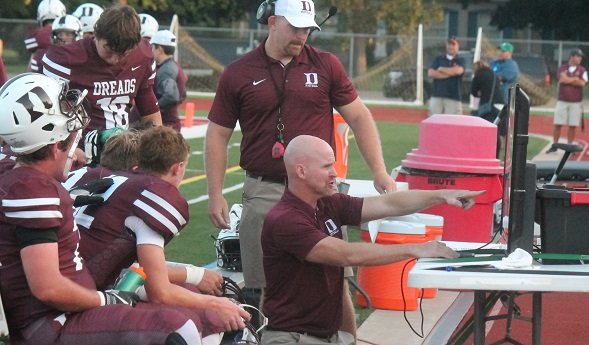
The timing right now has a lot to do with the arrival of head coach Phil Jacobs. The Adrian native spent nearly two decades on the Maples staff, including 11 seasons as head coach. He stepped down as the head coach after the 2014 season and spent two seasons as an assistant at Siena Heights University, before he was brought into the Dexter fold by Timmis, his former boss at Adrian.
“It took a lot of persuasion,” Timmis said.
Jacobs called it a “full-court press” to lure him back. Whatever it was, it looks like a successful move for Dexter.
“I was confident it would be,” Timmis said. “What I knew about Phil from when I was superintendent and principal at Adrian was he is a fantastic teacher. When we were working on a lot of academic improvement, Phil had a model classroom. I knew what he could bring to us was a lot more than just a football coach.”
Dexter was looking to hire a football coach a couple of years ago when Timmis made a short list of coaches from across the state that had rebuilt programs. Jacobs was on the list but wasn’t interested in coaching himself. Dexter made a hire, but it was short-lived. That coach left after only a short time on the job.
 Timmis called up Jacobs.
“I told him I wanted to talk to him again,” he said. “I think it was meant to be.”
Jacobs came on board in late April and started working with the Dreadnaughts players, getting them into the weight room in particular. Dexter went 0-9 in 2017, but as the season went on, Jacobs and others saw progress.
“He was putting the pieces together,” Timmis said.
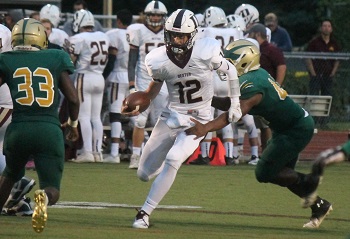
Dexter began this season with a 41-game losing streak and lost the season opener. In Week 2, however, Dexter pulled out a 36-22 win over Ypsilanti Community to break the streak. The next week the Dreadnaughts won again, this time a 37-14 win over Ann Arbor Huron. In Week 5, they topped Adrian, 42-30, as junior receiver Antwan Ficklen caught six passes for 177 yards and three touchdowns to lead Dexter to the win. Sophomore quarterback Colin Parachek threw for more than 300 yards and ran for a couple of touchdowns.
The Dreadnaughts aren’t just winning – they are exciting. Through five games, Dexter is averaging 30.8 points per game.
That Adrian win leaves Dexter with regular-season games against Tecumseh (2-3), Pinckney (1-4), Ypsilanti Lincoln (4-1) and Whitehall (3-2). Win three, and the team is automatically in the playoffs.
Jacobs points to three differences with this season’s Dexter team. For one, the players’ commitment to the weight room is paying off.
“We are stronger. With strength comes confidence,” Jacobs said. “We are nowhere near where we want to be or can be, but we are headed in the right direction.”
 Another difference is the players’ football knowledge is growing. With each week of practice, each week of repetition, Jacobs said the players are learning more about the game.
“Our football I.Q. is so much better than last year,” Jacobs said. “Last year, we were yelling things from the sidelines on every play, ‘get here,’ ‘get there.’ This year, we aren’t doing that as much. Our kids are learning. They speak our terms now.”
Lastly, Jacobs said having enough numbers so that his players are starting on only one side of the ball has paid huge dividends.
“In the third and fourth quarters, they are fresh,” he said. “They are learning one position. Plus, when you get your athletes playing on only one side of the ball, it frees them up to play special teams. You find creative ways to get your best kids on the field.”
Dexter’s most recent winning season was a 5-4 finish in 2010. The Dreadnaughts have had two winning seasons total during their players’ lifetimes.
“It’s great to see the kids believe in themselves,” Timmis said. “The whole community is feeling it right now.”
Dexter athletic director Mike Bavineau said the school and community are excited about the football team. There’s a buzz in the halls and at the Dexter field on Friday nights.
“The kids are excited, everyone is excited,” he said. “When you can win a little bit, it breeds confidence.”
 Doug Donnelly has served as a sports and news reporter and city editor over 25 years, writing for the Daily Chief-Union in Upper Sandusky, Ohio from 1992-1995, the Monroe Evening News from 1995-2012 and the Adrian Daily Telegram since 2013. He's also written a book on high school basketball in Monroe County and compiles record books for various schools in southeast Michigan. E-mail him at [email protected] with story ideas for Jackson, Washtenaw, Hillsdale, Lenawee and Monroe counties.
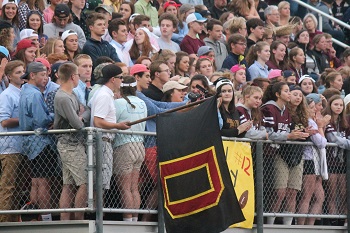
PHOTOS: (Top) Dexter coach Phil Jacobs gives his players some pointers on the sideline. (Middle) Quarterback Colin Parachek works to elude a pair of Ann Arbor Huron defenders. (Below) Students fill the stands to support the Dreadnaughts. (Photos by Terry Jacoby.)