


Classes Still Create Hoosier Hysteria
July 27, 2017
By Rob Kaminski
MHSAA benchmarks editor
This is the fourth part in a series on MHSAA tournament classification, past and present, that will be published over the next two weeks. This series originally ran in this spring's edition of MHSAA benchmarks.
Twenty years ago, Bloomington North High School won the Indiana High School Athletic Association boys basketball championship, defeating Delta 75-54 at the RCA Dome in Indianapolis.
The date, March 22, 1997, is at the same time revered and disdained by traditionalists in the state who saw it as the last schoolboy championship game the state would ever host.
That’s how devout the game of basketball, particularly interscholastic basketball, had become in the Hoosier state during the 87 years a state champion – one state champion, to be precise – was crowned.
Following that 1997 season, the IHSAA moved to a four-class system for its roundball tournaments, like so many of its state association counterparts had done years earlier.
It would be shocking to find more than a small percentage of current high school basketball players around the country unfamiliar with the iconic movie Hoosiers, even though the film is now more than 30 years old.
And, the storyline for that blockbuster unfolded more than 30 years prior to its release, when small-town, undermanned Milan High School defeated Muncie Central High School 32-30 in the 1954 IHSAA title game.
Perhaps it’s because of the David vs Goliath notion, or the fame of the movie that replaced Milan with the fictional Hickory and real-life star Bobby Plump with Hollywood hero Jimmy Chitwood, or the simple fact that Indiana had something other states didn’t.
Whatever the reason, plenty of opposition remains to this day to basketball classification in the state.
The fact is, the small rural schools were regularly being beaten handily by the much larger suburban and city schools as the tournament progressed each season.
Small schools also were closing at a rapid rate following the state’s School Reorganization Act in 1959, as students converged on larger, centralized county schools. From 1960 to 2000, the number of schools entering the tournament dropped from 694 to 381, and in 1997 a total of 382 schools and 4,584 athletes began competition at the Sectional level (the first level of the IHSAA Basketball Tournament).
It was at the entry level of the tournament where school administrators felt the pain of the new class system, but not necessarily for the same nostalgic reasons as the fans who either attended or boycotted the tournament.
At the Sectional round of the tournament, the IHSAA was culling just 2 percent of the revenue, with the participating schools splitting the balance. So, when Sectional attendance dropped by 14 percent in that first year of class basketball, many schools realized a financial loss. It was money they had grown to count on in prior years to help fund various aspects of the department.
Schools cumulatively received more than $900,000 from Sectional competition in 1998, but that total was down from more than $1 million in the last year of the single-class tournament.
Yet, the current format provides a great deal more opportunity and realistic chances at championship runs for schools of all enrollments.
To date, 60 additional teams have championship or runner-up trophies on display in school trophy cases around Indiana.
That was the mission in front of then-IHSAA commissioner Bob Gardner (now National Federation executive director) once the board made its decision: to give thousands more student-athletes the opportunity for once-in-a-lifetime experiences.
As any statistician knows, figures can be manipulated to tell any side of a story. Declining attendance in year one of class basketball is such a number.
The truth is tournament attendance had been on a steady downward spiral since its peak of just over 1.5 million in 1962. By the last single-class event in 1997, the total attendance was half that.
The challenge then and today, as it is for all state associations, is to find that delicate balance for those holding onto tradition, those holding onto trophies, and the number of trophies to hand out.
Editor’s Note: Stories from the Fort Wayne Journal Gazette in 1998 and from a 2007 issue of Indianapolis Monthly provided facts in this article.
Chain Gang Linked by Decades of Down & Distance
By
Pam Shebest
Special for MHSAA.com
September 18, 2018
SCHOOLCRAFT — Skip Fox figures he and his buddies have the best seats in the house when it comes to Schoolcraft football.
 And the four have had them for a combined 167 years.
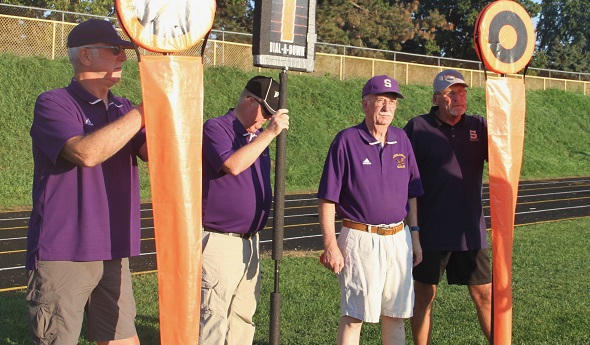
Fox, Jeff Bell, David Krum and Dick Goldschmeding make up the chain gang for the Eagles’ home games, and boast tenures individually and working together that surely rank among the longest in Michigan for providing that gameday duty.
They work well together, an asset when it comes to games like Schoolcraft’s 49-48 double overtime win against Saugatuck last Friday.
Each has a specific job with Bell and Goldschmeding working the chains, Krum the clip and Fox the down box.
Do they lose focus during those long games?
“Never,” Bell said, as the others burst into laughter, with one chiming in: “Good answer.”
“We’re always consummate chain people,” Bell continued. “Never once have I been leaning on that stake and having Dick on the other end pull me along to get going.”
The camaraderie among the four is evident as they share memories.
Fox, who is in his 55th season working the chains, started on the sidelines after his 1964 graduation from Schoolcraft High School.
“When I started, it was a three-man crew,” he said. “We always invited somebody from the opposing team to be on the chains. Then they started changing some of the rules.
“At that time, we worked one half on the visitors’ side and one half on the home side. When the chains had to be opposite the press box, we started working the games all on one side.
“It’s always the opposing side, so we’ve heard a lot of opposing coaches over the years. We’ve learned a few new words.”
 Bell, a 1966 Schoolcraft grad, joined the crew 51 years ago.
Before retiring, he was a middle school teacher in the district for 28 years and “doing that, you get to know all the kids so it was always fun to be down there watching the kids you knew.
“It’s different now (that he is retired). We kind of refer to the program all the time to make sure we know who’s who on the team.”
The gang has seen definite changes in the game over their tenure.
“We see a lot more conditioning and a lot more safety regulations,” Bell said. “The rules change and we try to keep up with that as much as possible.
“It’s a faster paced game than it was when we first started.”
Krum worked part-time on the chain gang from 1965 to 1970 while he attended Michigan State University and has been full-time the last 49 seasons.
One down side of the job, he said, is “Mother Nature. At times I wished we weren’t out there because we can’t leave. We’re stuck there rain or snow.”
Bell said weather seems to be one of the biggest changes over the years.
“At least half of the season we worked in Carhartts and snow was at least ankle deep,” he said. “Now we usually don’t see snow, but we get cold weather, mosquitoes, things like that.”
Krum really did have the best seat in the house to see his son, Dean, make an outstanding play several years ago.
“It was right in front of us in the end zone,” Krum said. “He knocked a pass down on the last play and we won the game. The whole crowd went crazy.
“I was in utter shock. I kept asking the guys, ‘He didn’t get a penalty, did he?’ It saved a two-pointer and we won the game by one.”
Krum is the one who protects the sideline.
“I’m the one who tells the coaches and players to please get back as we are going up and down,” he said. “You’ve got to talk to them all the time.”
Goldschmeding is the new guy on the crew.
A graduate of Portage Central High school, he moved to Schoolcraft 50 years ago and was recruited 12 years ago.
“We’ve been friends for a number of years, and they said they had an opening on the chain gang and would I be interested,” Goldschmeding said. “I fell for it hook, line and sinker.
“At the time I was assisting on the (Schoolcraft) sideline at football games, so I moved from one side of the field to the other.”
 As an assistant coach, Goldschmeding said he was well aware of the guys working the chains across the field.
“I think every coach is aware of what is going on on the other side of the field because they have to be involved in every play,” he said. “They’re thinking two or three plays ahead all the time.”
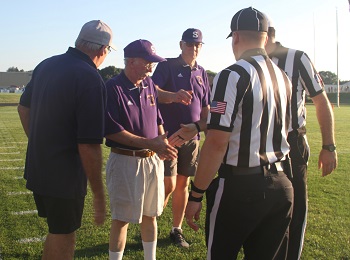
One of the first things the crew does is meet with game officials to coordinate moves.
“When a first down is made, one of us will mark the spot and the other will extend the chain the full extent of the 10 yards,” Bell said. “We hold that position until the officials give us the nod.”
Sometimes the crew has to scamper down the field, which becomes time for Fox’s stand-in to appear.
“When they have a 40- or 50-yard run, David’s nephew (Blake Krum) takes over and runs down the field for me,” Fox said. “At age 72, I’m not that fast anymore.”
Bell said the crew’s goal is to go unnoticed.
“If you hold up the game, that’s real bad,” he said. “You want to do your job, and if you’re not noticed and nobody has anything to say about the chain gang, you’ve done your job. That’s pretty much the way it works.”
Fox said about the only downside of the job is not sitting with their wives at games.
“All our wives sit on the other side without us,” he said. “You’ve got to have understanding wives.”
Sideline service one of many school connections
For Fox, Schoolcraft football has been a generational thing.
He lettered in football all four years and added, “My oldest son (Matthew) was on the championship team in 1990 and my other son, Mark, made all-state on both offense and defense, which was a rarity.”
“I’ve got four grandsons, and they all played for Schoolcraft.”
He also served on the Schoolcraft Board of Education for 34 years.
Bell played basketball for the Eagles and his son, Ross, played on the MHSAA Division 6 champion football team in 2001.
Krum did not play sports, but was a sports enthusiast in school.
He spent 29½ years on the school board.
Although he wasn’t involved in Eagles sports as a student, Goldschmeding’s two sons, John and Josh, played football at Schoolcraft and he was involved in the Athletic Boosters. He also has grandchildren involved in Schoolcraft sports.
 Pam Shebest served as a sportswriter at the Kalamazoo Gazette from 1985-2009 after 11 years part-time with the Gazette while teaching French and English at White Pigeon High School. She can be reached at [email protected] with story ideas for Calhoun, Kalamazoo and Van Buren counties.
PHOTOS: (Top) Schoolcraft's Jeff Bell, Skip Fox, David Krum, Dick Goldschmeding work the chains during a game this season. (Middle) Clockwise, from top left: Bell, Fox, Goldschmeding and Krum. (Below) From left, Goldschmeding, Bell and Krum meet with game officials. (Photos by Pam Shebest.)