


Classes Still Create Hoosier Hysteria
July 27, 2017
By Rob Kaminski
MHSAA benchmarks editor
This is the fourth part in a series on MHSAA tournament classification, past and present, that will be published over the next two weeks. This series originally ran in this spring's edition of MHSAA benchmarks.
Twenty years ago, Bloomington North High School won the Indiana High School Athletic Association boys basketball championship, defeating Delta 75-54 at the RCA Dome in Indianapolis.
The date, March 22, 1997, is at the same time revered and disdained by traditionalists in the state who saw it as the last schoolboy championship game the state would ever host.
That’s how devout the game of basketball, particularly interscholastic basketball, had become in the Hoosier state during the 87 years a state champion – one state champion, to be precise – was crowned.
Following that 1997 season, the IHSAA moved to a four-class system for its roundball tournaments, like so many of its state association counterparts had done years earlier.
It would be shocking to find more than a small percentage of current high school basketball players around the country unfamiliar with the iconic movie Hoosiers, even though the film is now more than 30 years old.
And, the storyline for that blockbuster unfolded more than 30 years prior to its release, when small-town, undermanned Milan High School defeated Muncie Central High School 32-30 in the 1954 IHSAA title game.
Perhaps it’s because of the David vs Goliath notion, or the fame of the movie that replaced Milan with the fictional Hickory and real-life star Bobby Plump with Hollywood hero Jimmy Chitwood, or the simple fact that Indiana had something other states didn’t.
Whatever the reason, plenty of opposition remains to this day to basketball classification in the state.
The fact is, the small rural schools were regularly being beaten handily by the much larger suburban and city schools as the tournament progressed each season.
Small schools also were closing at a rapid rate following the state’s School Reorganization Act in 1959, as students converged on larger, centralized county schools. From 1960 to 2000, the number of schools entering the tournament dropped from 694 to 381, and in 1997 a total of 382 schools and 4,584 athletes began competition at the Sectional level (the first level of the IHSAA Basketball Tournament).
It was at the entry level of the tournament where school administrators felt the pain of the new class system, but not necessarily for the same nostalgic reasons as the fans who either attended or boycotted the tournament.
At the Sectional round of the tournament, the IHSAA was culling just 2 percent of the revenue, with the participating schools splitting the balance. So, when Sectional attendance dropped by 14 percent in that first year of class basketball, many schools realized a financial loss. It was money they had grown to count on in prior years to help fund various aspects of the department.
Schools cumulatively received more than $900,000 from Sectional competition in 1998, but that total was down from more than $1 million in the last year of the single-class tournament.
Yet, the current format provides a great deal more opportunity and realistic chances at championship runs for schools of all enrollments.
To date, 60 additional teams have championship or runner-up trophies on display in school trophy cases around Indiana.
That was the mission in front of then-IHSAA commissioner Bob Gardner (now National Federation executive director) once the board made its decision: to give thousands more student-athletes the opportunity for once-in-a-lifetime experiences.
As any statistician knows, figures can be manipulated to tell any side of a story. Declining attendance in year one of class basketball is such a number.
The truth is tournament attendance had been on a steady downward spiral since its peak of just over 1.5 million in 1962. By the last single-class event in 1997, the total attendance was half that.
The challenge then and today, as it is for all state associations, is to find that delicate balance for those holding onto tradition, those holding onto trophies, and the number of trophies to hand out.
Editor’s Note: Stories from the Fort Wayne Journal Gazette in 1998 and from a 2007 issue of Indianapolis Monthly provided facts in this article.
Memphis Tastes Victory, Plays for More
By
Paul Costanzo
Special for MHSAA.com
September 12, 2018
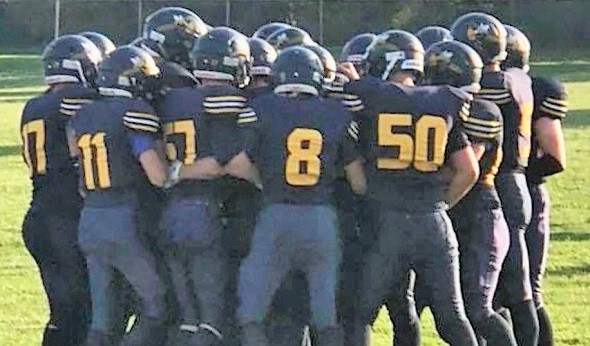
Winning was such an unfamiliar feeling for the Memphis varsity football team that when the Yellowjackets picked up a victory in Week 1, coach Pat Connell had to give some of his players a push when it came to enjoying it.
 “We call (the victory formation), they take a knee and nobody knows what to do,” Connell said. “The kids on the field are starting to celebrate, and I looked at the kids behind me and said, ‘Hey, this is when you celebrate.’”
Memphis’ 14-12 win against Burton Bentley on Aug. 23 snapped a 26-game losing streak for the Yellowjackets, who hadn’t been victorious since Week 1 of the 2015 season. It was a cathartic moment for the players, coaching staff, school and community – one that won’t soon be forgotten.
“Honestly, I’d say it was the best feeling I’ve ever felt on that field,” senior wingback and defensive tackle Cole Myers said. “My entire time playing football at my school, we hadn’t gotten a win in the last two to three years. It felt like the turning point of our program.”
One win was great, and something Memphis desperately needed. But while everyone involved in the Memphis program knows things are looking up, they also know there is plenty of work still to be done to turn things completely around. That was evident in 44-0 and 42-0 losses to Ubly and Brown City, respectively, in the following weeks.
But it’s work the coaches and players are now willing to put in.
“I enjoyed it; it was nice to have my first Memphis football win,” senior quarterback and safety Cale Shivers said. “I’ve played football my whole life and been on winning teams my whole life, so I know that if we want to win more games, we have to keep working.”
When Connell and his staff took over, Memphis had just finished its first 0-9 season in 2016, which came on the heels of back-to-back 1-8 seasons.
During those struggles, numbers had gotten so low for the Yellowjackets that there were talks of prematurely ending a season -- not to end the losing, but to keep kids safe.
To build the program, Connell first needed players, and to get players, he needed to be recruiting in the hallways. Unfortunately for him, he teaches at Port Huron Northern, a good 30-minute drive from Memphis, as does his assistant Casey Kucsera. Assistant coach Pete Fox teaches at St. Clair, which is closer, but clearly not in the building.
“That first year when we took over in April or May, we were trying to get any kids, but it was a slow process,” Connell said. “We were taking personal days to set up in the school to go meet kids.”
The idea of simply playing a junior varsity schedule was brought up, but Connell said that if there was just one senior who wanted to play, the Yellowjackets would play as a varsity team so that player could have that experience. They wound up with 10, and while it was another 0-9 season, that fall was a building block.
“That first year was just about making it fun,” Connell said. “It isn’t us coming in to yell and scream at you; we want you to come out and enjoy football. It was opening the weight room, and sometimes kids would stumble in, and we were developing that trust. Then the word started getting out.”
 When comparing 0-9 seasons, it can be hard to find tangible improvement. But Memphis scored more points (60-39) and allowed fewer (427-538) while playing a similar schedule in 2017.
Most importantly, though, the players were noticing that things were different.
“Kids didn’t really see the progression until other coaches and players from teams were saying, ‘Even though you guys lost, we can tell you really look like a football team now,’’ Shivers said. “And we were hearing from the public that we actually looked good out there.”
Despite not winning a game, Memphis did pick up some momentum.
“When I first got out to Memphis, I would ask kids, ‘Are you interested in playing football?’ and it was, ‘I don’t know, maybe,’” said Connell, who is up to 28 players on his roster. “This offseason, it was, ‘Are you playing,’ and they were like, ‘Yes sir, I’m playing.’ We had like 20 kids who were all in on football. Now, that didn’t mean that they realized they had to be there three days a week in the winter lifting, but they were excited.”
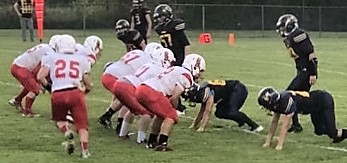
The excitement grew after the opening win against Burton Bentley, a game that was filled with drama. After Memphis took a 14-12 lead on Shivers’ second touchdown pass of the evening and his ensuing 2-point conversion run, it had a chance to ice the game by running out the clock with a few first downs. Before that could happen, however, the lights -- which were set on a timer -- went out in the stadium.
When they came back on about 20 minutes later, Burton Bentley forced a Memphis punt to give itself one more chance.
Fortunately for the Yellowjackets, that drive ended with a turnover, and Memphis was able to run a play out of the victory formation for the first time in three years.
“I wouldn’t even call it remembering how to win,” Myers said. “Because I’ve never been on a winning team for football. It was something new.”
The feeling, Myers said, made him want to win more. And while Weeks 2 and 3 were a return to Earth for the Yellowjackets, those defeats haven’t dampened their spirits or their outlook. Connell knows there is still plenty of work to be done in the weight room and on the field to have his team competing with its Greater Thumb Conference East opponents.
But his players believe in what he and his staff are doing, and they are now starting to believe in themselves.
“It might take a couple more wins before people (in the school) start realizing this is a different program from past years,” Myers said. “(A successful season would be) to put in everything that we possibly can and have more wins than losses at this point. I would say five to six wins would be what I would hope out of this season.”
 Paul Costanzo served as a sportswriter at The Port Huron Times Herald from 2006-15, including three years as lead sportswriter, and prior to that as sports editor at the Hillsdale Daily News from 2005-06. He can be reached at [email protected] with story ideas for Genesee, Lapeer, St. Clair, Sanilac, Huron, Tuscola, Saginaw, Bay, Arenac, Midland and Gladwin counties.
PHOTOS: (Top) Memphis players huddle up before a game this season. (Middle) The Yellowjackets defense held Burton Bentley to 12 points. (Photos courtesy of the Memphis football program.)