


Classes Still Create Hoosier Hysteria
July 27, 2017
By Rob Kaminski
MHSAA benchmarks editor
This is the fourth part in a series on MHSAA tournament classification, past and present, that will be published over the next two weeks. This series originally ran in this spring's edition of MHSAA benchmarks.
Twenty years ago, Bloomington North High School won the Indiana High School Athletic Association boys basketball championship, defeating Delta 75-54 at the RCA Dome in Indianapolis.
The date, March 22, 1997, is at the same time revered and disdained by traditionalists in the state who saw it as the last schoolboy championship game the state would ever host.
That’s how devout the game of basketball, particularly interscholastic basketball, had become in the Hoosier state during the 87 years a state champion – one state champion, to be precise – was crowned.
Following that 1997 season, the IHSAA moved to a four-class system for its roundball tournaments, like so many of its state association counterparts had done years earlier.
It would be shocking to find more than a small percentage of current high school basketball players around the country unfamiliar with the iconic movie Hoosiers, even though the film is now more than 30 years old.
And, the storyline for that blockbuster unfolded more than 30 years prior to its release, when small-town, undermanned Milan High School defeated Muncie Central High School 32-30 in the 1954 IHSAA title game.
Perhaps it’s because of the David vs Goliath notion, or the fame of the movie that replaced Milan with the fictional Hickory and real-life star Bobby Plump with Hollywood hero Jimmy Chitwood, or the simple fact that Indiana had something other states didn’t.
Whatever the reason, plenty of opposition remains to this day to basketball classification in the state.
The fact is, the small rural schools were regularly being beaten handily by the much larger suburban and city schools as the tournament progressed each season.
Small schools also were closing at a rapid rate following the state’s School Reorganization Act in 1959, as students converged on larger, centralized county schools. From 1960 to 2000, the number of schools entering the tournament dropped from 694 to 381, and in 1997 a total of 382 schools and 4,584 athletes began competition at the Sectional level (the first level of the IHSAA Basketball Tournament).
It was at the entry level of the tournament where school administrators felt the pain of the new class system, but not necessarily for the same nostalgic reasons as the fans who either attended or boycotted the tournament.
At the Sectional round of the tournament, the IHSAA was culling just 2 percent of the revenue, with the participating schools splitting the balance. So, when Sectional attendance dropped by 14 percent in that first year of class basketball, many schools realized a financial loss. It was money they had grown to count on in prior years to help fund various aspects of the department.
Schools cumulatively received more than $900,000 from Sectional competition in 1998, but that total was down from more than $1 million in the last year of the single-class tournament.
Yet, the current format provides a great deal more opportunity and realistic chances at championship runs for schools of all enrollments.
To date, 60 additional teams have championship or runner-up trophies on display in school trophy cases around Indiana.
That was the mission in front of then-IHSAA commissioner Bob Gardner (now National Federation executive director) once the board made its decision: to give thousands more student-athletes the opportunity for once-in-a-lifetime experiences.
As any statistician knows, figures can be manipulated to tell any side of a story. Declining attendance in year one of class basketball is such a number.
The truth is tournament attendance had been on a steady downward spiral since its peak of just over 1.5 million in 1962. By the last single-class event in 1997, the total attendance was half that.
The challenge then and today, as it is for all state associations, is to find that delicate balance for those holding onto tradition, those holding onto trophies, and the number of trophies to hand out.
Editor’s Note: Stories from the Fort Wayne Journal Gazette in 1998 and from a 2007 issue of Indianapolis Monthly provided facts in this article.
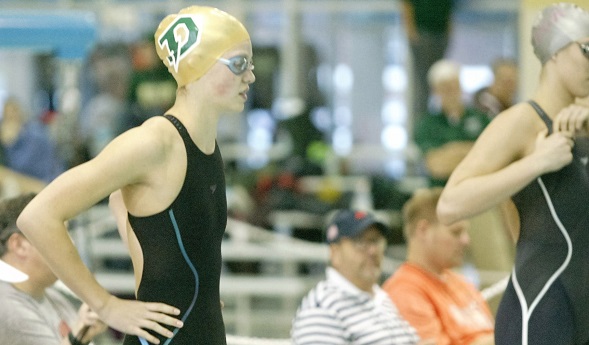
Dow's Newman Right at Home in Water
By
Paul Costanzo
Special for MHSAA.com
August 29, 2018
Claire Newman described her younger self as “a complete amphibian,” and not much has changed as she goes through her teenage years.
 “I’ve just always felt at home in the water,” the Midland Dow junior said. “It helps me work out my school day and any emotional problems. Being in swim also kind of reminds me of my abilities and, personally, I feel more spiritually sound when I swim.”
Newman is a four-time Division 2 Finals runner-up, having placed second in the 50 and 100-yard freestyles both of the past two seasons. She has won state titles in club competition, and is already drawing interest from college swim programs at all levels.
So it’s no surprise she feels comfortable in the water. It’s an offseason spent mostly on dry land, however, that could be the catalyst for Newman’s strongest season yet.
“I spent two to three months doing physical therapy on my shoulder,” Newman said. “I feel much better now that my shoulder is all healed up. I know better how to prevent another injury. I’m already starting to see the results of it. I’m much more conscious of which muscles I’m using for every part of my stroke, but especially my shoulders.”
The shoulder injury surfaced during Newman’s sophomore season, and she said it was the result of overuse. While still in season, she trained by simply kicking in the pool for two weeks.
Newman managed to perform well when it mattered at the Division 2 meet, also helping Dow touch third in the 400-yard freestyle relay in addition to her runner-up individual finishes. But she said the entire process was tough emotionally.
She would go on to compete in Junior Nationals in Tennessee following the prep season, but eventually focused on getting healthy.
“She was working very hard on the dry-land aspect, then she started swimming again full-time in May and swam through the summer,” Dow coach Chilly Smith said. “She did very little swimming in January through April. It’s going to help her, hopefully, stay healthy. By doing all the dry land, she stabilized (her shoulder). That was probably the first time she’s ever had really four months out of the pool since she was younger -- a lot younger. I think it was good for her, and that’s why we brought her back fairly slow.”
Now healthy, Newman is ready to meet the goals she’s set for herself. While they’re lofty, they look to be well within her reach.
 “I think winning an event at state is probably one of my goals,” she said. “Breaking 23 (seconds) officially in the 50 -- I’ve sort of, kind of done it unofficially. I want personal improvement in my other strokes, specifically the breaststroke and the butterfly, and I also want to get more college exposure.”
Based on last year’s results, Newman appears to be the favorite to complete her first goal – something she was on track to do a year ago.
In 2016, Newman finished second to Birmingham Seaholm’s Haley Doan in the 50 and Dexter’s Annette Schultz in the 100. She passed both of them in 2017, but East Grand Rapids’ move to Division 2 (from Division 3) brought into her races Ileah Doctor, who went on to set meet records in both events in finishing ahead of Newman. Doctor graduated this spring and will be swimming at Indiana University, but Newman’s motivation remains the same.
“I was aware of how incredibly fast she was,” Newman said. “I didn’t really focus on her as competition, though. I usually use myself as competition, trying to beat my own times and focus more on improving myself.
“I wasn’t waking up every morning thinking about Ileah Doctor. I was waking up every morning thinking about how I could get better.”
Winning an MHSAA Finals title, and breaking 23 seconds, would go a long way toward achieving Newman’s final goal of attracting more college attention. So would improving her other strokes and proving she can win at longer distances, as Newman is well aware.
“A lot of colleges really like to see a 200 (yard) swimmer,” Newman said. “That signals that you’re pretty flexible in your events, same with the two (individual medley events). I think it’s also really great for aerobic training.”
Smith said he’ll be working the longer events, as well as the butterfly, into Newman’s competitive schedule this season to help her and the team.
“A swimmer has to be able to swim different events, because that’s one way you can keep a swimmer from becoming stale or bored with their swimming,” he said. “We’re really trying to work the 200, because if we can get a better 200 out of her, that’s just going to help her 100 freestyle.”
Newman has taken a visit to Michigan State University and said that Notre Dame (which she has visited on her own) and Indiana also interest her significantly, as does Division III Kenyon College in Ohio. While she admits she wants to swim against Division I competition, the most important factor for Newman is finding the right academic fit, as well as an athletic one. She plans to study something in liberal arts that allows her to tap into her creative side.
No matter where she goes, as long as she’s in the water, she’ll be right at home.
 Paul Costanzo served as a sportswriter at The Port Huron Times Herald from 2006-15, including three years as lead sportswriter, and prior to that as sports editor at the Hillsdale Daily News from 2005-06. He can be reached at [email protected] with story ideas for Genesee, Lapeer, St. Clair, Sanilac, Huron, Tuscola, Saginaw, Bay, Arenac, Midland and Gladwin counties.
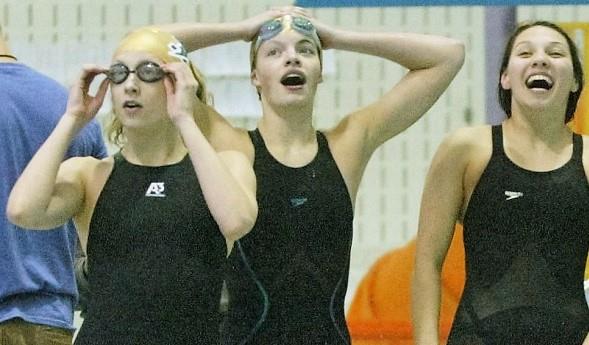
PHOTOS: (Top) Midland Dow’s Claire Newman prepares to swim the 50-yard freestyle at last season’s Lower Peninsula Division 2 Finals at Holland Aquatic Center. (Middle) Newman, middle, looks to the scoreboard with her teammates in anticipation of their relay time. (Click to see more from HighSchoolSportsScene.com.)