


Classes Still Create Hoosier Hysteria
July 27, 2017
By Rob Kaminski
MHSAA benchmarks editor
This is the fourth part in a series on MHSAA tournament classification, past and present, that will be published over the next two weeks. This series originally ran in this spring's edition of MHSAA benchmarks.
Twenty years ago, Bloomington North High School won the Indiana High School Athletic Association boys basketball championship, defeating Delta 75-54 at the RCA Dome in Indianapolis.
The date, March 22, 1997, is at the same time revered and disdained by traditionalists in the state who saw it as the last schoolboy championship game the state would ever host.
That’s how devout the game of basketball, particularly interscholastic basketball, had become in the Hoosier state during the 87 years a state champion – one state champion, to be precise – was crowned.
Following that 1997 season, the IHSAA moved to a four-class system for its roundball tournaments, like so many of its state association counterparts had done years earlier.
It would be shocking to find more than a small percentage of current high school basketball players around the country unfamiliar with the iconic movie Hoosiers, even though the film is now more than 30 years old.
And, the storyline for that blockbuster unfolded more than 30 years prior to its release, when small-town, undermanned Milan High School defeated Muncie Central High School 32-30 in the 1954 IHSAA title game.
Perhaps it’s because of the David vs Goliath notion, or the fame of the movie that replaced Milan with the fictional Hickory and real-life star Bobby Plump with Hollywood hero Jimmy Chitwood, or the simple fact that Indiana had something other states didn’t.
Whatever the reason, plenty of opposition remains to this day to basketball classification in the state.
The fact is, the small rural schools were regularly being beaten handily by the much larger suburban and city schools as the tournament progressed each season.
Small schools also were closing at a rapid rate following the state’s School Reorganization Act in 1959, as students converged on larger, centralized county schools. From 1960 to 2000, the number of schools entering the tournament dropped from 694 to 381, and in 1997 a total of 382 schools and 4,584 athletes began competition at the Sectional level (the first level of the IHSAA Basketball Tournament).
It was at the entry level of the tournament where school administrators felt the pain of the new class system, but not necessarily for the same nostalgic reasons as the fans who either attended or boycotted the tournament.
At the Sectional round of the tournament, the IHSAA was culling just 2 percent of the revenue, with the participating schools splitting the balance. So, when Sectional attendance dropped by 14 percent in that first year of class basketball, many schools realized a financial loss. It was money they had grown to count on in prior years to help fund various aspects of the department.
Schools cumulatively received more than $900,000 from Sectional competition in 1998, but that total was down from more than $1 million in the last year of the single-class tournament.
Yet, the current format provides a great deal more opportunity and realistic chances at championship runs for schools of all enrollments.
To date, 60 additional teams have championship or runner-up trophies on display in school trophy cases around Indiana.
That was the mission in front of then-IHSAA commissioner Bob Gardner (now National Federation executive director) once the board made its decision: to give thousands more student-athletes the opportunity for once-in-a-lifetime experiences.
As any statistician knows, figures can be manipulated to tell any side of a story. Declining attendance in year one of class basketball is such a number.
The truth is tournament attendance had been on a steady downward spiral since its peak of just over 1.5 million in 1962. By the last single-class event in 1997, the total attendance was half that.
The challenge then and today, as it is for all state associations, is to find that delicate balance for those holding onto tradition, those holding onto trophies, and the number of trophies to hand out.
Editor’s Note: Stories from the Fort Wayne Journal Gazette in 1998 and from a 2007 issue of Indianapolis Monthly provided facts in this article.
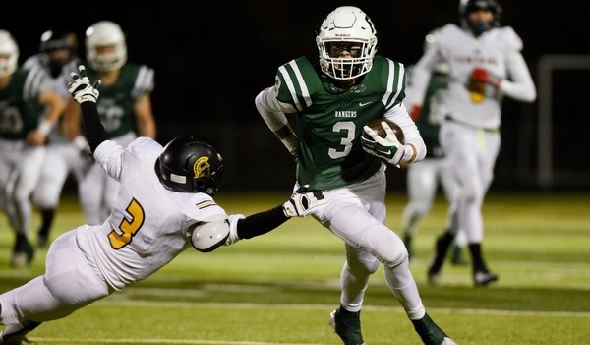
FHC's Hallock Shines in Green & White
August 22, 2018
By Dean Holzwarth
Special for Second Half
GRAND RAPIDS – It was pretty much a foregone conclusion that Tate Hallock would eventually wind up wearing green and white.
 The Grand Rapids Forest Hills Central senior receiver already has had plenty of success wearing those colors, and he’s always wanted to follow in the footsteps of his family members.
In June, Hallock verbally committed to sign with Michigan State’s football program. He will join his brother Tanner, a second-year walk-on who redshirted last year.
Hallock’s father, Ty, played at MSU from 1989-92 and was drafted by the Detroit Lions in 1993. Ty Hallock played eight seasons in the NFL with three teams (Detroit, Jacksonville and Chicago). Tate’s mother, Jennifer, also graduated from MSU.
“I think my whole life I knew I wanted to go to Michigan State,” said the 6-foot-4, 190-pound Tate, who also was recruited by Notre Dame and several Mid-American Conference schools.
“Obviously my brother plays there, so that was a huge factor, and overall the legacy of my family going to Michigan State played a huge role in that, too. My brother and I had a plan when we were younger that we were going to play together there, so I was able to get that opportunity and commit.”
The Spartans will get a playmaker who produced on both sides of the ball last season as the Rangers turned in one of the best in school history.
Forest Hills Central set a school record for wins, finishing 12-1 with the lone loss a shutout by Livonia Franklin in the Division 2 Semifinals.
 Hallock had 779 receiving yards and 10 touchdowns a year ago, while also recording 81 tackles on defense.
“He is a threat to score on every down on offense,” FHC coach Tim Rogers said. “He has excellent speed and can go up and take the ball away from most defensive backs. We will move him from free safety to strong safety this season. He’s always around the ball, and he’s a violent tackler.”
Tate Hallock is in daily contact with his brother, who played a major role in FHC’s resurgence two years ago as the starting quarterback.
Tanner Hallock helped lead the Rangers to a nine-win season and playoff berth in 2016.
“We are very close, and I talk to him every day,” Tate Hallock said. “We’re always keeping each other in line, and I’ve learned a ton from him. He was a huge leader two years ago, and he really helped put the program back on track.”
Tate Hallock was just born when his father retired from the NFL, but he’s been around football his entire life.
He credits his father for teaching him the game and providing encouragement when needed.
“My dad has really taught me everything, and he just talks to me about being a leader and playing my role,” Tate Hallock said. “He’s my best motivator and the one I really look up to.”
While Tate Hallock waits for his time in East Lansing, he’s excited to play one more high school season and build off last year’s historic run.
“I’m definitely looking forward to next year, but I’m glad I’m finally done with the recruiting process so I can focus on this year and bringing home something for FHC.”
Hallock will benefit from having his longtime friend around to throw him the ball.
Senior dual-threat quarterback Luke Majick returns to engineer a potent Rangers’ offense. He threw for 1,787 yards and 21 touchdowns last season while also rushing for 840 yards and 15 touchdowns.
“I think it’s very important that we’re both back, but definitely Luke, because you need a quarterback and he brought a lot to us last year,” Tate Hallock said. “I think that will be the key to our success this year.”
 Tate Hallock and Majick aren’t just teammates. They’ve known each other since elementary school and have developed a bond on and off the field.
It’s a connection that has enabled both of them to thrive.
“We’ve been best friends since fourth grade,” Tate Hallock said. “I think I’m capable of getting open, and he just knows where I am. We have good chemistry because he’s used to throwing me the ball.”
Majick echoed those sentiments, as both seem to always be in sync.
“We have great chemistry because we’re best buds, and I always know where he is going to be at on the field,” Majick said. “He’s so fast and tall, he makes my job a lot easier.
“Going to Michigan State has always been his dream, and I’ve been to a couple games with him. It seems that’s where his heart’s at, and I’m sure he’ll do great there.”
Tate Hallock hopes to prove last season wasn’t a one-time phenomenon. The Rangers have similar goals in mind, and ending the season at Ford Field instead of watching at home would be at the top of the list.
“I think you should prove something every year, and we definitely showed that last year and the year before,” he said. “The senior class really took a step forward last year, and now we need to take another step forward and show what we are all about.
“We definitely want to go undefeated during the regular season again and get to the state championship, but it’s really a day-by-day process starting with Jenison (on Thursday) and going from there.”
 Dean Holzwarth covered primarily high school sports for the Grand Rapids Press and MLive for 16 years and more recently served as sports editor of the Ionia Sentinel and as a sports photojournalist for WZZM. Contact him at [email protected] with story ideas for Allegan, Kent and Ottawa counties.
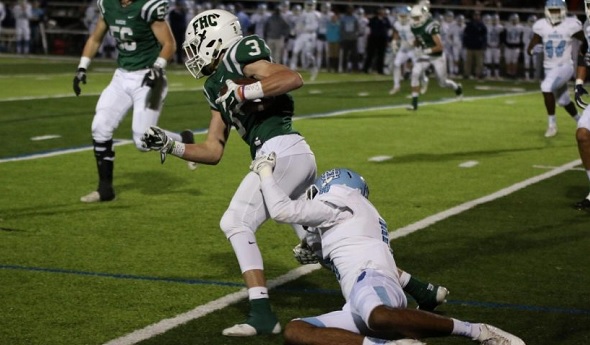
PHOTOS: (Top) Tate Hallock (3) turns up field looking for yardage last season against Traverse City Central. (Middle) Hallock works to pull away from a Muskegon Mona Shores defender. (Action photos courtesy of The Central Trend.)