


Classes Still Create Hoosier Hysteria
July 27, 2017
By Rob Kaminski
MHSAA benchmarks editor
This is the fourth part in a series on MHSAA tournament classification, past and present, that will be published over the next two weeks. This series originally ran in this spring's edition of MHSAA benchmarks.
Twenty years ago, Bloomington North High School won the Indiana High School Athletic Association boys basketball championship, defeating Delta 75-54 at the RCA Dome in Indianapolis.
The date, March 22, 1997, is at the same time revered and disdained by traditionalists in the state who saw it as the last schoolboy championship game the state would ever host.
That’s how devout the game of basketball, particularly interscholastic basketball, had become in the Hoosier state during the 87 years a state champion – one state champion, to be precise – was crowned.
Following that 1997 season, the IHSAA moved to a four-class system for its roundball tournaments, like so many of its state association counterparts had done years earlier.
It would be shocking to find more than a small percentage of current high school basketball players around the country unfamiliar with the iconic movie Hoosiers, even though the film is now more than 30 years old.
And, the storyline for that blockbuster unfolded more than 30 years prior to its release, when small-town, undermanned Milan High School defeated Muncie Central High School 32-30 in the 1954 IHSAA title game.
Perhaps it’s because of the David vs Goliath notion, or the fame of the movie that replaced Milan with the fictional Hickory and real-life star Bobby Plump with Hollywood hero Jimmy Chitwood, or the simple fact that Indiana had something other states didn’t.
Whatever the reason, plenty of opposition remains to this day to basketball classification in the state.
The fact is, the small rural schools were regularly being beaten handily by the much larger suburban and city schools as the tournament progressed each season.
Small schools also were closing at a rapid rate following the state’s School Reorganization Act in 1959, as students converged on larger, centralized county schools. From 1960 to 2000, the number of schools entering the tournament dropped from 694 to 381, and in 1997 a total of 382 schools and 4,584 athletes began competition at the Sectional level (the first level of the IHSAA Basketball Tournament).
It was at the entry level of the tournament where school administrators felt the pain of the new class system, but not necessarily for the same nostalgic reasons as the fans who either attended or boycotted the tournament.
At the Sectional round of the tournament, the IHSAA was culling just 2 percent of the revenue, with the participating schools splitting the balance. So, when Sectional attendance dropped by 14 percent in that first year of class basketball, many schools realized a financial loss. It was money they had grown to count on in prior years to help fund various aspects of the department.
Schools cumulatively received more than $900,000 from Sectional competition in 1998, but that total was down from more than $1 million in the last year of the single-class tournament.
Yet, the current format provides a great deal more opportunity and realistic chances at championship runs for schools of all enrollments.
To date, 60 additional teams have championship or runner-up trophies on display in school trophy cases around Indiana.
That was the mission in front of then-IHSAA commissioner Bob Gardner (now National Federation executive director) once the board made its decision: to give thousands more student-athletes the opportunity for once-in-a-lifetime experiences.
As any statistician knows, figures can be manipulated to tell any side of a story. Declining attendance in year one of class basketball is such a number.
The truth is tournament attendance had been on a steady downward spiral since its peak of just over 1.5 million in 1962. By the last single-class event in 1997, the total attendance was half that.
The challenge then and today, as it is for all state associations, is to find that delicate balance for those holding onto tradition, those holding onto trophies, and the number of trophies to hand out.
Editor’s Note: Stories from the Fort Wayne Journal Gazette in 1998 and from a 2007 issue of Indianapolis Monthly provided facts in this article.
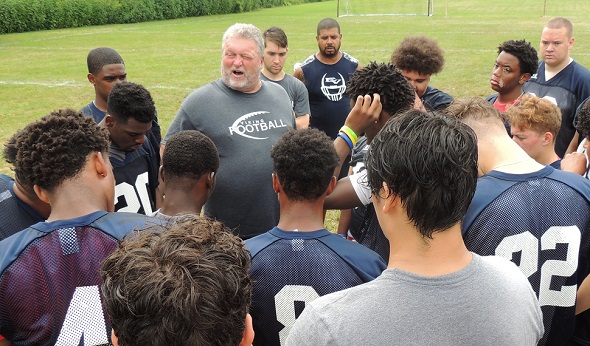
Smith Takes on Next Challenge at Everett
August 6, 2018
By Geoff Kimmerly
Second Half editor
LANSING – On a frequently stormy Monday in the shadow of iconic Archie Ross Stadium, the sun broke in for the end of Lansing Everett’s first football practice – just in time for coach Mike Smith to remind his players they have an opportunity to accomplish great things this fall.
Senior Noah Smith knows it. He may have been a first-grader in 2007 when Mike Smith left one of the state’s top Division 1 programs at Holt, but he’s heard plenty about those Rams – who finished the coach’s tenure with 25 straight league wins over four seasons and a District title.
Noah Smith was following mid-Michigan football much more closely in 2013, when Mike Smith took over an Eaton Rapids program that had never made the playoffs and immediately led the Greyhounds to two postseason appearances in his first two seasons.
“I knew that at Eaton Rapids, he came in and changed the program – and when I heard that he was coming here, I was hoping he would do that here,” Noah Smith said.
And Noah’s reaction after Monday’s first session?
“He’s going to change the program,” Smith adamantly added.
It’s not that easy, and even over-the-top to say Mike Smith has made it look that way. But it’s also impossible to argue with his work over the last 30 years.
The Detroit Denby and Michigan State University graduate took over a Dansville team in 1989 coming off a 1-8 finish and led the Aggies to a combined 32-6 run over four seasons including two they finished at 9-1.
After a one-year stop at Eaton Rapids in 1993 (the Greyhounds went 5-4, their last winning season before 20 straight below .500), Smith moved on to Holt in 1994, taking a Rams varsity that hadn’t won more than six games since 1981 to the Class A championship game in 1995. Holt was 98-54 over his 15 seasons with the Rams.
Smith left to assist at Olivet College, then assisted at Grand Ledge for a season before returning to Eaton Rapids in 2013 and leading the Greyhounds to 7-5 and then 8-4 records over his first two seasons – and a 25-26 run overall while navigating a league that has sent three of its six teams to Ford Field over the last eight seasons.
Add it up, and the first four high school varsities (including Eaton Rapids twice) that Smith has taken over were a combined 8-28 the year before – and a combined 24-15 his first seasons. All told, Smith enters this fall at Everett 160-90 for his career and raring for this next challenge and the greater opportunities to educate that come with it.
“I love to teach. I love this part about, it’s not just the football,” Smith said. “It’s about doing something for someone else, the greater good, the whole thing like that. I just really, really enjoy coaching. But it’s not just that – it’s the teaching as well.”
Everett welcomes Smith coming off a 1-8 finish a year ago after former coach Marcelle Carruthers – who turned the program into a local power over 17 seasons – stepped down in the spring to become principal at Lansing Eastern.
 Smith had 25 players on the field Monday, with three more for sure on the way, and he expects to end up with a roster in the low 30s – and with junior varsity and freshman teams as well, the freshman team possibly the largest of the three.
Smith also took over as the school’s athletic director in January. He knew his athletes coming into the first practice, but not as football players – and he admitted to being a little nervous Sunday night as he readied for another start.
Noah Smith said his classmates were a little anxious as well when Mike Smith was hired. But that’s eased as they’ve become familiar with their jolly new leader who long has been known for matching intensity with playfulness and genuine care for his athletes.
Noah Smith is entering his fourth season on varsity and earned all-league honors as a receiver last season in the Capital Area Activities Conference Blue. Mike Smith’s “calmer” approach caught his attention Monday, even as the new coach did make vocal points on occasion.
“It brings us together even more. You realize that he’s there. He’s actually coaching us. He’s a real coach for us,” Noah Smith said.
Mike Smith said he’s watching this week to see who shows up every day and works hard every day – another part of the culture he’s bringing from his previous stops.
Noah Smith knows it will be sinking in “when people start listening all the time instead of most of the time. We listen, I can honestly say we listen, but we need to listen all the time instead of most of the time because most of the time’s not going to cut it.”
This first practice was over by noon, and Mike Smith already was enjoying what he saw about 100 yards in front of him – players on both sides of assistant Jacob Wyatt, chatting up the former Sexton and Eastern Michigan standout on their way to the locker room.
“If you do the right thing every day, the game’s going to take care of itself,” he said. “You need to know what kind of offense and defense to run and put your kids in the best spots to be successful. (But) the other thing I’ve always stressed to my teams, this team can’t be my team. It’s gotta be your team. When you can get the kids all playing for each other, you’ve got yourself there.”
PHOTOS: (Top) First-year Lansing Everett football coach Mike Smith talks with his team at the end of their first practice of this season Monday. (Middle) A row of Vikings line up during a kickoff drill. (Photos by Geoff Kimmerly.)