


Classes Still Create Hoosier Hysteria
July 27, 2017
By Rob Kaminski
MHSAA benchmarks editor
This is the fourth part in a series on MHSAA tournament classification, past and present, that will be published over the next two weeks. This series originally ran in this spring's edition of MHSAA benchmarks.
Twenty years ago, Bloomington North High School won the Indiana High School Athletic Association boys basketball championship, defeating Delta 75-54 at the RCA Dome in Indianapolis.
The date, March 22, 1997, is at the same time revered and disdained by traditionalists in the state who saw it as the last schoolboy championship game the state would ever host.
That’s how devout the game of basketball, particularly interscholastic basketball, had become in the Hoosier state during the 87 years a state champion – one state champion, to be precise – was crowned.
Following that 1997 season, the IHSAA moved to a four-class system for its roundball tournaments, like so many of its state association counterparts had done years earlier.
It would be shocking to find more than a small percentage of current high school basketball players around the country unfamiliar with the iconic movie Hoosiers, even though the film is now more than 30 years old.
And, the storyline for that blockbuster unfolded more than 30 years prior to its release, when small-town, undermanned Milan High School defeated Muncie Central High School 32-30 in the 1954 IHSAA title game.
Perhaps it’s because of the David vs Goliath notion, or the fame of the movie that replaced Milan with the fictional Hickory and real-life star Bobby Plump with Hollywood hero Jimmy Chitwood, or the simple fact that Indiana had something other states didn’t.
Whatever the reason, plenty of opposition remains to this day to basketball classification in the state.
The fact is, the small rural schools were regularly being beaten handily by the much larger suburban and city schools as the tournament progressed each season.
Small schools also were closing at a rapid rate following the state’s School Reorganization Act in 1959, as students converged on larger, centralized county schools. From 1960 to 2000, the number of schools entering the tournament dropped from 694 to 381, and in 1997 a total of 382 schools and 4,584 athletes began competition at the Sectional level (the first level of the IHSAA Basketball Tournament).
It was at the entry level of the tournament where school administrators felt the pain of the new class system, but not necessarily for the same nostalgic reasons as the fans who either attended or boycotted the tournament.
At the Sectional round of the tournament, the IHSAA was culling just 2 percent of the revenue, with the participating schools splitting the balance. So, when Sectional attendance dropped by 14 percent in that first year of class basketball, many schools realized a financial loss. It was money they had grown to count on in prior years to help fund various aspects of the department.
Schools cumulatively received more than $900,000 from Sectional competition in 1998, but that total was down from more than $1 million in the last year of the single-class tournament.
Yet, the current format provides a great deal more opportunity and realistic chances at championship runs for schools of all enrollments.
To date, 60 additional teams have championship or runner-up trophies on display in school trophy cases around Indiana.
That was the mission in front of then-IHSAA commissioner Bob Gardner (now National Federation executive director) once the board made its decision: to give thousands more student-athletes the opportunity for once-in-a-lifetime experiences.
As any statistician knows, figures can be manipulated to tell any side of a story. Declining attendance in year one of class basketball is such a number.
The truth is tournament attendance had been on a steady downward spiral since its peak of just over 1.5 million in 1962. By the last single-class event in 1997, the total attendance was half that.
The challenge then and today, as it is for all state associations, is to find that delicate balance for those holding onto tradition, those holding onto trophies, and the number of trophies to hand out.
Editor’s Note: Stories from the Fort Wayne Journal Gazette in 1998 and from a 2007 issue of Indianapolis Monthly provided facts in this article.

Escanaba Finds Home as Softball Champ
June 26, 2018
By Geoff Kimmerly
Second Half editor
Relative to the other 15 softball teams playing in the MHSAA Semifinals two weekends ago at Michigan State University’s Secchia Stadium, the Escanaba contingent was far from home.
Escanaba not only advanced to play in its first MHSAA championship game since 2003, but returned home to the Upper Peninsula with its first MHSAA Finals title in the sport – and first in any sport with a unified tournament (both peninsulas together) since the football team won Class A in 1981.
The Eskymos gave up two runs total over six postseason games, shutting out Eaton Rapids 2-0 in a Semifinal and South Haven 5-0 in the Division 2 championship game to earn the honor as the final MHSAA/Applebee’s “Team of the Month” for 2017-18.
“It had been so long since we’d had a group down here, I think it was kinda nerve-wracking for them to be down on that field,” said Escanaba coach Jamie Segorski of the 2016 team, the first to return to the Semifinals since that 2003 Division 1 runner-up. “The last couple of years we’ve been fortunate enough to get down there, develop a comfort level, and we’ve come up with a nice schedule that’s convenient and comfortable and helped the girls stay with their norm.
“We expect to make it down there. Will we make it every year? Absolutely not. The competition is fierce. But in their minds, they know they can do it.”
Escanaba finished the spring 31-3, its only losses to eventual Division 3 runner-up Millington, Division 3 semifinalist Clinton and Rice Lake of Wisconsin. All three defeats were by just a run.
The Eskymos, as noted, also had advanced to the 2016 and 2017 Division 2 Semifinals, and they entered this playoffs ranked No. 3 by the state coaches association. So opening with District wins of 4-0 over Cheboygan and 11-1 over Petoskey wasn’t shocking. But a 10-0 shutout of No. 8 Muskegon Oakridge followed by a 12-0 shutout of Remus Chippewa Hills in the Regional certainly grabbed some attention.
Escanaba followed those with a 9-1 Quarterfinal win over annual power Saginaw Swan Valley, before finishing the run with two more shutouts – and a combined postseason scoring edge of 53-2.
Sophomore Gabi Salo without question is one of the best pitchers in the state. She came in in relief during the 2017 Semifinal loss to Richmond, but returned to Secchia to throw 14 shutout innings, giving up a combined seven hits and one walk with 20 strikeouts. She has added four mph to her fastball over the last year, dialing up 66 during the final inning against South Haven. For the season she finished 21-3 with a 0.40 ERA and 287 strikeouts in 156 innings pitched – and she’s already set to play at University of Wisconsin after graduation.
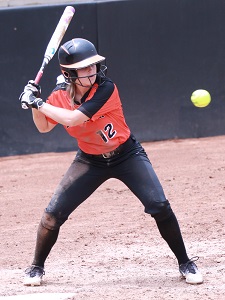 Her nearly unhittable performance was matched by plenty of hitting from her teammates. Junior rightfielder Lexi Chaillier hit .510 with eight home runs and 27 stolen bases from the leadoff spot. Senior second baseman Claire McInerney (.439, 16 SB), senior shortstop Taylor Gauthier (.400, 37 RBI) and senior third baseman Madison Griffin (.430, 6 HR, 46 RBI) filled in the next three places in the lineup, respectively. Eight starters entered the final week of the season batting at least .371, and all nine starters this season had at least one home run. Freshman Nicole Kamin batted fifth both games of Finals weekend and finished the season hitting .526 over 13 games, while going 10-0 with a 1.26 ERA from the pitching circle.
Gauthier and McInerney were three-year starters in the middle of the infield, and the rest of the team’s seniors all came up for the 2016 tournament run and had made all the trips to MSU. The team is well-traveled during the regular season as well, frequently heading downstate and into Wisconsin to find tough competition. The Eskymos find plenty at home too, as Delta County also includes Gladstone and Rapid River – ranked No. 8 in Division 3 and No. 9 in Division 4, respectively, heading into the postseason.
Football is king in Escanaba, and basketball rules the girls sports scene across the Upper Peninsula. But Eskymos softball came home as first-time-in-a-long-time champion, toppling history, clichés about the weather and any remaining misconceptions that teams traveling over the Bridge will sooner or later run into a rocky road.
“It’s fun to watch the girls develop that grit – being from the U.P., they always feel like they’re not looked at like everybody else, like they’re not as good, like how can they be good when they have snow until July,” Segorski said. “I think it really helps determine that higher sense of determination to win games.
“They’ll bask in the glory. They’ll enjoy it. And the younger girls were able to see what happened, see the fun and what we got done, and they’ll come in next year very determined.”
Past Teams of the Month, 2017-18
May: Brownstown Woohaven baseball - Report
April: Detroit Catholic Central boys lacrosse - Report
March: Brighton hockey - Report
February: Marquette girls and boys skiing - Report
January: Sterling Heights Stevenson competitive cheer - Report
December: Cadillac boys bowling - Report
November: Ottawa Lake Whiteford football - Report
October: Beaverton volleyball - Report
September: Shepherd girls golf - Report
PHOTOS: (Top) Escanaba gets ready for its turn at bat after holding South Haven to another scoreless inning during the Division 2 Final. (Middle) Lexi Chaillier lines up a pitch during the championship game.