


Classes Still Create Hoosier Hysteria
July 27, 2017
By Rob Kaminski
MHSAA benchmarks editor
This is the fourth part in a series on MHSAA tournament classification, past and present, that will be published over the next two weeks. This series originally ran in this spring's edition of MHSAA benchmarks.
Twenty years ago, Bloomington North High School won the Indiana High School Athletic Association boys basketball championship, defeating Delta 75-54 at the RCA Dome in Indianapolis.
The date, March 22, 1997, is at the same time revered and disdained by traditionalists in the state who saw it as the last schoolboy championship game the state would ever host.
That’s how devout the game of basketball, particularly interscholastic basketball, had become in the Hoosier state during the 87 years a state champion – one state champion, to be precise – was crowned.
Following that 1997 season, the IHSAA moved to a four-class system for its roundball tournaments, like so many of its state association counterparts had done years earlier.
It would be shocking to find more than a small percentage of current high school basketball players around the country unfamiliar with the iconic movie Hoosiers, even though the film is now more than 30 years old.
And, the storyline for that blockbuster unfolded more than 30 years prior to its release, when small-town, undermanned Milan High School defeated Muncie Central High School 32-30 in the 1954 IHSAA title game.
Perhaps it’s because of the David vs Goliath notion, or the fame of the movie that replaced Milan with the fictional Hickory and real-life star Bobby Plump with Hollywood hero Jimmy Chitwood, or the simple fact that Indiana had something other states didn’t.
Whatever the reason, plenty of opposition remains to this day to basketball classification in the state.
The fact is, the small rural schools were regularly being beaten handily by the much larger suburban and city schools as the tournament progressed each season.
Small schools also were closing at a rapid rate following the state’s School Reorganization Act in 1959, as students converged on larger, centralized county schools. From 1960 to 2000, the number of schools entering the tournament dropped from 694 to 381, and in 1997 a total of 382 schools and 4,584 athletes began competition at the Sectional level (the first level of the IHSAA Basketball Tournament).
It was at the entry level of the tournament where school administrators felt the pain of the new class system, but not necessarily for the same nostalgic reasons as the fans who either attended or boycotted the tournament.
At the Sectional round of the tournament, the IHSAA was culling just 2 percent of the revenue, with the participating schools splitting the balance. So, when Sectional attendance dropped by 14 percent in that first year of class basketball, many schools realized a financial loss. It was money they had grown to count on in prior years to help fund various aspects of the department.
Schools cumulatively received more than $900,000 from Sectional competition in 1998, but that total was down from more than $1 million in the last year of the single-class tournament.
Yet, the current format provides a great deal more opportunity and realistic chances at championship runs for schools of all enrollments.
To date, 60 additional teams have championship or runner-up trophies on display in school trophy cases around Indiana.
That was the mission in front of then-IHSAA commissioner Bob Gardner (now National Federation executive director) once the board made its decision: to give thousands more student-athletes the opportunity for once-in-a-lifetime experiences.
As any statistician knows, figures can be manipulated to tell any side of a story. Declining attendance in year one of class basketball is such a number.
The truth is tournament attendance had been on a steady downward spiral since its peak of just over 1.5 million in 1962. By the last single-class event in 1997, the total attendance was half that.
The challenge then and today, as it is for all state associations, is to find that delicate balance for those holding onto tradition, those holding onto trophies, and the number of trophies to hand out.
Editor’s Note: Stories from the Fort Wayne Journal Gazette in 1998 and from a 2007 issue of Indianapolis Monthly provided facts in this article.
MHSAA Building Named for Retiring Director
By
Geoff Kimmerly
MHSAA.com senior editor
June 26, 2018
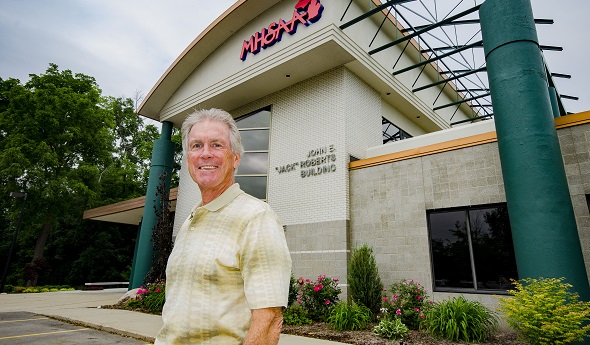
To recognize 32 years of leadership and service to Michigan educational athletics, the MHSAA Representative Council has named its home office in East Lansing after longtime Executive Director John E. “Jack” Roberts, who will retire in August.
The dedication of the “John E. ‘Jack’ Roberts Building” was approved by the Council during its Spring Meeting, May 6-7 in Gaylord, with the fabrication and assembly of the lettering financed by several private donations.
The building, located at 1661 Ramblewood Drive in East Lansing, opened as headquarters for the Association on January 3, 1997. The 20,000-square-foot, two-story facility houses MHSAA staff offices and resources including a publications library, plus multiple conference spaces frequently used to host meetings not only for MHSAA business but by leagues, coaches associations and other groups joining people from across the state.
Roberts, who announced his retirement April 24, will conclude his tenure next month as the second-longest serving full-time executive director during the MHSAA’s 94-year history. He is the fourth person to serve that leadership role full time, following Charles E. Forsythe (1931-42, 1945-68), Allen W. Bush (1968-78) and Vern L. Norris (1978-86). Roberts currently is also the nation’s longest-serving executive director of a state high school athletic association.
“This is an entirely unexpected honor,” Roberts said, “and while I am proud of the building, I’m even prouder of the people who have worked in it.”
The metallic lettering announcing the building’s name was designed by Image360 of Brighton and placed on the façade at the center of the building below the large MHSAA logo facing the property’s parking lot.
John Peckham, then of Martin Property Development of East Lansing, oversaw the original Ramblewood project. The building was designed by Keystone Design and built by Granger Construction.
Prior to the move to its current offices, the MHSAA was housed at 1019 Trowbridge Road in East Lansing from 1976-96. The MHSAA moved to the Trowbridge location from a downtown Lansing office it had leased since 1958.
With his retirement upcoming, Roberts also will leave the National Federation of State High School Associations (NFHS) Board of Directors later this week during the Summer Meeting in Chicago. He also will conclude an extended term as board chairperson of the NFHS Network. Roberts previously served as an assistant director for the National Federation from 1973-80 and came to the MHSAA in the fall of 1986 from the Fellowship of Christian Athletes, which he served as executive vice president.
Assistant Director Mark Uyl was chosen by the Representative Council in May to succeed Roberts as MHSAA executive director.
The MHSAA is a private, not-for-profit corporation of voluntary membership by more than 1,500 public and private senior high schools and junior high/middle schools which exists to develop common rules for athletic eligibility and competition. No government funds or tax dollars support the MHSAA, which was the first such association nationally to not accept membership dues or tournament entry fees from schools. Member schools which enforce these rules are permitted to participate in MHSAA tournaments, which attract more than 1.4 million spectators each year.