


Classes Still Create Hoosier Hysteria
July 27, 2017
By Rob Kaminski
MHSAA benchmarks editor
This is the fourth part in a series on MHSAA tournament classification, past and present, that will be published over the next two weeks. This series originally ran in this spring's edition of MHSAA benchmarks.
Twenty years ago, Bloomington North High School won the Indiana High School Athletic Association boys basketball championship, defeating Delta 75-54 at the RCA Dome in Indianapolis.
The date, March 22, 1997, is at the same time revered and disdained by traditionalists in the state who saw it as the last schoolboy championship game the state would ever host.
That’s how devout the game of basketball, particularly interscholastic basketball, had become in the Hoosier state during the 87 years a state champion – one state champion, to be precise – was crowned.
Following that 1997 season, the IHSAA moved to a four-class system for its roundball tournaments, like so many of its state association counterparts had done years earlier.
It would be shocking to find more than a small percentage of current high school basketball players around the country unfamiliar with the iconic movie Hoosiers, even though the film is now more than 30 years old.
And, the storyline for that blockbuster unfolded more than 30 years prior to its release, when small-town, undermanned Milan High School defeated Muncie Central High School 32-30 in the 1954 IHSAA title game.
Perhaps it’s because of the David vs Goliath notion, or the fame of the movie that replaced Milan with the fictional Hickory and real-life star Bobby Plump with Hollywood hero Jimmy Chitwood, or the simple fact that Indiana had something other states didn’t.
Whatever the reason, plenty of opposition remains to this day to basketball classification in the state.
The fact is, the small rural schools were regularly being beaten handily by the much larger suburban and city schools as the tournament progressed each season.
Small schools also were closing at a rapid rate following the state’s School Reorganization Act in 1959, as students converged on larger, centralized county schools. From 1960 to 2000, the number of schools entering the tournament dropped from 694 to 381, and in 1997 a total of 382 schools and 4,584 athletes began competition at the Sectional level (the first level of the IHSAA Basketball Tournament).
It was at the entry level of the tournament where school administrators felt the pain of the new class system, but not necessarily for the same nostalgic reasons as the fans who either attended or boycotted the tournament.
At the Sectional round of the tournament, the IHSAA was culling just 2 percent of the revenue, with the participating schools splitting the balance. So, when Sectional attendance dropped by 14 percent in that first year of class basketball, many schools realized a financial loss. It was money they had grown to count on in prior years to help fund various aspects of the department.
Schools cumulatively received more than $900,000 from Sectional competition in 1998, but that total was down from more than $1 million in the last year of the single-class tournament.
Yet, the current format provides a great deal more opportunity and realistic chances at championship runs for schools of all enrollments.
To date, 60 additional teams have championship or runner-up trophies on display in school trophy cases around Indiana.
That was the mission in front of then-IHSAA commissioner Bob Gardner (now National Federation executive director) once the board made its decision: to give thousands more student-athletes the opportunity for once-in-a-lifetime experiences.
As any statistician knows, figures can be manipulated to tell any side of a story. Declining attendance in year one of class basketball is such a number.
The truth is tournament attendance had been on a steady downward spiral since its peak of just over 1.5 million in 1962. By the last single-class event in 1997, the total attendance was half that.
The challenge then and today, as it is for all state associations, is to find that delicate balance for those holding onto tradition, those holding onto trophies, and the number of trophies to hand out.
Editor’s Note: Stories from the Fort Wayne Journal Gazette in 1998 and from a 2007 issue of Indianapolis Monthly provided facts in this article.
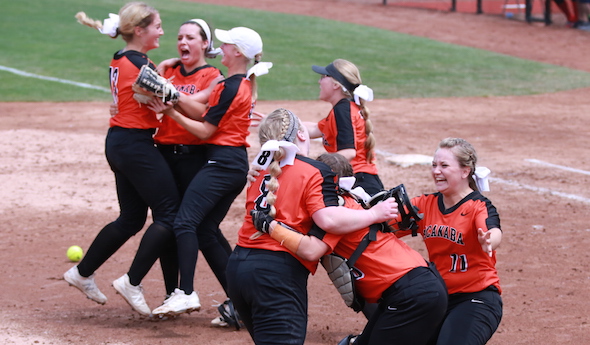
Escanaba Follows Ace to Historic Finish
By
Paul Costanzo
Special for MHSAA.com
June 16, 2018
EAST LANSING – South Haven managed three hits Saturday, so it wouldn’t be accurate to say Escanaba sophomore Gabi Salo was unhittable in the MHSAA Division 2 softball championship game.
But the University of Wisconsin recruit was pretty close.
Salo threw a second straight shutout at Secchia Stadium on the campus of Michigan State University, striking out 13 and not allowing a walk in Escanaba’s 5-0 win.
“I definitely think she’s the best pitcher that we’ve faced this year,” South Haven coach Wilma Wilson said. “We’ve faced some really good pitchers, but she was just living on the edge with every little thing and painting the corners and working the zone that the umpire was giving her. So no, we have not faced anyone like her this year.”
The MHSAA title was the first in program history for the Eskymos (31-3), who were making their third straight appearance in the Final Four, and first title game appearance since 2003.
“It feels amazing,” Salo said. “The last time Escanaba brought home a state championship was 1981 (in Class A football), and to bring home another one is really cool.”
To clarify: The Eskymos frequently claim MHSAA Finals titles in sports where the peninsulas play in separate divisions. But Saturday’s victory clinched Escanaba’s first championship in a statewide tournament since that 1981 football win – although the softball team long has been considered among the state’s elite regardless of peninsula.
Salo set the tone early Saturday, striking out 11 of the first 13 batters she faced, including the first eight. She did this despite a 25-minute rain delay that began two strikes into the second at-bat of the game.
“We just kept ourselves up and went out there and played like we were playing,” Salo said. “It didn’t bother us.”
Salo, who also shut out Eaton Rapids in the Semifinal on Thursday, finished the season with an earned-run average below 0.40.
“She was absolutely incredible,” Escanaba coach Jamie Segorski said. “It’s hard, you know, because we’ve come to expect it. She does it continuously. The bigger the game the better she pitches, and it’s a credit to all the work she puts in. Nobody works harder; nobody works longer. As a matter of fact, when she leaves here today, she’s going to be playing this weekend in Ohio. She doesn’t take breaks; she just plays.”
Escanaba catcher Dakota Cloutier knew coming into the game that her pitcher was going to be tough to hit – although she comes into most games with that feeling.
 “She was on another level today,” Cloutier said. “She was pitching harder and pulling through all her pitches more than she ever has before.”
The game ended with a Salo strikeout, this one on a called strike, and one the umpire took a second to signal.
“When you’re waiting for changeup to float in there like that on that last pitch, I think (the umpire) was even surprised,” Segorski said. “That was a great pitch. It just takes a second to get the call, and we were all waiting and watching, and it was awesome.”
Salo was given all the run support she needed in the first inning, as Madison Griffin drove in Lexi Chaillier with a double.
While South Haven pitcher Hayley Kreiger was strong after that, the Eskymos were able to push across two unearned runs in the fourth inning with two outs, as Nicole Kamin scored on an error and Cloutier drove in Savannah Barron with a double.
Escanaba added two more runs in the bottom of the sixth inning as Heather Bergstrom, Barron and Cloutier hit back-to-back-to-back doubles with two outs.
“It was awesome,” Segorski said. “It’s a relaxed feeling for the hitters when they go up there and we have a nice lead. All they have to do is go up there and square the ball, and they did it. For Heather Bergstrom to come in as a pinch hitter and drive that one to right center was fantastic, and for Savannah Barron to end her high school softball career with a double and drive in an insurance run for us is an amazing feeling for her. It goes all the way through. Just a bunch of amazing kids who did an amazing thing.”
Kreiger finished with nine strikeouts of her own, allowing seven hits, one walk and three earned runs.
“She’s been our workhorse, and she’s the one we’re going to match up against anybody,” Wilson said. “Give them kudos, though; they had some nice line-drive hits and put the ball in play better than we did. “Hayley’s been there for us all year, and even came up with a nice hit there in the last inning to end her high school career. She’s been on the varsity for four years and been just a key player for us for four years. That’s the kind of player you build around, and our senior group in general is just a great group of athletes that work hard and are super gritty.”
South Haven, making its first championship game appearance since 1979, finished 32-9.
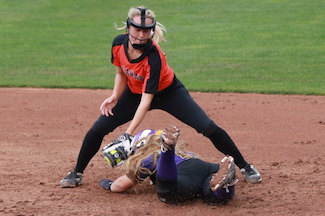
PHOTOS: (Top) Escanaba players celebrate their first MHSAA softball championship Saturday at Secchia Stadium. (Middle) Eskymos shortstop Taylor Gauthier applies a tag to a South Haven runner.