


Classes Still Create Hoosier Hysteria
July 27, 2017
By Rob Kaminski
MHSAA benchmarks editor
This is the fourth part in a series on MHSAA tournament classification, past and present, that will be published over the next two weeks. This series originally ran in this spring's edition of MHSAA benchmarks.
Twenty years ago, Bloomington North High School won the Indiana High School Athletic Association boys basketball championship, defeating Delta 75-54 at the RCA Dome in Indianapolis.
The date, March 22, 1997, is at the same time revered and disdained by traditionalists in the state who saw it as the last schoolboy championship game the state would ever host.
That’s how devout the game of basketball, particularly interscholastic basketball, had become in the Hoosier state during the 87 years a state champion – one state champion, to be precise – was crowned.
Following that 1997 season, the IHSAA moved to a four-class system for its roundball tournaments, like so many of its state association counterparts had done years earlier.
It would be shocking to find more than a small percentage of current high school basketball players around the country unfamiliar with the iconic movie Hoosiers, even though the film is now more than 30 years old.
And, the storyline for that blockbuster unfolded more than 30 years prior to its release, when small-town, undermanned Milan High School defeated Muncie Central High School 32-30 in the 1954 IHSAA title game.
Perhaps it’s because of the David vs Goliath notion, or the fame of the movie that replaced Milan with the fictional Hickory and real-life star Bobby Plump with Hollywood hero Jimmy Chitwood, or the simple fact that Indiana had something other states didn’t.
Whatever the reason, plenty of opposition remains to this day to basketball classification in the state.
The fact is, the small rural schools were regularly being beaten handily by the much larger suburban and city schools as the tournament progressed each season.
Small schools also were closing at a rapid rate following the state’s School Reorganization Act in 1959, as students converged on larger, centralized county schools. From 1960 to 2000, the number of schools entering the tournament dropped from 694 to 381, and in 1997 a total of 382 schools and 4,584 athletes began competition at the Sectional level (the first level of the IHSAA Basketball Tournament).
It was at the entry level of the tournament where school administrators felt the pain of the new class system, but not necessarily for the same nostalgic reasons as the fans who either attended or boycotted the tournament.
At the Sectional round of the tournament, the IHSAA was culling just 2 percent of the revenue, with the participating schools splitting the balance. So, when Sectional attendance dropped by 14 percent in that first year of class basketball, many schools realized a financial loss. It was money they had grown to count on in prior years to help fund various aspects of the department.
Schools cumulatively received more than $900,000 from Sectional competition in 1998, but that total was down from more than $1 million in the last year of the single-class tournament.
Yet, the current format provides a great deal more opportunity and realistic chances at championship runs for schools of all enrollments.
To date, 60 additional teams have championship or runner-up trophies on display in school trophy cases around Indiana.
That was the mission in front of then-IHSAA commissioner Bob Gardner (now National Federation executive director) once the board made its decision: to give thousands more student-athletes the opportunity for once-in-a-lifetime experiences.
As any statistician knows, figures can be manipulated to tell any side of a story. Declining attendance in year one of class basketball is such a number.
The truth is tournament attendance had been on a steady downward spiral since its peak of just over 1.5 million in 1962. By the last single-class event in 1997, the total attendance was half that.
The challenge then and today, as it is for all state associations, is to find that delicate balance for those holding onto tradition, those holding onto trophies, and the number of trophies to hand out.
Editor’s Note: Stories from the Fort Wayne Journal Gazette in 1998 and from a 2007 issue of Indianapolis Monthly provided facts in this article.
Finalists Cash In on Clutch Performances
By
Tom Markowski
Special for Second Half
June 14, 2018
By Tom Markowski
Special for Second Half
EAST LANSING – Oli Carmody had been in pressure situations before, but nothing compared to what confronted the sophomore from Stevensville Lakeshore on Thursday.
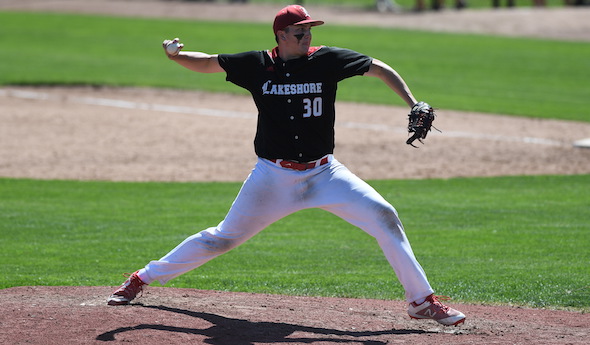
With one out in a scoreless game, Carmody relieved Logan Morrow with runners on first and second base in the bottom of the ninth inning. Carmody went to 3-0 on Orchard Lake St. Mary’s leadoff hitter before retiring him on a fly to center. He got the next batter on a fly out to end the inning, and then singled in Lakeshore’s first run of a three-run 10th as the Lancers held on to defeat St. Mary’s 3-0 in a Division 2 Semifinal at Michigan State’s McLane Stadium.
Back in November, Carmody – playing his first season as goalkeeper on the soccer team – made a diving stop of a penalty kick to give Lakeshore a 2-1 victory over Plainwell in a Division 2 Regional Semifinal.
When asked which game held more importance, Carmody gave a quick response.
“It’s not even close,” he said. “Baseball is my life. This was the greatest experience of my life.
“I’ll admit that I was a little nervous (pitching in relief). When I saw I was missing high, I made adjustments. Once I got that first strike over, I got my confidence right there.”
Lakeshore (26-14) will attempt to repeat as Division 2 baseball champion when it faces Saginaw Swan Valley at 9 a.m. Saturday. Lakeshore also won Class B in 1990.
Thursday’s starting pitchers Connor Brawley of Lakeshore and Logan Wood of St. Mary’s were outstanding. Brawley allowed six hits, one walk and struck out seven in his 7 1/3 innings, and Wood went 8 2/3 and allowed two hits, three walks and struck out nine.
“It was crazy,” Brawley said. “The game flies by. I felt good out there. It was so hard (to come out). Our offense, we just compete. It’s been that way all season.”
Carmody went 1 2/3 innings to notch the victory, allowing no hits and one walk.
Catcher Bray Plomb and Cam Dalrymple started the 10th inning for Lakeshore with singles. A wild pitch put runners on second and third. Carmody singled to score the first run, and the second run scored on a wild pitch. Joel Brawley, Connor’s cousin, knocked in the third run with a bunt single.
St. Mary’s (28-13), the champion in 2015, had good chances to win the game in the seventh, eighth and ninth innings. The Eaglets had two runners in the seventh, but Connor Brawley recorded a strikeout to end the inning.
In the eighth, St. Mary’s loaded the bases and Alex Mooney lined out to right field to end the inning. In the ninth Carmody worked out of the jam to end the Eaglets’ last serious threat.
“There were many times we were against the ropes,” Lakeshore coach Mark Nate said. “They score, they win. We grinded it out.”
St. Mary’s is a young team, but coach Matt Petry gave no excuses. The Eaglets started four freshmen and four sophomores last season, so even though they have only four seniors on the roster, two of whom start, Petry said his players have been in a number of big games.
“We made the Catholic League final this year,” he said. “These guys have played in Comerica Park. We expected to make a good run in the tournament. We’re excited for the future. but today stinks. We hit the ball hard. We had runners in scoring position.”
Saginaw Swan Valley 3, DeWitt 1
Swan Valley scored three runs in the first inning, and that’s all the Vikings needed to earn their first championship game appearance since 2001, when they defeated Wyoming Park, 4-1, for the Division 2 title.
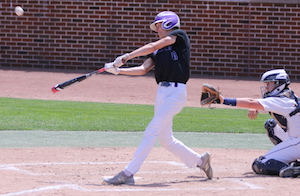 In the first frame, Swan Valley (33-8-3) loaded the bases with one out, and Easton Goldensoph was hit by a pitch to force in the first run Logan Pietz drove in the next with a single, and the third run scored on a wild pitch.
DeWitt (27-7) scored its run in the top of the sixth inning on a Jace Preston single.
Goldensoph’s brother, Avery, a freshman, went the distance for the victory. He allowed six hits, walked two and struck out five.
“We’re excited to be back,” Swan Valley first-year coach Craig Leddy said. “These kids are young. They don’t know what pressure is. They drive me crazy, they’re so loose.”
Nolan Knauf allowed just two hits in going all six innings for DeWitt. The one bad inning did him in.
“Nothing’s promised,” DeWitt coach Alan Shankel said. “Credit goes to Swan Valley. They made the plays. We were knocking on the door all game.”
PHOTOS: (Top) Stevensville Lakeshore’s Logan Morrow makes his move toward the plate in Thursday’s first Division 2 Semifinal. (Middle) Swan Valley’s Avery Goldensoph drives a pitch during the second Semifinal at McLane Stadium.