


Classes Still Create Hoosier Hysteria
July 27, 2017
By Rob Kaminski
MHSAA benchmarks editor
This is the fourth part in a series on MHSAA tournament classification, past and present, that will be published over the next two weeks. This series originally ran in this spring's edition of MHSAA benchmarks.
Twenty years ago, Bloomington North High School won the Indiana High School Athletic Association boys basketball championship, defeating Delta 75-54 at the RCA Dome in Indianapolis.
The date, March 22, 1997, is at the same time revered and disdained by traditionalists in the state who saw it as the last schoolboy championship game the state would ever host.
That’s how devout the game of basketball, particularly interscholastic basketball, had become in the Hoosier state during the 87 years a state champion – one state champion, to be precise – was crowned.
Following that 1997 season, the IHSAA moved to a four-class system for its roundball tournaments, like so many of its state association counterparts had done years earlier.
It would be shocking to find more than a small percentage of current high school basketball players around the country unfamiliar with the iconic movie Hoosiers, even though the film is now more than 30 years old.
And, the storyline for that blockbuster unfolded more than 30 years prior to its release, when small-town, undermanned Milan High School defeated Muncie Central High School 32-30 in the 1954 IHSAA title game.
Perhaps it’s because of the David vs Goliath notion, or the fame of the movie that replaced Milan with the fictional Hickory and real-life star Bobby Plump with Hollywood hero Jimmy Chitwood, or the simple fact that Indiana had something other states didn’t.
Whatever the reason, plenty of opposition remains to this day to basketball classification in the state.
The fact is, the small rural schools were regularly being beaten handily by the much larger suburban and city schools as the tournament progressed each season.
Small schools also were closing at a rapid rate following the state’s School Reorganization Act in 1959, as students converged on larger, centralized county schools. From 1960 to 2000, the number of schools entering the tournament dropped from 694 to 381, and in 1997 a total of 382 schools and 4,584 athletes began competition at the Sectional level (the first level of the IHSAA Basketball Tournament).
It was at the entry level of the tournament where school administrators felt the pain of the new class system, but not necessarily for the same nostalgic reasons as the fans who either attended or boycotted the tournament.
At the Sectional round of the tournament, the IHSAA was culling just 2 percent of the revenue, with the participating schools splitting the balance. So, when Sectional attendance dropped by 14 percent in that first year of class basketball, many schools realized a financial loss. It was money they had grown to count on in prior years to help fund various aspects of the department.
Schools cumulatively received more than $900,000 from Sectional competition in 1998, but that total was down from more than $1 million in the last year of the single-class tournament.
Yet, the current format provides a great deal more opportunity and realistic chances at championship runs for schools of all enrollments.
To date, 60 additional teams have championship or runner-up trophies on display in school trophy cases around Indiana.
That was the mission in front of then-IHSAA commissioner Bob Gardner (now National Federation executive director) once the board made its decision: to give thousands more student-athletes the opportunity for once-in-a-lifetime experiences.
As any statistician knows, figures can be manipulated to tell any side of a story. Declining attendance in year one of class basketball is such a number.
The truth is tournament attendance had been on a steady downward spiral since its peak of just over 1.5 million in 1962. By the last single-class event in 1997, the total attendance was half that.
The challenge then and today, as it is for all state associations, is to find that delicate balance for those holding onto tradition, those holding onto trophies, and the number of trophies to hand out.
Editor’s Note: Stories from the Fort Wayne Journal Gazette in 1998 and from a 2007 issue of Indianapolis Monthly provided facts in this article.
Cranbrook Emerges With 2nd-Half Surge
June 9, 2018
By Geoff Kimmerly
Second Half editor
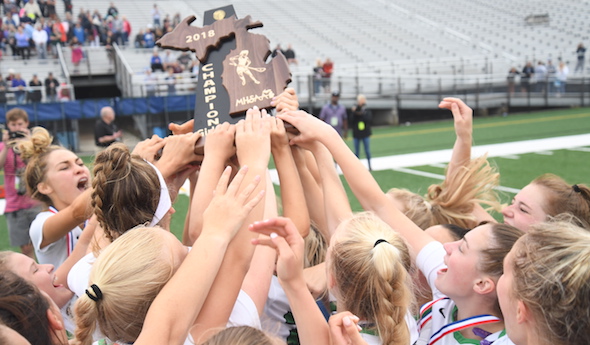
GRAND LEDGE – Many of the players on the field to start the second half of Saturday’s Division 2 Girls Lacrosse Final had played major roles when Bloomfield Hills Cranbrook Kingswood won its first championship in the sport a year ago.
They weren’t about to settle for less.
The Cranes clutched a one-goal lead with 19 minutes to play, but scored 13 of the next 15 goals to finish with a much more comfortable 18-6 win over Okemos at Grand Ledge High School.
Four of the brightest stars from an accomplished group of eight seniors combined to score 11 of those second-half goals for Cranbrook, which also had finished Division 2 runner-up in 2015 and 2016.
“We had a little pep talk at halftime, which we do, and it really gets everyone pumped. And a lot of us, it was our last game of high school – and the girls who aren’t going to play in college, their last game ever,” Cranbrook senior Isabelle Scane said. “I think they just wanted something special, and I think that’s how we got the rally going. And once you get going, it’s almost impossible to stop.”
Scane – set to continue playing at Northwestern University – scored five goals, including four in the second half. She ended this season with 101 and closed her four-year varsity career with an MHSAA record 461, 185 more goals than the next player on the all-time list.
Senior Sophia Milia added three goals and five assists, the latter all during the second half. All four of senior Angelina Wiater’s goals and both assists also came over the final 25 minutes, while junior Jessica Geiger added two of her three goals and senior Delaney Langdon netted her score during the second half as well.
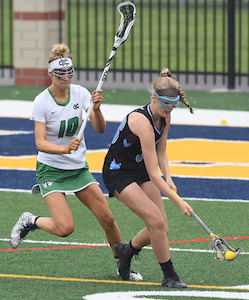 In the end, the Cranes’ 18 goals ranked as the fifth most in MHSAA Finals history – while they gave up what tied for the third fewest all-time.
“It was a matter of giving them a reality check – you don’t get to take this game back. You don’t have another chance at the state championship,” Cranes first-year coach Evan Foulsham said of the halftime chat. “You don’t get to wear the uniform again if you’re a senior.
“It was all a little bit of a heart check in terms of bringing out the passion, and I think it worked.”
Cranbrook finished 17-1-1, its only loss to Rockford, which won the Division 1 championship earlier Saturday.
The Cranes and Chiefs had faced off earlier this season, Cranbrook emerging a 14-10 victor. Okemos (19-4) in its Semifinal had avenged a regular-season loss (and three straight Semifinal defeats) to East Grand Rapids, and was seeking to flip one more past result to close the season.
Senior Alyssa Karber scored two goals for the Chiefs, who graduated nine contributors to this breakthrough run.
“I’m so lucky to have played with those girls growing up. I definitely think this year we took it to another level,” Okemos senior Melaina Grewal said. “The (senior) girls taught the younger girls a lot of things about how to push through, how to keep practicing, how to work hard, and this is just proof that you can end up where you want after you work hard – so I’m assuming that the younger girls’ work ethic will continue to be strong.”
Click for the full scoring summary.
VIDEO: Isabelle Scane scores during the closing seconds of the first half.
PHOTOS: (Top) Bloomfield Hills Cranbrook Kingswood raises the Division 2 championship trophy Saturday for the second straight season. (Middle) Cranbrook’s Sophia Milia (10) defends Okemos’ Campbell Foltz.