


Classes Still Create Hoosier Hysteria
July 27, 2017
By Rob Kaminski
MHSAA benchmarks editor
This is the fourth part in a series on MHSAA tournament classification, past and present, that will be published over the next two weeks. This series originally ran in this spring's edition of MHSAA benchmarks.
Twenty years ago, Bloomington North High School won the Indiana High School Athletic Association boys basketball championship, defeating Delta 75-54 at the RCA Dome in Indianapolis.
The date, March 22, 1997, is at the same time revered and disdained by traditionalists in the state who saw it as the last schoolboy championship game the state would ever host.
That’s how devout the game of basketball, particularly interscholastic basketball, had become in the Hoosier state during the 87 years a state champion – one state champion, to be precise – was crowned.
Following that 1997 season, the IHSAA moved to a four-class system for its roundball tournaments, like so many of its state association counterparts had done years earlier.
It would be shocking to find more than a small percentage of current high school basketball players around the country unfamiliar with the iconic movie Hoosiers, even though the film is now more than 30 years old.
And, the storyline for that blockbuster unfolded more than 30 years prior to its release, when small-town, undermanned Milan High School defeated Muncie Central High School 32-30 in the 1954 IHSAA title game.
Perhaps it’s because of the David vs Goliath notion, or the fame of the movie that replaced Milan with the fictional Hickory and real-life star Bobby Plump with Hollywood hero Jimmy Chitwood, or the simple fact that Indiana had something other states didn’t.
Whatever the reason, plenty of opposition remains to this day to basketball classification in the state.
The fact is, the small rural schools were regularly being beaten handily by the much larger suburban and city schools as the tournament progressed each season.
Small schools also were closing at a rapid rate following the state’s School Reorganization Act in 1959, as students converged on larger, centralized county schools. From 1960 to 2000, the number of schools entering the tournament dropped from 694 to 381, and in 1997 a total of 382 schools and 4,584 athletes began competition at the Sectional level (the first level of the IHSAA Basketball Tournament).
It was at the entry level of the tournament where school administrators felt the pain of the new class system, but not necessarily for the same nostalgic reasons as the fans who either attended or boycotted the tournament.
At the Sectional round of the tournament, the IHSAA was culling just 2 percent of the revenue, with the participating schools splitting the balance. So, when Sectional attendance dropped by 14 percent in that first year of class basketball, many schools realized a financial loss. It was money they had grown to count on in prior years to help fund various aspects of the department.
Schools cumulatively received more than $900,000 from Sectional competition in 1998, but that total was down from more than $1 million in the last year of the single-class tournament.
Yet, the current format provides a great deal more opportunity and realistic chances at championship runs for schools of all enrollments.
To date, 60 additional teams have championship or runner-up trophies on display in school trophy cases around Indiana.
That was the mission in front of then-IHSAA commissioner Bob Gardner (now National Federation executive director) once the board made its decision: to give thousands more student-athletes the opportunity for once-in-a-lifetime experiences.
As any statistician knows, figures can be manipulated to tell any side of a story. Declining attendance in year one of class basketball is such a number.
The truth is tournament attendance had been on a steady downward spiral since its peak of just over 1.5 million in 1962. By the last single-class event in 1997, the total attendance was half that.
The challenge then and today, as it is for all state associations, is to find that delicate balance for those holding onto tradition, those holding onto trophies, and the number of trophies to hand out.
Editor’s Note: Stories from the Fort Wayne Journal Gazette in 1998 and from a 2007 issue of Indianapolis Monthly provided facts in this article.
Unbeaten Spring Lake Eyes Perfect Finish
By
Tom Kendra
Special for MHSAA.com
June 7, 2018
By Tom Kendra
Special for Second Half
It didn’t matter if it was driving rain, scorching heat, prom day, snowflakes, seven-game weeks, high winds, AP testing time or even a high-stakes showdown with archrival Grand Haven in the annual “Battle of the Bridge” at the end of May.
 This Spring Lake girls softball team found a way to win – every game, 38 in a row and counting, to be exact.
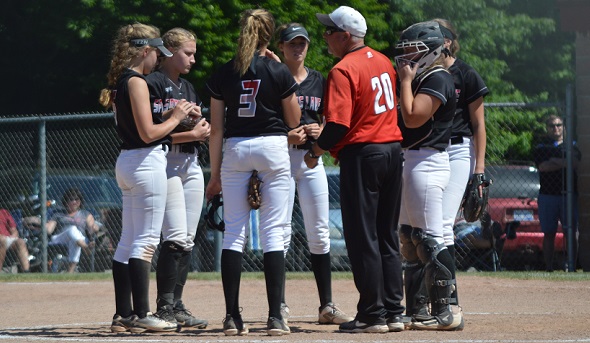
Spring Lake coach Bill Core says that incredible consistency is what sets this team apart from any other in his 29 years at the helm.
“This is the most incredibly focused team I’ve ever had,” said Core, who hit the lofty 600-win mark for his coaching career last month. “They pay attention to detail. I think they’re on a mission.”
No. 2-ranked Spring Lake (38-0) puts its perfect season on the line against No. 6 Wayland in Saturday’s 11 a.m. opener in the MHSAA Division 2 Regional Tournament at Hope College in Holland.
The winner of that showdown will face the Comstock Park vs. Holland Christian winner in Saturday’s 3 p.m. Regional championship game.
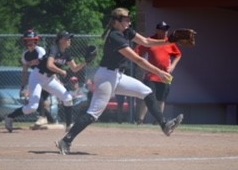
The Lakers are led by junior ace Leah Vaughan, who sports a perfect 26-0 record, with a miniscule 0.83 ERA and 219 strikeouts in 152 innings pitched. Vaughan was sharp in Saturday’s competitive home District, striking out 10 in a 7-2 victory over neighboring rival Fruitport and then whiffing nine in a 7-1 win over Ottawa-Kent Conference Blue foe Allendale.
 While Vaughan is expected to carry the load the rest of the way, Spring Lake also has a solid No. 2 pitcher in senior Lauren Somers, who has a 12-0 record and 2.41 ERA in 61 innings pitched.
On the offensive side, Spring Lake puts pressure on opponents with hitting threats throughout the lineup.
Madelyn Nelson, a senior shortstop, leads the team with a gaudy .636 batting average, 82 hits and 33 stolen bases in 33 attempts. While she certainly has college-level softball skills, Nelson will play golf at Valparaiso University in Indiana. Nelson was part of three straight Lower Peninsula Division 3 championship golf teams for Spring Lake from 2014 to 2016.
Vaughan also does her part at the plate, batting .532 with a team-high 63 RBI. Other top hitters are a pair of senior returning all-staters in second baseman Linsey Paggeot (.484 with 57 RBI) and centerfielder Lauren Hellman (.477 with 17 stolen bases in 18 attempts).
The biggest long-ball threat is junior outfielder Jenna Core, the oldest of Coach Core’s three children (and only girl), who has 10 home runs and 45 RBI. She already holds the school record with 24 home runs over her three-year varsity career, with one more season to go. Core and his wife, Tracy, also have two boys coming up in the Spring Lake system – Jackson, in 8th grade, and Jaden, 5th grade.
“Our lineup from 1 to 9 is pretty solid,” said the 55-year-old Bill Core. “That allows us to have more big innings. If you have a few good batters, you might score two or three runs, but we can keep it rolling and score six or seven.”
Spring Lake has had plenty of big innings this year, outscoring its opponents by a 424-54 margin.
The other starters for the team include junior catcher and No. 5 batter Molly Poole (.358 with 43 RBI), freshman third baseman Alicia Mumby (.410 with three home runs) and senior outfielder Kileah Rymal (.308).
 At the “core” of the Lakers’ softball success is Coach Core, the oldest of four boys who grew up in a sports-crazy family in the sports-crazy town of Traverse City.
Core, now 55, played quarterback for legendary Traverse City coach Jim Ooley and was the first starting quarterback for the West team in the inaugural East-West Michigan High School All-Star Football Game in 1981.
He went on to play one year of football and four years of basketball and baseball at Alma College.
Core, who is assisted by Sarah Bulthuis and Kolbey Nelson, has turned Spring Lake into a regional power in both boys basketball and softball. Now that those programs have stocked several trophy cases with conference, District and Regional hardware, the new goal is to take the next step and get the Lakers to the “Final Four” at Michigan State University.
The Lakers’ basketball team came tantalizingly close in 2017, losing a 46-44 heartbreaker to Benton Harbor in the Class B Quarterfinals. The softball team, which has now won four consecutive District championships and 12 of the past 16 conference titles, broke through last spring with the school’s first-ever Regional championship. Spring Lake’s run was then ended in the Quarterfinals by Stevensville-Lakeshore, 6-1.
If the Lakers are able to win two more games Saturday and improve to 40-0, there is a good chance they could get a Quarterfinal rematch back at Hope College on June 12 with top-ranked Stevensville-Lakeshore.
Core said that season-ending loss last June has motivated this year’s team every day.
“We returned eight starters from last year’s team, so they know how to win and they also learned what they need to do better,” explained Core. “This is the real test now. Now we’ll be in those 2-1 and 3-2 games and, hopefully, that experience will pay off for us.”
 Tom Kendra worked 23 years at The Muskegon Chronicle, including five as assistant sports editor and the final six as sports editor through 2011. E-mail him at [email protected] with story ideas for Muskegon, Oceana, Mason, Lake, Oceola, Mecosta and Newaygo counties.
PHOTOS: (Top) Spring Lake coach Bill Core huddles with his team during a game this season. (Middle) Pitcher Leah Vaughan begins her approach toward the plate. (Photos courtesy of the Spring Lake softball program.)