


Classes Still Create Hoosier Hysteria
July 27, 2017
By Rob Kaminski
MHSAA benchmarks editor
This is the fourth part in a series on MHSAA tournament classification, past and present, that will be published over the next two weeks. This series originally ran in this spring's edition of MHSAA benchmarks.
Twenty years ago, Bloomington North High School won the Indiana High School Athletic Association boys basketball championship, defeating Delta 75-54 at the RCA Dome in Indianapolis.
The date, March 22, 1997, is at the same time revered and disdained by traditionalists in the state who saw it as the last schoolboy championship game the state would ever host.
That’s how devout the game of basketball, particularly interscholastic basketball, had become in the Hoosier state during the 87 years a state champion – one state champion, to be precise – was crowned.
Following that 1997 season, the IHSAA moved to a four-class system for its roundball tournaments, like so many of its state association counterparts had done years earlier.
It would be shocking to find more than a small percentage of current high school basketball players around the country unfamiliar with the iconic movie Hoosiers, even though the film is now more than 30 years old.
And, the storyline for that blockbuster unfolded more than 30 years prior to its release, when small-town, undermanned Milan High School defeated Muncie Central High School 32-30 in the 1954 IHSAA title game.
Perhaps it’s because of the David vs Goliath notion, or the fame of the movie that replaced Milan with the fictional Hickory and real-life star Bobby Plump with Hollywood hero Jimmy Chitwood, or the simple fact that Indiana had something other states didn’t.
Whatever the reason, plenty of opposition remains to this day to basketball classification in the state.
The fact is, the small rural schools were regularly being beaten handily by the much larger suburban and city schools as the tournament progressed each season.
Small schools also were closing at a rapid rate following the state’s School Reorganization Act in 1959, as students converged on larger, centralized county schools. From 1960 to 2000, the number of schools entering the tournament dropped from 694 to 381, and in 1997 a total of 382 schools and 4,584 athletes began competition at the Sectional level (the first level of the IHSAA Basketball Tournament).
It was at the entry level of the tournament where school administrators felt the pain of the new class system, but not necessarily for the same nostalgic reasons as the fans who either attended or boycotted the tournament.
At the Sectional round of the tournament, the IHSAA was culling just 2 percent of the revenue, with the participating schools splitting the balance. So, when Sectional attendance dropped by 14 percent in that first year of class basketball, many schools realized a financial loss. It was money they had grown to count on in prior years to help fund various aspects of the department.
Schools cumulatively received more than $900,000 from Sectional competition in 1998, but that total was down from more than $1 million in the last year of the single-class tournament.
Yet, the current format provides a great deal more opportunity and realistic chances at championship runs for schools of all enrollments.
To date, 60 additional teams have championship or runner-up trophies on display in school trophy cases around Indiana.
That was the mission in front of then-IHSAA commissioner Bob Gardner (now National Federation executive director) once the board made its decision: to give thousands more student-athletes the opportunity for once-in-a-lifetime experiences.
As any statistician knows, figures can be manipulated to tell any side of a story. Declining attendance in year one of class basketball is such a number.
The truth is tournament attendance had been on a steady downward spiral since its peak of just over 1.5 million in 1962. By the last single-class event in 1997, the total attendance was half that.
The challenge then and today, as it is for all state associations, is to find that delicate balance for those holding onto tradition, those holding onto trophies, and the number of trophies to hand out.
Editor’s Note: Stories from the Fort Wayne Journal Gazette in 1998 and from a 2007 issue of Indianapolis Monthly provided facts in this article.

Ishpeming 'Grinds Out' 4th Title in 5 Seasons
By
John Vrancic
Special for MHSAA.com
June 3, 2018
KINGSFORD — First-place finishes may not have been plentiful for the Ishpeming boys Saturday, but they placed in enough events to edge Iron Mountain 90-82 for their fourth Upper Peninsula Division 2 track title in five years.
Third-place Norway scored 64 points, three more than reigning champ Newberry.
Hart Holmgren’s leap of 19 feet, 5½ inches provided Ishpeming with its lone first on this sunny, mild and breezy day at Flivver Field.
“I thought we’d win it by a little more, although it was still a good win,” said Ishpeming coach P.J. Pruett. “Our guys had to grind it out. I was very pleased with their fight to win. Our depth came through.”
The Hematites placed second in three relays and got runner-up finishes from Holmgren in high jump (6-2), Jonah Broberg in the 1,600 at 4 minutes, 48.24 seconds and Spencer Giroux in the 3,200 (10:38.83). They claimed three places in the 3,200 and two apiece in the 800 and 1,600.
“Distance is where we got our major points,” said Pruett. “That’s where we won the meet. Overall, we had a lot of third-place medal winners. Gavin Sundberg was seeded fifth in the 400 and placed third (53.01). Every point counts, and that was proven today. We put more than two in each (distance) event and that’s why we won.
 Beating Newberry in the Regional (May 18 at Manistique) was a big boost for us. Last year, we were runner-up in D-2 and Iron Mountain was runner-up in D-1. Surviving the Regional was key for us.”
Iron Mountain’s Michael Kulas won the 800 (2:09.14), helped the winning 1,600 (3:40.31) and 3,200 (8:44.88) and placed second in the 400 (51.57). Junior Charlie Gerhard added a first in the 300 hurdles (41.1) and second in the 110s (16.55).
Norway senior Inocencio Stankevich won the 110s (16.0) and was runner-up in the 300s (41.93), and Josh Boulden provided a first in discus (131-3).
Newberry swept the sprint relays, edging Ishpeming on a lean for first in the 400 (45.35) and taking the 800 (1:34.05) in what is believed to be a school record.
“We fixed Brandon’s handoff,” said Newberry senior Andre James, who anchored both relays. “He (Christensen) dropped the baton in the (Straits Area) conference meet, but he did it perfect today. The 4x1 was really close and in the 4x2 we won by more than we thought. We just have some fast kids on the team and had a lot of adrenalin on a big stage. It’s exciting to be here. A lot of people turn out for this.”
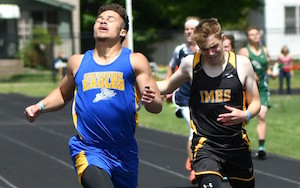
Stephenson junior Montel Glover was a triple winner, taking the 100 (11.36), 200 (22.98) and 400 (51.3).
PHOTOS: (Top) Ishpeming Gavin Sundberg leads off the 800-meter relay. (Middle) Stephenson's Montell Glover, left, outleans Iron Mountain's Michael Kulas in the 400. (Photos by Cara Kamps. Click for more at RunMichigan.com.)