


Classes Still Create Hoosier Hysteria
July 27, 2017
By Rob Kaminski
MHSAA benchmarks editor
This is the fourth part in a series on MHSAA tournament classification, past and present, that will be published over the next two weeks. This series originally ran in this spring's edition of MHSAA benchmarks.
Twenty years ago, Bloomington North High School won the Indiana High School Athletic Association boys basketball championship, defeating Delta 75-54 at the RCA Dome in Indianapolis.
The date, March 22, 1997, is at the same time revered and disdained by traditionalists in the state who saw it as the last schoolboy championship game the state would ever host.
That’s how devout the game of basketball, particularly interscholastic basketball, had become in the Hoosier state during the 87 years a state champion – one state champion, to be precise – was crowned.
Following that 1997 season, the IHSAA moved to a four-class system for its roundball tournaments, like so many of its state association counterparts had done years earlier.
It would be shocking to find more than a small percentage of current high school basketball players around the country unfamiliar with the iconic movie Hoosiers, even though the film is now more than 30 years old.
And, the storyline for that blockbuster unfolded more than 30 years prior to its release, when small-town, undermanned Milan High School defeated Muncie Central High School 32-30 in the 1954 IHSAA title game.
Perhaps it’s because of the David vs Goliath notion, or the fame of the movie that replaced Milan with the fictional Hickory and real-life star Bobby Plump with Hollywood hero Jimmy Chitwood, or the simple fact that Indiana had something other states didn’t.
Whatever the reason, plenty of opposition remains to this day to basketball classification in the state.
The fact is, the small rural schools were regularly being beaten handily by the much larger suburban and city schools as the tournament progressed each season.
Small schools also were closing at a rapid rate following the state’s School Reorganization Act in 1959, as students converged on larger, centralized county schools. From 1960 to 2000, the number of schools entering the tournament dropped from 694 to 381, and in 1997 a total of 382 schools and 4,584 athletes began competition at the Sectional level (the first level of the IHSAA Basketball Tournament).
It was at the entry level of the tournament where school administrators felt the pain of the new class system, but not necessarily for the same nostalgic reasons as the fans who either attended or boycotted the tournament.
At the Sectional round of the tournament, the IHSAA was culling just 2 percent of the revenue, with the participating schools splitting the balance. So, when Sectional attendance dropped by 14 percent in that first year of class basketball, many schools realized a financial loss. It was money they had grown to count on in prior years to help fund various aspects of the department.
Schools cumulatively received more than $900,000 from Sectional competition in 1998, but that total was down from more than $1 million in the last year of the single-class tournament.
Yet, the current format provides a great deal more opportunity and realistic chances at championship runs for schools of all enrollments.
To date, 60 additional teams have championship or runner-up trophies on display in school trophy cases around Indiana.
That was the mission in front of then-IHSAA commissioner Bob Gardner (now National Federation executive director) once the board made its decision: to give thousands more student-athletes the opportunity for once-in-a-lifetime experiences.
As any statistician knows, figures can be manipulated to tell any side of a story. Declining attendance in year one of class basketball is such a number.
The truth is tournament attendance had been on a steady downward spiral since its peak of just over 1.5 million in 1962. By the last single-class event in 1997, the total attendance was half that.
The challenge then and today, as it is for all state associations, is to find that delicate balance for those holding onto tradition, those holding onto trophies, and the number of trophies to hand out.
Editor’s Note: Stories from the Fort Wayne Journal Gazette in 1998 and from a 2007 issue of Indianapolis Monthly provided facts in this article.

Pair Cracks Lineup, Clinches Seaholm Title
By
Pam Shebest
Special for MHSAA.com
June 2, 2018
KALAMAZOO — A year ago, Charlie Kuchman and Sofia Manzo could not crack Birmingham Seaholm’s varsity lineup.
On Saturday, the duo’s three-set win at No. 4 doubles clinched the MHSAA Lower Peninsula Division 2 tennis team title for Seaholm, its first since 2015.
The Maples finished with 34 points, followed by Bloomfield Hills Marian with 27 and East Grand Rapids with 26.
“To win all four doubles says a lot,” Seaholm coach Casey Cullen said. “Five flight championships. Even where we lost, we fought hard.”
For the third-year coach, who played high school tennis at Seaholm, the title is extra special.
“In high school, I never won a team championship,” he said, adding, “I played at Western Michigan (University) so this is my backyard. It was meant to be.”
He said the team knew it had a chance at the title.
“They knew they had a good team; we knew we were something special,” he said. “The rankings would come out and they are No. 1 and they’re like, ‘Man, now we have a target on our back.’
“But they handled that really well. They continued to get better every day, and this is the result.”
Although Seaholm won five flights, the Maples did not have a player in the No. 1 singles final.
That individual title went to reigning champ Sloane Teske of East Grand Rapids, who defeated freshman Olivia Weiss of Royal Oak, 4-6, 6-4, 6-0, in the final.
Teske’s first lead of the match was at 5-4 in the second set.
“I just had a moment of realization and I looked around with all my family and friends supporting me,” the top-seeded junior said. “I just thought whatever happens, happens.
“I know they’ll support me and love me no matter what if I win or lose.”
Weiss, the second seed, was coming off another tough three-setter in the semifinal, with a hard-fought 1-6, 6-2, 7-6 (3) win over Holly’s third-seeded Taylor Barrett.
Weiss qualified for the Finals but her Royal Oak team did not, leading her to figure she would not be seeded at all, let alone second.
 “We’re in a little lower flight in our region,” she said. “Our team works really hard and really good, but we just happen to be at a lower flight, and I didn’t think I’d be seeded at all.
“To be in the first singles seeds is an accomplishment in itself.”
Top-seeded Nicole Johnson of Holly ended her senior year with a 6-4, 6-4, win at No. 2 singles over Seaholm freshman Sofia Gryzenia, the second seed.
“This was my biggest goal for a long time,” said Johnson, who lost in the semifinals last year at the same flight.
“Being a senior didn’t matter. I have experience but she’s a very, very good player. I couldn’t have done it without (my team’s) support cheering me on.”
Gryzenia lost to Johnson earlier in the season.
“I think it makes me a little more nervous because I already think sometimes that I’m going to lose,” the freshman said.
“I think I just needed to keep more balls in against her because she has a really good backhand, so I tried to hit it to her forehand.”
At No. 3 singles, a pair of sophomores went against each other with second-seeded Halley Elliott of East Grand Rapids defeating fifth-seeded Marlo Hudson of Marian, 7-6 (5), 6-1.
Hudson upset top-seeded Mollie Judge, from Seaholm, 7-5, 1-6, 6-4, in the semifinal, a match watched by Elliott.
“They both played such a great match,” Elliott said. “I wasn’t expecting an easy match, but we both gave it our all.”
Although Elliott defeated Hudson earlier in the season, “definitely going into the tournament, I had a little more confidence, but when I saw her play Seaholm, she played so well, I definitely had to adjust my plan a little bit,” Elliott said.
At No. 4 singles, another pair of sophomores faced each other with a very animated Greta Albertie, also of Seaholm, defeating top seed Yana Semerly of Okemos, 6-1, 6-1.
“Last year, I lost in quarterfinals to my best friend (Marian’s Gigi Kalabat),” Albertie said. “I realized that you have to cheer for yourself. You are out on the court alone. You really have to support yourself, and that just really pushed me to win.”
Albertie not only had the crowd with her (“I’ve had like eight different teams cheering for me. I make friends with everyone,” she added) but the second seed was a dynamo on the court with fist pumps toward the crowd.
“Every single time I won a point, I screamed, ‘Yeah’ like that,” she said. “This was states, and I kinda just really stepped that up.”
While Albertie cheered for herself, she said her mother will not allow her to cheer for her twin sister — who plays No. 4 doubles for Marian.
“Me and my sister are close at home, but I just wanted to try something new and be different,” Emma Albertie said of choosing the all-girls school.
“She always tries to ask me ‘What are your weaknesses?’ And I’m like, ‘Ah, I’m not telling you.’ I try to ask her and she says ‘I’m not telling you.’”
As for the cheering, “My mom does not let me cheer for my sister,” Greta Albertie said. “I can’t be down there. It’s that serious. Whenever I cheer for the other team, my sister will start losing really bad.
“I got like grounded because I did that. It was terrible.”
Kuchman and Manzo were stunned to learn they had the team title-winning match.
“This whole team depends on each other, and it’s going to fall to somebody, and we really wanted to make the lineup this year and we made it,” Kuchman said. “We’re really happy. It was worth it. All our hard work paid off.”
The top seeds defeated Marian’s second seeds, sophomore Emma Albertie and freshman Kathryn Torak, 6-2, 6-7 (2), 6-4.
Kuchman, a sophomore, said their mindset heading into the third set was “it’s just like have fun because, honestly, nothing’s worth it if you can’t have fun. It’s the whole reason why I do tennis.
“I was trying to play to win before and it wasn’t working, but when I didn’t worry about it and tried to have fun, it was better,” Manzo said
The pair trailed 0-3 in the third set before turning things around.
“It was kind of hard,” said Manzo, a junior. “They were playing really well, and we were trying to figure out what to do differently because it’s hard when you’re in the finals and you’re down 0-3.
“I just looked at Charlie and said, ‘We have to get this.’
“We worked so hard for it. I think it’s more in your head, and our heads were in the right place.”
Cullen did not know at the time that his team had clinched the title but was not too surprised that Kuchman and Manzo did it.
“To win in their first year in the lineup says a lot about how hard they worked,” he said. “Obviously, it’s a team effort.
“They’ve been playing really well lately. They beat Midland Dow, which was undefeated, in the last week. So they were playing well at the right time.
“I was probably hardest on them because they had the most to learn being in the lineup. They totally took it and ran with it. It’s just awesome to see.”
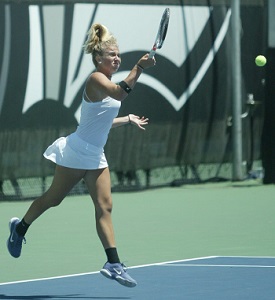
PHOTOS: (Top) Birmingham Seaholm’s Greta Albertie volleys while helping her team to an MHSAA title Saturday. (Middle) East Grand Rapids’ Sloane Teske rockets a return during her repeat run at No. 1 singles. (Click to see more from HighSchoolSportsScene.com.)