


Classes Still Create Hoosier Hysteria
July 27, 2017
By Rob Kaminski
MHSAA benchmarks editor
This is the fourth part in a series on MHSAA tournament classification, past and present, that will be published over the next two weeks. This series originally ran in this spring's edition of MHSAA benchmarks.
Twenty years ago, Bloomington North High School won the Indiana High School Athletic Association boys basketball championship, defeating Delta 75-54 at the RCA Dome in Indianapolis.
The date, March 22, 1997, is at the same time revered and disdained by traditionalists in the state who saw it as the last schoolboy championship game the state would ever host.
That’s how devout the game of basketball, particularly interscholastic basketball, had become in the Hoosier state during the 87 years a state champion – one state champion, to be precise – was crowned.
Following that 1997 season, the IHSAA moved to a four-class system for its roundball tournaments, like so many of its state association counterparts had done years earlier.
It would be shocking to find more than a small percentage of current high school basketball players around the country unfamiliar with the iconic movie Hoosiers, even though the film is now more than 30 years old.
And, the storyline for that blockbuster unfolded more than 30 years prior to its release, when small-town, undermanned Milan High School defeated Muncie Central High School 32-30 in the 1954 IHSAA title game.
Perhaps it’s because of the David vs Goliath notion, or the fame of the movie that replaced Milan with the fictional Hickory and real-life star Bobby Plump with Hollywood hero Jimmy Chitwood, or the simple fact that Indiana had something other states didn’t.
Whatever the reason, plenty of opposition remains to this day to basketball classification in the state.
The fact is, the small rural schools were regularly being beaten handily by the much larger suburban and city schools as the tournament progressed each season.
Small schools also were closing at a rapid rate following the state’s School Reorganization Act in 1959, as students converged on larger, centralized county schools. From 1960 to 2000, the number of schools entering the tournament dropped from 694 to 381, and in 1997 a total of 382 schools and 4,584 athletes began competition at the Sectional level (the first level of the IHSAA Basketball Tournament).
It was at the entry level of the tournament where school administrators felt the pain of the new class system, but not necessarily for the same nostalgic reasons as the fans who either attended or boycotted the tournament.
At the Sectional round of the tournament, the IHSAA was culling just 2 percent of the revenue, with the participating schools splitting the balance. So, when Sectional attendance dropped by 14 percent in that first year of class basketball, many schools realized a financial loss. It was money they had grown to count on in prior years to help fund various aspects of the department.
Schools cumulatively received more than $900,000 from Sectional competition in 1998, but that total was down from more than $1 million in the last year of the single-class tournament.
Yet, the current format provides a great deal more opportunity and realistic chances at championship runs for schools of all enrollments.
To date, 60 additional teams have championship or runner-up trophies on display in school trophy cases around Indiana.
That was the mission in front of then-IHSAA commissioner Bob Gardner (now National Federation executive director) once the board made its decision: to give thousands more student-athletes the opportunity for once-in-a-lifetime experiences.
As any statistician knows, figures can be manipulated to tell any side of a story. Declining attendance in year one of class basketball is such a number.
The truth is tournament attendance had been on a steady downward spiral since its peak of just over 1.5 million in 1962. By the last single-class event in 1997, the total attendance was half that.
The challenge then and today, as it is for all state associations, is to find that delicate balance for those holding onto tradition, those holding onto trophies, and the number of trophies to hand out.
Editor’s Note: Stories from the Fort Wayne Journal Gazette in 1998 and from a 2007 issue of Indianapolis Monthly provided facts in this article.
Hart, St. Charles Share Historic Finish
June 2, 2018
By Jeff Bleiler
Special for Second Half
COMSTOCK PARK – Put the Hart and St. Charles teams together, and you’d have had a runaway winner in the Lower Peninsula Division 3 Track & Field Finals on Saturday at Comstock Park.
Hart’s dominance in the distance events and St. Charles’ performances in the sprints would have made it difficult for any other team to challenge for the title.
As it was, each team’s strength countered the other to near perfection as Hart and St. Charles tied for the Division 3 championship with 46 points, earning both their first MHSAA Finals title in this sport.
They finished 10 points ahead of third-place Onsted, which closed the gap by placing fifth in the final event, the 1,600-meter relay. Neither Hart nor St. Charles fielded a team in that event, and Onsted entered it 14 points behind with only 10 available to the winner – so the championship had been decided before that last race even got started.
Both Hart and St. Charles’ coaches were pleased with the shared championship, the first time that’s happened in Division 3 since Laingsburg and Monroe St. Mary Catholic Central split the crown in 2003.
“We had an idea we’d have a chance if we used (junior) Adelyn (Ackley) in three events but didn’t know where she’d end up,” said Hart coach Mindy Whitney, who actually inserted Ackley into a fourth event, which proved critical.
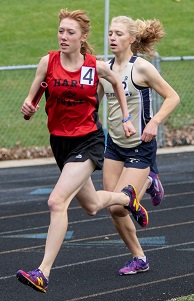
Ackley – who led the cross country team to the LPD3 title in the fall as well – won the 3,200 in 10 minutes, 45.54 seconds; finished runner-up in the 1,600 to Hanover-Horton’s Judy Rector; and placed sixth in the 800, all that after anchoring the winning 3,200 relay in the day’s first event. Alayna Ackley, her older sister, led off and sophomore Brenna Aerts and freshman MacKenzie Stitt filled the second and third slots, respectively, as the relay finished in 9:32.67.
Alayna Ackley also provided valuable points by placing third in the 3,200 despite coming back from a stress fracture injury just last month. The 3,200 was a boon of points for Hart, which picked up 20 in that event alone as the third Ackley sister, freshman Savannah, was fifth.
Whitney said her brother was keeping tabs on the team scoring but after the completion of the 3,200, she thought they came up a point short.
“I was very happy; it was a good day,” she said.
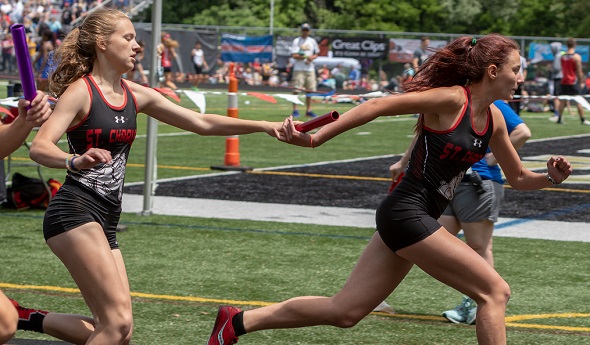
The same could be said for St. Charles, which did its damage in the sprints. Najiyah Holden did the most by winning the 200 in 25.61 seconds, finishing third in the 100 in 12.73 seconds and running the first leg of the winning 400 and 800 relays. The other members of the relays were freshman Hope Kushion and sophomores Erica Garcia and Celine Whiren.
Coach Andre Williams was especially pleased with the 800 relay team’s time of 1:44.97, which broke by three seconds the school record.
“I’m satisfied with (sharing the title),” he said. “After the 400 relay, I knew we had a shot. I told Najiyah she had a shot at winning the 200, and she did. We just don’t have any distance runners.”
 Sprinter Jenna Odykirk of Farwell put to rest previous struggles at the Finals by winning the 100, edging reigning champion Shiyon Taylor of Parchment by two hundredths of a second, and finishing runner-up in the 200.
Odykirk, who finished a disappointing 16th in the long jump, took solace with her finishes in the sprints after she missed the finals in 2017 in the 200 by one spot and was a distant 16th in the 100.
“I didn’t do too well in the long jump, but I had decent times in everything else,” said Odykirk, whose time of 12.63 seconds in the 100 was a personal best.
Odykirk, a junior, credited the improvement to off season indoor work at Saginaw Valley State University with coach Kyle Payne and outdoor work with Farwell coach Matt Horodyski.
“Next year, my goal is to be state champ in the 200 and the 100, do better in the long jump and run in the 400,” said Odykirk, who qualified this year for the 400 after finishing sixth in the event at last year’s Finals. She opted not to run it Saturday.
In the field events, the shot put provided some late fireworks as Beaverton senior Alicia Aldrich and Clinton’s Amanda Schaare put on quite a show.
In her final attempt with Aldrich on deck, and with the crowd slow clapping as she readied, Schaare heaved it 43 feet, 9¼ inches to move into first. The crowd gave Aldrich a similar slow clap, and she responded with a launch of 44 feet, 7½ inches to take the championship.
“I was like shaking a lot,” Aldrich said. “It feels really great. I wasn’t expecting that at all. The competition really makes you want to throw it farther. I got nervous when I saw Amanda throw it, but then I heard the atmosphere and it pumped me right up.”
Aldrich, who just started competing in shot put last year, will continue in the sport at SVSU.
The runner-up finish for Schaare was not a disappointment as she already had repeated as the discus champion. Schaare won with a toss of 128 feet, beating Sheridan Dinsmore of Caro by six inches.
“(Repeating) was awesome; I really wanted to do that for myself,” Schaare said. “Words just can’t describe it. It’s a feeling that not everyone gets to experience. I just have the greatest support system.”
Schaare’s runner-up put was a personal record, beating the 41-9 she posted early in the season.
“I didn’t finish first in the shot put, but I’m OK with that because with the discus, that would have been icing on the cake,” said Schaare, who will compete in track for the University of Michigan.
Marlette senior Emily Schaub swept the hurdles, winning the 100 hurdles in 15.01 seconds and taking the 300 in 46.96 seconds. She was third in the 100 hurdles a year ago and did not qualify for the 300 final after placing 15th in her 2017 preliminary.
Jackson Lumen Christi freshman Renae Kutcha won the 800 in 58.75 seconds, and Hanover-Horton’s Rector won the 1,600 in 4:52.59. Kutcha also led off the opening leg of Lumen Christi’s winning 1,600 relay team, joining junior Allison Rand, junior Marilyn Schonhard and senior Audrey Warriner with a finish in 4:01.9.
Boyne City senior Anna Harmeling won the pole vault in 11-6, Millington senior Hannah Hall won the high jump at 5-3 and Onsted senior Harlie Sweet won the long jump with a leap of 17-3½.
VIDEO: Holden On For A Bulldogs Co-Championship
PHOTOS: (Top) A pair of St. Charles runners execute a handoff during a relay Saturday. (Middle) Hart's Adelyn Ackley, left, stays a step ahead during one of her relays. (Photos by Annette Tipton. Click for more from RunMichigan.com.)