


Classes Still Create Hoosier Hysteria
July 27, 2017
By Rob Kaminski
MHSAA benchmarks editor
This is the fourth part in a series on MHSAA tournament classification, past and present, that will be published over the next two weeks. This series originally ran in this spring's edition of MHSAA benchmarks.
Twenty years ago, Bloomington North High School won the Indiana High School Athletic Association boys basketball championship, defeating Delta 75-54 at the RCA Dome in Indianapolis.
The date, March 22, 1997, is at the same time revered and disdained by traditionalists in the state who saw it as the last schoolboy championship game the state would ever host.
That’s how devout the game of basketball, particularly interscholastic basketball, had become in the Hoosier state during the 87 years a state champion – one state champion, to be precise – was crowned.
Following that 1997 season, the IHSAA moved to a four-class system for its roundball tournaments, like so many of its state association counterparts had done years earlier.
It would be shocking to find more than a small percentage of current high school basketball players around the country unfamiliar with the iconic movie Hoosiers, even though the film is now more than 30 years old.
And, the storyline for that blockbuster unfolded more than 30 years prior to its release, when small-town, undermanned Milan High School defeated Muncie Central High School 32-30 in the 1954 IHSAA title game.
Perhaps it’s because of the David vs Goliath notion, or the fame of the movie that replaced Milan with the fictional Hickory and real-life star Bobby Plump with Hollywood hero Jimmy Chitwood, or the simple fact that Indiana had something other states didn’t.
Whatever the reason, plenty of opposition remains to this day to basketball classification in the state.
The fact is, the small rural schools were regularly being beaten handily by the much larger suburban and city schools as the tournament progressed each season.
Small schools also were closing at a rapid rate following the state’s School Reorganization Act in 1959, as students converged on larger, centralized county schools. From 1960 to 2000, the number of schools entering the tournament dropped from 694 to 381, and in 1997 a total of 382 schools and 4,584 athletes began competition at the Sectional level (the first level of the IHSAA Basketball Tournament).
It was at the entry level of the tournament where school administrators felt the pain of the new class system, but not necessarily for the same nostalgic reasons as the fans who either attended or boycotted the tournament.
At the Sectional round of the tournament, the IHSAA was culling just 2 percent of the revenue, with the participating schools splitting the balance. So, when Sectional attendance dropped by 14 percent in that first year of class basketball, many schools realized a financial loss. It was money they had grown to count on in prior years to help fund various aspects of the department.
Schools cumulatively received more than $900,000 from Sectional competition in 1998, but that total was down from more than $1 million in the last year of the single-class tournament.
Yet, the current format provides a great deal more opportunity and realistic chances at championship runs for schools of all enrollments.
To date, 60 additional teams have championship or runner-up trophies on display in school trophy cases around Indiana.
That was the mission in front of then-IHSAA commissioner Bob Gardner (now National Federation executive director) once the board made its decision: to give thousands more student-athletes the opportunity for once-in-a-lifetime experiences.
As any statistician knows, figures can be manipulated to tell any side of a story. Declining attendance in year one of class basketball is such a number.
The truth is tournament attendance had been on a steady downward spiral since its peak of just over 1.5 million in 1962. By the last single-class event in 1997, the total attendance was half that.
The challenge then and today, as it is for all state associations, is to find that delicate balance for those holding onto tradition, those holding onto trophies, and the number of trophies to hand out.
Editor’s Note: Stories from the Fort Wayne Journal Gazette in 1998 and from a 2007 issue of Indianapolis Monthly provided facts in this article.
'Field & Track' Earns Falcons' Latest Title
By
Paul Costanzo
Special for MHSAA.com
June 2, 2018
EAST KENTWOOD – Dave Emeott is making some changes to his East Kentwood boys track & field team this summer.
After the Falcons’ field events put on a dominant display Saturday to lead the team to a second straight Lower Peninsula Division 1 championship, Emeott feels it’s time for a new name.
“Officially now, for at least one year, we’re going to be East Kentwood Field & Track from now on,” Emeott said. “Everything changes, the Twitter page, the Facebook page, T-shirts will be made. The field events guys took a lot of pride, and it was fun because those were the first events of the morning. We came out of the morning with 40 points, or whatever they ended up scoring.”
East Kentwood finished with 61 points, well ahead of second-place Ann Arbor Pioneer, which had 39. Saline and Grand Blanc tied for third with 37 points, while Rockford was fifth with 35.
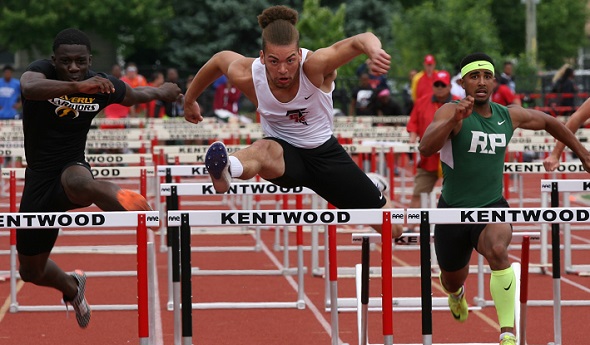
Logan Brown (shot put), Trevor Stephenson (pole vault) and Job Mayhue (110-meter hurdles) won individual titles for the Falcons, who have won seven of the last 10 team championships in the division. By the time Mayhue won the hurdles, the third running final of the day, his team already had 46 points, which would prove enough to clinch the title.
“When you look at where we won, it wasn’t just that we were overwhelmingly more talented than everybody; where the points were scored was in the technical events – shot put, long jump, pole vault – those three events alone we scored with seven guys in those events,” Emeott said. “Then the hurdles and the relays, that was really our day. It’s cool to do it in a different way.”
Stephenson’s pole vault title came after a head-to-head battle with Saline’s Eric Harris that featured multiple MHSAA Finals records. Stephenson won with a height of 16 feet, 9½ inches, a new all-division meet record. Harris took second at 16-6½, which also broke the previous record.
“I was surprised that I cleared that,” Stephenson said. “I was coming in thinking 16 feet might be the winning height, then Eric Harris from Saline just kept pushing the bar up and I just kept going with him. Eventually it got to 16-9½, and I just didn’t feel like it was there, and I got over and it was an amazing feeling.”
Mayhue won the hurdles with a time of 13.99 seconds, while Brown won the shot put with a throw of 57-1½.
Rockford’s Cole Johnson pulled off an impressive double in the 800 and 1,600, winning both with strong finishes. In the 800, he ran past a tight pack in the final 50 meters to win in 1:53.11, edging out Ann Arbor Pioneer’s Netunji Paige who finished in 1:53.41.
In the 1,600, Johnson took an early lead, then had to surge over the final lap to overtake a strong field and win in 4:08.47, less than two tenths of a second ahead of Pioneer’s Nick Foster who was second in 4:08.64.
 “My race plan in the beginning (of the 1,600) was to try and push the pace to try and beat our school record held by Dathan Ritzenhein, a 4:05.9,” Johnson said. “The first lap, I knew I was going to go out fast, and I just tried to keep pushing it the second and third lap, but I fell off a little bit. Then the race plan was just kind of holding form a little bit that last lap to try and get the win. I found a lot of energy from all the people supporting me and all the fans; it is packed here today. Winning the mile in Michigan is very prestigious, so that’s kind of what kept me going as I got passed on that last lap.”
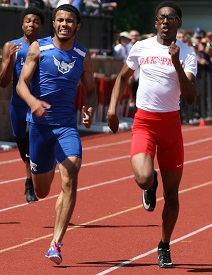
Oak Park’s Donnie James pulled off a double of his own, and was four hundredths of a second away from pulling off a triple. James ran 47.14 to hold off a strong field in the 400 meters, and 21.2 to squeak out a win in the 200. He finished second in the 100 with a time of 10.7, just edged by Eric Labonte of Traverse City West, who won in 10.66 seconds.
In the 400, James won from an outside lane, holding off charges from Saginaw Heritage’s Marcus Montgomery (47.65) and Ypsilanti Lincoln’s Matthew Moorer (47.79), who were chasing him from the inside.
“I had that mentality that I know I had to run at full speed because I had Matthew Moorer and Montgomery (behind me),” James said. “It was a lot of competition during that time, so I had to get my head geeked because I knew I had to run this to get first place for our team. My coach said catch the dude off the turn and to just run it like you did indoors.”
Lansing Waverly’s Keshaun Harris won the 300 hurdles in 37.81 seconds. Pioneer’s Foster won the 3,200 in 9:07.93. Grand Blanc’s Aidan Martini won the discus with a throw of 167-2. Traverse City Central’s Cassidy Henshaw won the high jump with a height of 6-9. West Bloomfield’s AJ Abbott won the long jump with a distance of 23-7¼.
Ann Arbor Pioneer (Foster, Paige, Aldo Pando-Girard and John Florence) won the 3,200 relay in 7:45.64. Detroit Martin Luther King (Jaeveyon Morton, Dylan Brown, Dequan Finn and Jalen McGaughy) won the 800 relay in 1:26.74. Farmington Hills Harrison (Moet Andrews, Alfred Hollie, Joe Stevens and Ben Williams) won the 400 relay out of the second heat with a time of 42.39. Grand Blanc (Austin Rippee, Victor Zarour, Jo Coleman and Jeronn Body) won the 1,600 relay in 3:20.48.
PHOTOS: (Top) East Kentwood’s Job Mayhue, middle, hurdles to the lead on the way to winning the 110 race. (Middle) Oak Park’s Donnie James, right, holds off Ypsilanti Lincoln’s Matthew Moorer in the 200. (Click for more from RunMichigan.com.)