


Classes Still Create Hoosier Hysteria
July 27, 2017
By Rob Kaminski
MHSAA benchmarks editor
This is the fourth part in a series on MHSAA tournament classification, past and present, that will be published over the next two weeks. This series originally ran in this spring's edition of MHSAA benchmarks.
Twenty years ago, Bloomington North High School won the Indiana High School Athletic Association boys basketball championship, defeating Delta 75-54 at the RCA Dome in Indianapolis.
The date, March 22, 1997, is at the same time revered and disdained by traditionalists in the state who saw it as the last schoolboy championship game the state would ever host.
That’s how devout the game of basketball, particularly interscholastic basketball, had become in the Hoosier state during the 87 years a state champion – one state champion, to be precise – was crowned.
Following that 1997 season, the IHSAA moved to a four-class system for its roundball tournaments, like so many of its state association counterparts had done years earlier.
It would be shocking to find more than a small percentage of current high school basketball players around the country unfamiliar with the iconic movie Hoosiers, even though the film is now more than 30 years old.
And, the storyline for that blockbuster unfolded more than 30 years prior to its release, when small-town, undermanned Milan High School defeated Muncie Central High School 32-30 in the 1954 IHSAA title game.
Perhaps it’s because of the David vs Goliath notion, or the fame of the movie that replaced Milan with the fictional Hickory and real-life star Bobby Plump with Hollywood hero Jimmy Chitwood, or the simple fact that Indiana had something other states didn’t.
Whatever the reason, plenty of opposition remains to this day to basketball classification in the state.
The fact is, the small rural schools were regularly being beaten handily by the much larger suburban and city schools as the tournament progressed each season.
Small schools also were closing at a rapid rate following the state’s School Reorganization Act in 1959, as students converged on larger, centralized county schools. From 1960 to 2000, the number of schools entering the tournament dropped from 694 to 381, and in 1997 a total of 382 schools and 4,584 athletes began competition at the Sectional level (the first level of the IHSAA Basketball Tournament).
It was at the entry level of the tournament where school administrators felt the pain of the new class system, but not necessarily for the same nostalgic reasons as the fans who either attended or boycotted the tournament.
At the Sectional round of the tournament, the IHSAA was culling just 2 percent of the revenue, with the participating schools splitting the balance. So, when Sectional attendance dropped by 14 percent in that first year of class basketball, many schools realized a financial loss. It was money they had grown to count on in prior years to help fund various aspects of the department.
Schools cumulatively received more than $900,000 from Sectional competition in 1998, but that total was down from more than $1 million in the last year of the single-class tournament.
Yet, the current format provides a great deal more opportunity and realistic chances at championship runs for schools of all enrollments.
To date, 60 additional teams have championship or runner-up trophies on display in school trophy cases around Indiana.
That was the mission in front of then-IHSAA commissioner Bob Gardner (now National Federation executive director) once the board made its decision: to give thousands more student-athletes the opportunity for once-in-a-lifetime experiences.
As any statistician knows, figures can be manipulated to tell any side of a story. Declining attendance in year one of class basketball is such a number.
The truth is tournament attendance had been on a steady downward spiral since its peak of just over 1.5 million in 1962. By the last single-class event in 1997, the total attendance was half that.
The challenge then and today, as it is for all state associations, is to find that delicate balance for those holding onto tradition, those holding onto trophies, and the number of trophies to hand out.
Editor’s Note: Stories from the Fort Wayne Journal Gazette in 1998 and from a 2007 issue of Indianapolis Monthly provided facts in this article.
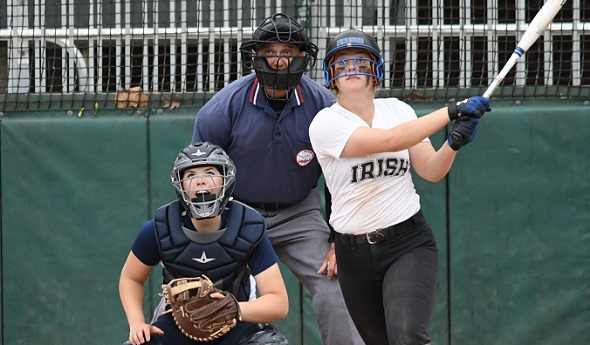
Powerful Kennedy Surges Into HR Chase
May 25, 2018
By Doug Donnelly
Special for Second Half
ANN ARBOR – Julia Kennedy isn’t worried about whether or not she finishes as the all-time home run leader in Michigan prep softball history. While it’s been a lot of fun chasing the top rung on the ladder, Kennedy has tried not to focus on hitting the long ball.
 There’s no better example of that reality when, in a game earlier this season, Kennedy, a senior first baseman for Ann Arbor Father Gabriel Richard, took a look at the defense and noticed the first baseman and third basemen playing almost on the outfield grass – figuring she was going to pound the ball. She laid down a bunt instead.
“I try and be a leader,” Kennedy said. “The defense was playing me so far back. I just went up there thinking I needed to advance the runner. I wanted to show everybody that I could put the bunt down. I think people were shocked, even my coach.”
The runner did move up a base, but Kennedy found herself in a bit of hot water with her coach, Nicole Lenhoff.
“We were playing Cabrini, and we were down a run,” Lenhoff said. “I had been telling the girls that if you have the opportunity and they are playing deep, you have to lay the bunt down once in a while to keep them off guard.
“When she did it, I think I yelled at her. We had a talk later about the situation and her being a power hitter, and I told her not to do that in that situation again. But, that’s who she is. She is all about the team.”
Kennedy, 18, has already committed to playing college softball at Miami of Ohio. Heading into this weekend, she has 50 career home runs, putting her in a tight chase with Muskegon Mona Shores’ Taylor Dew, who reached 50 on May 16. Both girls have passed the co-record holders in Michigan career prep softball home runs heading into this season – Erika Underwood of Addison (2012-15) and Taylor Johnson from Belding (2007-10), who both hit 49. Underwood is currently playing for Central Michigan and is likely to play against Kennedy next season in Mid-American Conference play.
Kennedy said she’s always been a power hitter.
“Even when I was young, I could hit the ball pretty far,” she said.
It was when she started working with hitting coach Amanda Chidester, a former Cabrini star and college All-American, that she saw her power turn line drives and fly balls into fence-clearing home runs.
“It was insane how much better I became at hitting,” she said. “I made some adjustments in my swing and with my legs. I had no idea what I was doing. I became much more consistent in hitting. It took some time to put it all together.”
 Kennedy hit seven home runs as a freshman, slugged 18 as a sophomore and had eight as a junior. She has 17 so far this season.
As a junior Kennedy played two sports in the spring, juggling soccer and softball. She’s focused on softball this year and that has made her a better player on the diamond, her coach said.
“She doesn’t like me saying so, but I think it has made her better,” Lenhoff said. “She’s more focused. There were times where she would be heading to a soccer game or coming from practice right to softball. She was just a little distracted. She’s always had the ability.”
Kennedy bats second in the Fighting Irish lineup, a move that Lenhoff made last year in an effort to get the slugger more at-bats and to help prevent the opposition from just pitching around her. With the No. 3 and No. 4 hitters coming up after her, it makes it more difficult for a team to intentionally walk Kennedy, Lenhoff said.
Kennedy is fine with taking a walk if it helps the team. But she also has more than 40 RBI and hits for a high average.
“I try not to think about the home runs or hitting a home run,” she said. “When I think about it, that’s when it seems I don’t hit as well. When I’m up to bat, I’m just thinking about advancing the runner or getting on base or just making contact.”
Julia is the daughter of David and Julianne Kennedy. Her father was a softball umpire when she was younger, and one of her brothers played baseball. She picked up his sport, mainly playing baseball at first.
“I didn’t play softball until I was like 10,” she said. “I learned to play by playing baseball.”
When she does make contact, and she knows the ball will be sailing over the outfield fence, Kennedy admits she gets a special feeling in her stomach.
“Oh, it is such an adrenaline rush,” she said. “The feeling when you hit that sweet spot with the bat is unbelievable. I just love it.”
 Doug Donnelly has served as a sports and news reporter and city editor over 25 years, writing for the Daily Chief-Union in Upper Sandusky, Ohio from 1992-1995, the Monroe Evening News from 1995-2012 and the Adrian Daily Telegram since 2013. He's also written a book on high school basketball in Monroe County and compiles record books for various schools in southeast Michigan. E-mail him at [email protected] with story ideas for Lenawee and Monroe counties.
PHOTOS: (Top) All eyes are on a drive by Gabriel Richard’s Julia Kennedy this season. (Middle) Kennedy puts a charge into another swing this spring. (Photos courtesy of the Ann Arbor Father Gabriel Richard softball program.)