


Classes Still Create Hoosier Hysteria
July 27, 2017
By Rob Kaminski
MHSAA benchmarks editor
This is the fourth part in a series on MHSAA tournament classification, past and present, that will be published over the next two weeks. This series originally ran in this spring's edition of MHSAA benchmarks.
Twenty years ago, Bloomington North High School won the Indiana High School Athletic Association boys basketball championship, defeating Delta 75-54 at the RCA Dome in Indianapolis.
The date, March 22, 1997, is at the same time revered and disdained by traditionalists in the state who saw it as the last schoolboy championship game the state would ever host.
That’s how devout the game of basketball, particularly interscholastic basketball, had become in the Hoosier state during the 87 years a state champion – one state champion, to be precise – was crowned.
Following that 1997 season, the IHSAA moved to a four-class system for its roundball tournaments, like so many of its state association counterparts had done years earlier.
It would be shocking to find more than a small percentage of current high school basketball players around the country unfamiliar with the iconic movie Hoosiers, even though the film is now more than 30 years old.
And, the storyline for that blockbuster unfolded more than 30 years prior to its release, when small-town, undermanned Milan High School defeated Muncie Central High School 32-30 in the 1954 IHSAA title game.
Perhaps it’s because of the David vs Goliath notion, or the fame of the movie that replaced Milan with the fictional Hickory and real-life star Bobby Plump with Hollywood hero Jimmy Chitwood, or the simple fact that Indiana had something other states didn’t.
Whatever the reason, plenty of opposition remains to this day to basketball classification in the state.
The fact is, the small rural schools were regularly being beaten handily by the much larger suburban and city schools as the tournament progressed each season.
Small schools also were closing at a rapid rate following the state’s School Reorganization Act in 1959, as students converged on larger, centralized county schools. From 1960 to 2000, the number of schools entering the tournament dropped from 694 to 381, and in 1997 a total of 382 schools and 4,584 athletes began competition at the Sectional level (the first level of the IHSAA Basketball Tournament).
It was at the entry level of the tournament where school administrators felt the pain of the new class system, but not necessarily for the same nostalgic reasons as the fans who either attended or boycotted the tournament.
At the Sectional round of the tournament, the IHSAA was culling just 2 percent of the revenue, with the participating schools splitting the balance. So, when Sectional attendance dropped by 14 percent in that first year of class basketball, many schools realized a financial loss. It was money they had grown to count on in prior years to help fund various aspects of the department.
Schools cumulatively received more than $900,000 from Sectional competition in 1998, but that total was down from more than $1 million in the last year of the single-class tournament.
Yet, the current format provides a great deal more opportunity and realistic chances at championship runs for schools of all enrollments.
To date, 60 additional teams have championship or runner-up trophies on display in school trophy cases around Indiana.
That was the mission in front of then-IHSAA commissioner Bob Gardner (now National Federation executive director) once the board made its decision: to give thousands more student-athletes the opportunity for once-in-a-lifetime experiences.
As any statistician knows, figures can be manipulated to tell any side of a story. Declining attendance in year one of class basketball is such a number.
The truth is tournament attendance had been on a steady downward spiral since its peak of just over 1.5 million in 1962. By the last single-class event in 1997, the total attendance was half that.
The challenge then and today, as it is for all state associations, is to find that delicate balance for those holding onto tradition, those holding onto trophies, and the number of trophies to hand out.
Editor’s Note: Stories from the Fort Wayne Journal Gazette in 1998 and from a 2007 issue of Indianapolis Monthly provided facts in this article.
Wilkinson Capping Record-Blazing Career
May 17, 2018
By Dennis Chase
Special for Second Half
KALKASKA – Rik Ponstein cuts to the chase when he talks about senior pitcher-centerfielder Makenzie Wilkinson.
 “She’s probably the best player I’ve ever coached,” he said.
It’s a telling statement considering Ponstein is in his 34th season coaching softball and – prior to Thursday’s doubleheader with Boyne City – is 11 wins shy of 700 in his career.
He’s coached several good teams, several good players.
Wilkinson pauses, searching for the right words, to respond to her coach’s assessment.
“That’s an honor,” the soon-to-be 18-year-old said. “It amazes me, really.”
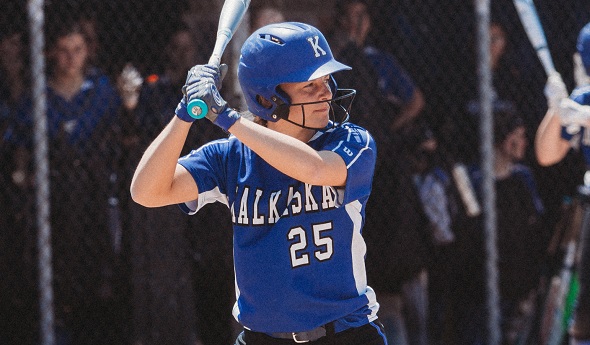
Wilkinson is on the verge of becoming the school’s Female Athlete of the Year for the fourth time – the first time that’s happened here.
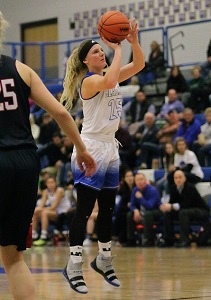
In basketball, the 5-foot-8 Wilkinson is a two-time all-state player and holds the school record in rebounds (696) and blocks (153). She tied the school mark for 3-pointers in a game (eight) and is fourth all-time in scoring (1,417 points).
In softball, she owns most of the school records, or will by the time the season ends.
“She’s a great competitor,” Dave Dalton, the longtime girls basketball coach, said. “She’s extremely skilled in both sports.”
The Blazers are currently 24-1 in softball, earning an honorable mention in this week’s Division 2 coaches poll.
It’s a veteran team; only two starters graduated off last year’s 37-5 squad that lost to Muskegon Oakridge in the Regionals.
Wilkinson, pitcher-shortstop MaKenzie Leach and rightfielder Taylor Kooistra are the leaders – four-year starters who have paced Kalkaska to a 125-23 record during that span. Wilkinson (60-15) and Leach (58-8) have been the winning pitchers in 118 of those triumphs.
“All three are outstanding,” Ponstein said. “They have melded together to help make this a very good team.”
On the mound, Wilkinson (12-1) and Leach (11-0) provide a formidable combination.
 “They’re different type of pitchers,” Ponstein said. “Makenzie Wilkinson is a power pitcher (441 career strikeouts) with a curve. MaKenzie Leach is more of a control pitcher with a good changeup. She’s only walked 70 batters in her career, just four this season. What’s made Makenzie Wilkinson tougher this year is that she’s only walked nine. I tell the girls if you don’t walk them, your teammates will make the plays behind you. The one time we didn’t make the plays, we lost. For the most part, though, we make the plays.”
At the plate, Wilkinson is hitting .545, Kooistra .529 and Leach .475. Wilkinson’s belted six home runs, Kooistra five. They rank one-two on the school’s career list for home runs with 29 and 17, respectively.
The trio are joined in the lineup by Angela Iott at first, Kayla Cavanaugh at second, Jaime Potter at third, Kayleigh Bunker in left and Ayla Gustafson behind the plate. Loren Schwab rotates between shortstop and centerfield, depending on who’s pitching. All are juniors, except Bunker, a senior.
“We’re experienced,” Wilkinson said. “We’ve been around each other a long time. We play well together.”
As for Wilkinson, she comes from an athletic family. Her father, Jeremy, was a football standout at Northern Michigan University and later inducted into the school’s Hall of Fame. He also served as Kalkaska’s football coach until stepping down last November. Makenzie’s mother, Cheri, was a four-sport standout (volleyball, basketball, softball and track) at Kalkaska, She played softball for Ponstein and JV basketball for Dalton. She ran track only her sophomore year, but set the school record in the 400 meters.
“Growing up they always taught me to go all out, give your best every second,” Makenzie said. “Mom always says that the sky’s the limit, to always put forth the effort and put in the extra time.”
“We had lots of conversations about that when she was in middle school,” Cheri said, laughing. “We knew she had gifts (athletically). We knew if she put in the time that later in life it would help her. Now, looking back, she realizes that and has thanked us for pushing her to work hard because it’s paid off.”
Wilkinson has signed to attend school and play basketball at Davenport University, which just transitioned to NCAA Division II. She’s also hoping to play softball.
Softball might be her best sport – and the one she thought she would play in college – but she did not receive many recruiting looks.
“It was a rough road,” Makenzie said. “Nothing really happened.
“It just didn’t pan out,” Cheri added. “Then, Rick Albro (Davenport’s women’s basketball coach) showed interest, and she connected with him. It fell into place. She’s still going to play travel softball this summer. She’s still trying to get her foot in the door at Davenport for softball. She’s been in contact with the coach. If it doesn’t work out, it doesn’t work out. She’s ready to play basketball. That’s her No. 1 priority.”
There’s a twist to the story. Jeremy Wilkinson is originally from Marlette, and that was one of the first stops on Albro’s coaching journey. Albro coached boys basketball at Marlette from 1974-78.
It promises to be a busy summer for Makenzie. In addition to playing travel softball with the Alpena Mystics, Wilkinson will be taking online classes through Davenport and working on her basketball skills, and lifting, almost daily. She’s currently working with coaches Chuck and Travis Schuba, who both played collegiately.
“I’m trying to get ready for the college level,” she said, “coming off screens quicker, shooting quicker, getting up to the speed of the game.”
Oh, by the way, she’s also working on a construction crew.
If she needs advice about playing at the next level, she can turn to her father.
“(Jeremy) knows what it takes to be a college athlete, and he’s already told her that you have to be ready or it’s going to be a tough road,” Cheri said. “He trained all the time when he was in school and during the summers. He was a kid who didn’t get a lot of attention, but he put the time in and succeeded.”
This past winter, Wilkinson led a small, inexperienced Blazers basketball team to a 17-6 record. She averaged 20.1 points, 9.8 rebounds and 4.4 steals a game.
 “I was surprised,” she admitted. “We did pretty well. I was proud of our team.”
The Blazers were ousted in the District by Kingsley, which reached the Class B Semifinals.
Wilkinson was Kalkaska’s go-to player.
“She has an incredible motor and knowledge (of the game),” Dalton said. “She’s strong, she’s fast, she’s super coordinated.”
The Blazers went 78-15 in her four years on varsity, winning three Districts and two Lake Michigan Conference crowns.
As a junior, she was selected to the Detroit Free Press Dream Team.
But those accolades do not define her.
“It’s not all about the recognition,” she said. “I’m not really a person who’s out there about my accomplishments. To me, it’s about giving it your all and having the heart to play.”
Cheri agrees.
“She’s a humble kid, very even-keeled,” she said. “She doesn’t let (awards) go to her head. She’s just a calm kid, who doesn’t talk much.”
Makenzie lets her determined play on the court and field do the talking.
Away from the action, she’s a member of the National Honor Society and in the fall was selected Homecoming queen.
“The students like her and respect her,” Dalton said.
“She’s not a cocky kid,” Cheri said. “She mingles with all the different cliques. She’s a very open kid. I really admire her for that. We’ve always told our kids to stand up for others.”
Right now, she’s having a little problem standing and moving around. She dropped a 25-pound weight on her foot during lifting class Tuesday. X-rays revealed that no bones were broken or fractured, but the foot is swollen and bruised.
“I was putting weight on the squat bar,” she said. “I put a 45 on – I was lucky I didn’t drop that one on my foot – and I went to grab the 25-pound weight off the rack to put on the barbell when I dropped it. I’m just glad it’s not broken or fractured. I’ll be ready to play later this week.”
Ponstein, meanwhile, has always set similar goals for his teams every season – win at least 20 games, and capture conference and District titles. This season, with a veteran cast returning, he added a Regional crown to the mix. The Blazers have never won a Regional under Ponstein.
If the rankings hold, that Regional in Gaylord could include No. 2 Escanaba and No. 8 Oakridge.
What would it mean to break the drought and win a Regional?
“It would be beyond exciting,” Wilkinson said. “It’s a new level when you get into Regionals. To be able to win at that level would be amazing.”
Time will soon tell.
 Dennis Chase worked 32 years as a sportswriter at the Traverse City Record-Eagle, including as sports editor from 2000-14. He can be reached at [email protected] with story ideas for Manistee, Wexford, Missaukee, Roscommon, Ogemaw, Iosco, Alcona, Oscoda, Crawford, Kalkaska, Grand Traverse, Benzie, Leelanau, Antrim, Otsego, Montmorency, Alpena, Presque Isle, Cheboygan, Charlevoix and Emmet counties.
PHOTOS: (Top) Kalkaska’s Makenzie Wilkinson stands in during an at bat this season. (Middle) Wilkinson pulls up for a jumpshot this past winter. (Softball photo by Capture Me Photography; head shot by Patricia Golden; basketball photo by RD Sports Photo.)