


Classes Still Create Hoosier Hysteria
July 27, 2017
By Rob Kaminski
MHSAA benchmarks editor
This is the fourth part in a series on MHSAA tournament classification, past and present, that will be published over the next two weeks. This series originally ran in this spring's edition of MHSAA benchmarks.
Twenty years ago, Bloomington North High School won the Indiana High School Athletic Association boys basketball championship, defeating Delta 75-54 at the RCA Dome in Indianapolis.
The date, March 22, 1997, is at the same time revered and disdained by traditionalists in the state who saw it as the last schoolboy championship game the state would ever host.
That’s how devout the game of basketball, particularly interscholastic basketball, had become in the Hoosier state during the 87 years a state champion – one state champion, to be precise – was crowned.
Following that 1997 season, the IHSAA moved to a four-class system for its roundball tournaments, like so many of its state association counterparts had done years earlier.
It would be shocking to find more than a small percentage of current high school basketball players around the country unfamiliar with the iconic movie Hoosiers, even though the film is now more than 30 years old.
And, the storyline for that blockbuster unfolded more than 30 years prior to its release, when small-town, undermanned Milan High School defeated Muncie Central High School 32-30 in the 1954 IHSAA title game.
Perhaps it’s because of the David vs Goliath notion, or the fame of the movie that replaced Milan with the fictional Hickory and real-life star Bobby Plump with Hollywood hero Jimmy Chitwood, or the simple fact that Indiana had something other states didn’t.
Whatever the reason, plenty of opposition remains to this day to basketball classification in the state.
The fact is, the small rural schools were regularly being beaten handily by the much larger suburban and city schools as the tournament progressed each season.
Small schools also were closing at a rapid rate following the state’s School Reorganization Act in 1959, as students converged on larger, centralized county schools. From 1960 to 2000, the number of schools entering the tournament dropped from 694 to 381, and in 1997 a total of 382 schools and 4,584 athletes began competition at the Sectional level (the first level of the IHSAA Basketball Tournament).
It was at the entry level of the tournament where school administrators felt the pain of the new class system, but not necessarily for the same nostalgic reasons as the fans who either attended or boycotted the tournament.
At the Sectional round of the tournament, the IHSAA was culling just 2 percent of the revenue, with the participating schools splitting the balance. So, when Sectional attendance dropped by 14 percent in that first year of class basketball, many schools realized a financial loss. It was money they had grown to count on in prior years to help fund various aspects of the department.
Schools cumulatively received more than $900,000 from Sectional competition in 1998, but that total was down from more than $1 million in the last year of the single-class tournament.
Yet, the current format provides a great deal more opportunity and realistic chances at championship runs for schools of all enrollments.
To date, 60 additional teams have championship or runner-up trophies on display in school trophy cases around Indiana.
That was the mission in front of then-IHSAA commissioner Bob Gardner (now National Federation executive director) once the board made its decision: to give thousands more student-athletes the opportunity for once-in-a-lifetime experiences.
As any statistician knows, figures can be manipulated to tell any side of a story. Declining attendance in year one of class basketball is such a number.
The truth is tournament attendance had been on a steady downward spiral since its peak of just over 1.5 million in 1962. By the last single-class event in 1997, the total attendance was half that.
The challenge then and today, as it is for all state associations, is to find that delicate balance for those holding onto tradition, those holding onto trophies, and the number of trophies to hand out.
Editor’s Note: Stories from the Fort Wayne Journal Gazette in 1998 and from a 2007 issue of Indianapolis Monthly provided facts in this article.
Tyler Meets Challenges, Aims for Final Goal
May 9, 2018
By Tom Kendra
Special for Second Half
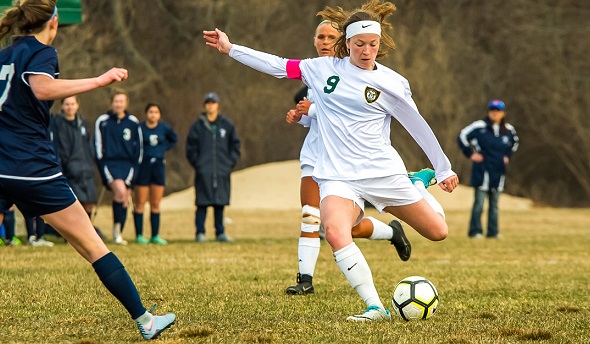
Talia Tyler has showed her competitive fire, really, since birth. But one really good example of how occurred when she was 6 years old.
 She had just scored a bunch of goals in a youth game and her father, Jim – partially to keep her humble and partially to be the smart-aleck that he is – quipped to her tongue-in-cheek:
“Too bad you didn’t score any with your left foot.”
Later that day, little Talia was out in the yard with her soccer ball, shooting exclusively with her left foot. The next game, she scored all of her goals with her left foot, each time followed immediately by a glare to her father on the sidelines.
“I always try to challenge myself, in school and in sports, to be the best that I can,” explained Tyler, whose constant striving – not to mention her speed and smarts – has landed her a spot on the women’s soccer team at Columbia University, a Division I school in the Ivy League, located in New York City.
The immediate challenge for Tyler, the senior striker and leader of the Muskegon Catholic Central girls soccer team, and her teammates is to try and improve on last year’s run to the MHSAA Division 4 Semifinals – which capped the best season in school history.
Muskegon Catholic, which is 8-1 overall and a perfect 4-0 in the Lakes 8 Athletic Conference this spring, lost just three seniors off last year’s team which won the school’s first-ever girls soccer Regional title before bowing 2-0 to Kalamazoo Christian in the Semifinals.
Led by Tyler, the Crusaders have made winning the Division 4 championship their No. 1 goal this year.
Tyler, who has six goals and three assists so far, is joined up front by senior Lauren Doriot (who currently leads the team with seven goals), freshman standout Emily Olsen, sophomores Caitlyn Fodrocy and Payton Helton and junior A’lahna Cherry.
Kyra Tyler, a junior and Talia’s younger sister and the last of four standout Tyler athletes at MCC, is the top defender for the Crusaders – along with seniors Kasia Gasior, Roxy Hubl and Zoie Price, who is currently sidelined with a leg injury.
The final line of defense is one of the state’s best keepers in senior Isabelle Bertolone, although she rarely gets to show her ability in regular-season games as the Crusaders normally keep most of the action on the opposite side of the midfield stripe.
“We are loaded enough that we should make another run,” said second-year MCC coach Art Dorsey, who was notably frustrated after a narrow 2-0 victory Monday over conference rival Muskegon Orchard View. “We should be playing much better than we are. We need a little more hunger, a little more sense of urgency.”
Dorsey knows one of the biggest challenges in the entire state is just a few miles away in North Muskegon, which is undefeated and on a District collision course with MCC.
 Tyler said the key to winning games in the postseason is mental.
“Girls soccer really comes down to which team shows up focused and ready,” said Tyler, who has served as her class president for the past three years. “Really, one of the biggest keys for us is staying healthy. We will keep working on it and getting better.”
Tyler’s tenacity and grit shines through in key moments in big games, but the first thing everyone notices about the 5-foot-6 senior is her speed.
Tyler is so fast that in her sophomore and junior years she ran track in the spring, in addition to her soccer. In her sophomore year, she finished eighth in the 200 meters at the Lower Peninsula Division 4 Finals. In her junior year, she qualified for the Finals in four events, but had to miss the meet to play in the Crusaders’ soccer District championship game.
Instead of on the track, Tyler used that speed throughout the tournament to make runs down the edges of the field and put major pressure on defenders. She finished her junior year with more than 20 goals and 20 assists.
“Talia has a complete skill set, and that’s what makes her the best soccer player ever at this school,” said Dorsey. “She can turn it on and get up to her top speed so quickly that it catches defenders off-guard. Then she is smart enough to make the right decisions going to the goal.”
Smarts is another trait that runs through the Tyler family. Talia’s older brother, Ian, plays football at Columbia and her older sister, Annika, is a club soccer player at the University of San Diego.
Talia has maintained a 3.85 grade-point average while taking a steady diet of AP classes and being a four-year varsity starter in both basketball and soccer. She also has racked up more than 200 service hours during high school, many on spring break mission trips.
Her final intangible, which she first displayed as the starting point guard on MCC’s varsity basketball team four years ago as a freshman, is leadership. On a team with plenty of young talent, Tyler is the veteran the other girls look to in crucial situations.
“Looking back to freshman year and everything that we’ve been through together, it’s kind of surreal that now it’s just down to this final sport and this final season,” Tyler said. “It’s great getting this chance to play with my friends and see if we can really leave our mark. That’s our goal.”
 Tom Kendra worked 23 years at The Muskegon Chronicle, including five as assistant sports editor and the final six as sports editor through 2011. E-mail him at [email protected] with story ideas for Muskegon, Oceana, Mason, Lake, Oceola, Mecosta and Newaygo counties.
PHOTOS: (Top) Muskegon Catholic Central’s Talia Tyler (9) winds up to send the ball downfield during a game this spring. (Middle) Tyler (3) charges ahead during her heat of the 200 at the 2016 MHSAA Lower Peninsula Division 4 Finals. (Photos courtesy of Kristine Tyler.)