


Classes Still Create Hoosier Hysteria
July 27, 2017
By Rob Kaminski
MHSAA benchmarks editor
This is the fourth part in a series on MHSAA tournament classification, past and present, that will be published over the next two weeks. This series originally ran in this spring's edition of MHSAA benchmarks.
Twenty years ago, Bloomington North High School won the Indiana High School Athletic Association boys basketball championship, defeating Delta 75-54 at the RCA Dome in Indianapolis.
The date, March 22, 1997, is at the same time revered and disdained by traditionalists in the state who saw it as the last schoolboy championship game the state would ever host.
That’s how devout the game of basketball, particularly interscholastic basketball, had become in the Hoosier state during the 87 years a state champion – one state champion, to be precise – was crowned.
Following that 1997 season, the IHSAA moved to a four-class system for its roundball tournaments, like so many of its state association counterparts had done years earlier.
It would be shocking to find more than a small percentage of current high school basketball players around the country unfamiliar with the iconic movie Hoosiers, even though the film is now more than 30 years old.
And, the storyline for that blockbuster unfolded more than 30 years prior to its release, when small-town, undermanned Milan High School defeated Muncie Central High School 32-30 in the 1954 IHSAA title game.
Perhaps it’s because of the David vs Goliath notion, or the fame of the movie that replaced Milan with the fictional Hickory and real-life star Bobby Plump with Hollywood hero Jimmy Chitwood, or the simple fact that Indiana had something other states didn’t.
Whatever the reason, plenty of opposition remains to this day to basketball classification in the state.
The fact is, the small rural schools were regularly being beaten handily by the much larger suburban and city schools as the tournament progressed each season.
Small schools also were closing at a rapid rate following the state’s School Reorganization Act in 1959, as students converged on larger, centralized county schools. From 1960 to 2000, the number of schools entering the tournament dropped from 694 to 381, and in 1997 a total of 382 schools and 4,584 athletes began competition at the Sectional level (the first level of the IHSAA Basketball Tournament).
It was at the entry level of the tournament where school administrators felt the pain of the new class system, but not necessarily for the same nostalgic reasons as the fans who either attended or boycotted the tournament.
At the Sectional round of the tournament, the IHSAA was culling just 2 percent of the revenue, with the participating schools splitting the balance. So, when Sectional attendance dropped by 14 percent in that first year of class basketball, many schools realized a financial loss. It was money they had grown to count on in prior years to help fund various aspects of the department.
Schools cumulatively received more than $900,000 from Sectional competition in 1998, but that total was down from more than $1 million in the last year of the single-class tournament.
Yet, the current format provides a great deal more opportunity and realistic chances at championship runs for schools of all enrollments.
To date, 60 additional teams have championship or runner-up trophies on display in school trophy cases around Indiana.
That was the mission in front of then-IHSAA commissioner Bob Gardner (now National Federation executive director) once the board made its decision: to give thousands more student-athletes the opportunity for once-in-a-lifetime experiences.
As any statistician knows, figures can be manipulated to tell any side of a story. Declining attendance in year one of class basketball is such a number.
The truth is tournament attendance had been on a steady downward spiral since its peak of just over 1.5 million in 1962. By the last single-class event in 1997, the total attendance was half that.
The challenge then and today, as it is for all state associations, is to find that delicate balance for those holding onto tradition, those holding onto trophies, and the number of trophies to hand out.
Editor’s Note: Stories from the Fort Wayne Journal Gazette in 1998 and from a 2007 issue of Indianapolis Monthly provided facts in this article.
Not Just Another Season for Watson
May 3, 2018
By Cody Porter
NFHS High School Today
A 32-second response by emergency medical technicians was the difference in life or death for 68-year-old Willie Watson, who was spared from becoming another victim of sudden cardiac arrest.
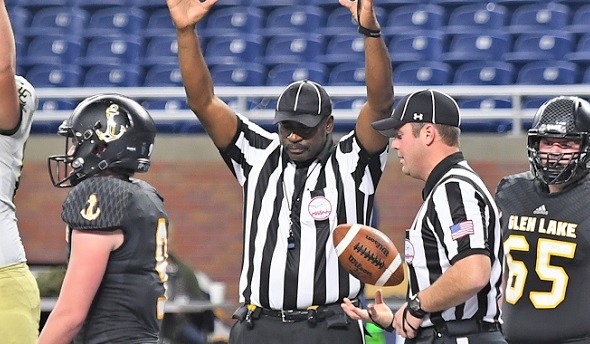
Watson, a 38-year official for the Michigan High School Athletic Association, collapsed in the tunnel near the officials’ locker room after the Division 6 Football Final at Ford Field last Nov. 25 in Detroit. Fortunately for the Kalamazoo native, stadium staff members were steps away as he fell unconscious. Within seconds, their call for help reached on-site EMTs who swiftly made their way to him from the field.
“It was strange because I wasn’t sick or anything. I drove to the game by myself. Everything was fine, got dressed, and then went out on the field for the game,” Watson said. “After the game, I came to the locker room, had a boxed lunch, and the last thing I remember is leaving towards the tunnel. That’s the last thing that I remember. I woke up in the hospital the next day, on Saturday.”
Moments before Watson’s dire situation occurred, he stood in the officials’ locker room speaking with Mark Uyl, the MHSAA assistant director who coordinates officials. Uyl said when he received the call regarding Watson, he arrived to find paramedics administering full CPR, in addition to using an automated external defibrillator (AED).
“It was a scene right out of a movie,” Uyl said.
After about 10 minutes of work on Watson, Uyl said paramedics found a pulse and promptly transported him to Detroit Medical Center.
“Things were very critical that Friday night – very touch and go,” Uyl said. “Overnight we got reports that he was slowly improving.”
An implantable cardioverter defibrillator (ICD) was placed in Watson’s chest. The pager-sized device is battery powered and placed below the skin to monitor heart rate, according to the American Heart Association. If an abnormal heart rhythm is discovered, the ICD delivers an electric shock to restore a normal heartbeat.
“I got to witness an absolute miracle,” Uyl said. “If the cardiac situation doesn’t happen literally at the feet of the medical staff that we have on-site at an event like that, he would’ve gotten up to the concourse or, heaven forbid, outside the building into the parking lot or his car and I believe it would’ve been a much more tragic ending.”
Watson was working the third game of the day as a line judge, and when he collapsed, was beginning to leave the facility and head to a local hotel reserved for MHSAA officials. Uyl told Watson how much of a blessing it was that he was assigned that game. At home or at the hotel, Watson would have been alone without access to proper medical attention.
“Certainly, where we got lucky is where he collapsed,” Uyl said. “We have emergency procedures, but when we’re at one of our college or pro venues, we often use the building’s plan. It could not have been more seamless between our staff and the Ford Field building personnel.”
At MHSAA events, such as those at Ford Field, an ambulance and two EMTs are stationed on the field next to the tunnel that connects it to the other areas of the stadium. Watson said he and fellow officials routinely confirm the location of emergency responders before starting a game.
“Schools almost always have somebody from a university around who does training. Most schools have ambulance service there at the site,” Watson said. “There have been incidences where we have had injuries that require them to come out onto the field to assist a student-athlete. It could be a concussion, a leg injury or who knows. We always have somebody at a venue.”
Equipped with his ICD, Watson left for home a week later from Detroit Medical Center. Expecting to make a full recovery, Watson said the only recommendations from his doctors were to tweak his diet and increase exercise. Although he said his recovery is on track, one of the most notable effects from his incident was memory loss.
“The strange thing is that I cannot remember a single thing about the game. I can’t remember anything,” Watson said. “If you ask me what Ford Field looked like now, I couldn’t tell you. I lost my short-term memory. I remember everything except the game. It’s those 48 minutes that I can’t remember.”
An official in basketball, softball and volleyball as well, staying active won’t be too much of an issue for Watson, who said he took last basketball season off to get himself better prepared for the softball season.
“It’s just amazing how quickly they responded in my situation. Regardless of who it is, the response time I received was tremendous,” Watson said. “I was out. They had to revive me. It only took them 32 seconds to get to me. Even if it’s an injured player on the field, response times are getting so quick.”
PHOTO: Official Willie Watson signals a touchdown during the 2016 MHSAA Division 6 Final at Ford Field.