


Classes Still Create Hoosier Hysteria
July 27, 2017
By Rob Kaminski
MHSAA benchmarks editor
This is the fourth part in a series on MHSAA tournament classification, past and present, that will be published over the next two weeks. This series originally ran in this spring's edition of MHSAA benchmarks.
Twenty years ago, Bloomington North High School won the Indiana High School Athletic Association boys basketball championship, defeating Delta 75-54 at the RCA Dome in Indianapolis.
The date, March 22, 1997, is at the same time revered and disdained by traditionalists in the state who saw it as the last schoolboy championship game the state would ever host.
That’s how devout the game of basketball, particularly interscholastic basketball, had become in the Hoosier state during the 87 years a state champion – one state champion, to be precise – was crowned.
Following that 1997 season, the IHSAA moved to a four-class system for its roundball tournaments, like so many of its state association counterparts had done years earlier.
It would be shocking to find more than a small percentage of current high school basketball players around the country unfamiliar with the iconic movie Hoosiers, even though the film is now more than 30 years old.
And, the storyline for that blockbuster unfolded more than 30 years prior to its release, when small-town, undermanned Milan High School defeated Muncie Central High School 32-30 in the 1954 IHSAA title game.
Perhaps it’s because of the David vs Goliath notion, or the fame of the movie that replaced Milan with the fictional Hickory and real-life star Bobby Plump with Hollywood hero Jimmy Chitwood, or the simple fact that Indiana had something other states didn’t.
Whatever the reason, plenty of opposition remains to this day to basketball classification in the state.
The fact is, the small rural schools were regularly being beaten handily by the much larger suburban and city schools as the tournament progressed each season.
Small schools also were closing at a rapid rate following the state’s School Reorganization Act in 1959, as students converged on larger, centralized county schools. From 1960 to 2000, the number of schools entering the tournament dropped from 694 to 381, and in 1997 a total of 382 schools and 4,584 athletes began competition at the Sectional level (the first level of the IHSAA Basketball Tournament).
It was at the entry level of the tournament where school administrators felt the pain of the new class system, but not necessarily for the same nostalgic reasons as the fans who either attended or boycotted the tournament.
At the Sectional round of the tournament, the IHSAA was culling just 2 percent of the revenue, with the participating schools splitting the balance. So, when Sectional attendance dropped by 14 percent in that first year of class basketball, many schools realized a financial loss. It was money they had grown to count on in prior years to help fund various aspects of the department.
Schools cumulatively received more than $900,000 from Sectional competition in 1998, but that total was down from more than $1 million in the last year of the single-class tournament.
Yet, the current format provides a great deal more opportunity and realistic chances at championship runs for schools of all enrollments.
To date, 60 additional teams have championship or runner-up trophies on display in school trophy cases around Indiana.
That was the mission in front of then-IHSAA commissioner Bob Gardner (now National Federation executive director) once the board made its decision: to give thousands more student-athletes the opportunity for once-in-a-lifetime experiences.
As any statistician knows, figures can be manipulated to tell any side of a story. Declining attendance in year one of class basketball is such a number.
The truth is tournament attendance had been on a steady downward spiral since its peak of just over 1.5 million in 1962. By the last single-class event in 1997, the total attendance was half that.
The challenge then and today, as it is for all state associations, is to find that delicate balance for those holding onto tradition, those holding onto trophies, and the number of trophies to hand out.
Editor’s Note: Stories from the Fort Wayne Journal Gazette in 1998 and from a 2007 issue of Indianapolis Monthly provided facts in this article.
Sprint Star Leads Southfield Christian Surge
By
Tom Markowski
Special for Second Half
May 2, 2018
SOUTHFIELD – The village of Grass Lake, located in Jackson County, and the country of Nigeria are worlds apart in many ways.
 But at Southfield Christian, chance circumstances have brought the two together – and the results have had a positive effect in the classroom and in the sport of track & field.
Todd Crouch ran track at Grass Lake High School and then in college at Spring Arbor before graduating in 2007. Crouch became a substitute teacher at Grass Lake soon after graduation, and he also helped coach the track team.
But securing a full-time teaching position wasn’t easy. Remember the times. The recession of the late 2000s left few unscathed.
“I applied, applied and applied,” Crouch said. “I graduated in 2007, and the recession followed. It was a situation where people who were working were holding onto their jobs, and art teachers weren’t in high demand.
“Then someone, I don’t even know who this person was, slipped me a sticky note. There was a message to contact a person. I had no idea what was going on. I’d never been to Southfield, and here I was contacting the superintendent at Southfield Christian, Sue Hoffenbacher, about a possible interview and Sue told me that she had been waiting for my call. I interviewed on a Friday, and on Monday I had the (teaching position).”
That was 2010. Crouch is now in his eighth season also as the girls and boys track & field coach at Southfield Christian and he teaches art classes at the high school level and at the middle school, which is located on the same campus.
In retrospect, Crouch said it was his destiny to coach and teach at a religious school like Southfield Christian.
“It’s a good story,” he said. “God meant for me to be here.”
It gets better. Southfield Christian won its first MHSAA track title last season, when the girls team finished with 62 points, 10 ahead of second-place Fowler at the Lower Peninsula Division 4 Finals held at Houseman Field in Grand Rapids. The program’s previous best finish was runner-up in 2007.
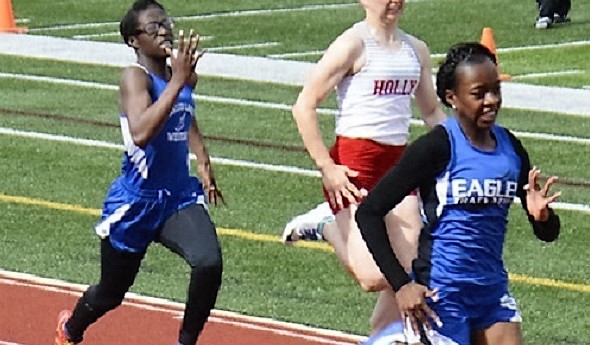
Chika Amene and Kaelin Ray, both juniors last season, were the stars on that team. Amene placed first in the three sprints and ran the third leg on the winning 1,600-meter relay team. Ray ran the second leg in that race, placed first in the 300 hurdles and third in the 100 hurdles.
Of the six athletes who qualified for last year’s Finals, five were possibilities to return this spring. Two of those five, however, are not competing in track at this time. Crouch said Ray is focusing on club volleyball this spring. Junior Grace Sanders competed in Southfield Christian’s first two track meets but suffered an injury also playing club volleyball – she could return to the track before the end of this season and was part of last year’s 800 relay that finished third at the Finals.
But Crouch remains optimistic his team can contend for another title. The Chargers have 16 on the girls varsity team, and a number of those athletes have stepped up and shown much improvement over last season – including seniors Grace McFerrin and Shelby Goodson, who both ran on the 800 relay at Houseman last spring as well.
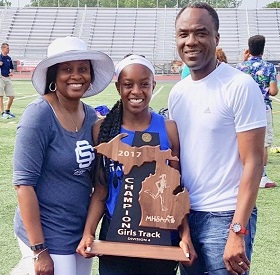 Southfield Christian’s chances begin with Amene, the best athlete in Division 4. Her parents, Chinedum and Uchenna, were born in Nigeria, and both competed in sports. Her mother was a track athlete in high school and Uchenna played soccer in college at University of Detroit Mercy. Amene’s brother, Dubem, is a sophomore and also runs track.
Physically, Chika Amene is stronger this season and competing at a higher level. If she can match what she did last season, that’s 40 points at the Finals, assuming she and three teammates can grab a first in a relay.
Amene has been a sprinter since before junior high. Early on she excelled in the 100 and 200. Gradually, the 400 became her best event. It took Amene until late in her freshman season to approach the 400 seriously, and it took an athlete on the boys team to provide that push.
Blake Washington is a junior at University of Michigan, and his best event is the 400. But it wasn’t always his favorite. Like Amene, Washington concentrated on the 100 and 200 early in his high school career.
“It was at the Regionals of his sophomore year,” Crouch said. “We had some injuries, and we told (Washington) he had to fill in. He ran so well in the (1,600) relay that I said to him, ‘You know, we’re going to have you work on that.’”
Washington set the LP Division 4 Finals record in the 400 in 2015 (49.34) that still stands.
“I was a freshman when Blake was a senior,” Amene said. “The 200, in my mind, was my best. Blake ran the 100 and 200, and transitioned to the 400. I didn’t even think about the 400. In one meet, one of my coaches said to run in the (1,600) relay and my time was really good. So I started training in the 400 as a sophomore.
“(Washington) was like a mentor. He gave me advice on my classes, my school work and running. He taught me a lot in the 400. He told me to make sure I got out fast, to get out hard. In college he told me to have my priorities straight, and don’t get distracted.”
Amene’s time when she won the 400 last season was 58.83. Her personal best is a 57.6. She ran 57.96 to finish 17th in March at the New Balance Nationals Indoor held in New York.
“I’m slowly getting back into shape,” she said. “That indoor season takes a lot out of you.”
A goal-setter, Amene said she hopes to run a 55 flat at the MHSAA Finals.
Amene said she’ll likely follow Washington to U-M. Amene’s grade-point average is 3.7, and she intends to major in business or economics with an eye on law school. She said she’s always been a Michigan fan, and the fact that a second cousin attended U-M doesn’t hurt – that cousin being 2012 Ann Arbor Huron grad Cindy Ofili, who won three LP Division 1 individual titles as a high school senior before becoming a Big 10 champion and Olympian representing Great Britain at the 2016 summer games.
 Tom Markowski is a columnist and directs website coverage for the State Champs! Sports Network. He previously covered primarily high school sports for the The Detroit News from 1984-2014, focusing on the Detroit area and contributing to statewide coverage of football and basketball. Contact him at [email protected] with story ideas for Oakland, Macomb and Wayne counties.
PHOTOS: (Top) Chika Amene, far right, leads the pack during a sprint. (Middle) Chika, with parents Chinedum and Uchenna at last season’s MHSAA Finals. (Photos courtesy of the Amene family.)