


Classes Still Create Hoosier Hysteria
July 27, 2017
By Rob Kaminski
MHSAA benchmarks editor
This is the fourth part in a series on MHSAA tournament classification, past and present, that will be published over the next two weeks. This series originally ran in this spring's edition of MHSAA benchmarks.
Twenty years ago, Bloomington North High School won the Indiana High School Athletic Association boys basketball championship, defeating Delta 75-54 at the RCA Dome in Indianapolis.
The date, March 22, 1997, is at the same time revered and disdained by traditionalists in the state who saw it as the last schoolboy championship game the state would ever host.
That’s how devout the game of basketball, particularly interscholastic basketball, had become in the Hoosier state during the 87 years a state champion – one state champion, to be precise – was crowned.
Following that 1997 season, the IHSAA moved to a four-class system for its roundball tournaments, like so many of its state association counterparts had done years earlier.
It would be shocking to find more than a small percentage of current high school basketball players around the country unfamiliar with the iconic movie Hoosiers, even though the film is now more than 30 years old.
And, the storyline for that blockbuster unfolded more than 30 years prior to its release, when small-town, undermanned Milan High School defeated Muncie Central High School 32-30 in the 1954 IHSAA title game.
Perhaps it’s because of the David vs Goliath notion, or the fame of the movie that replaced Milan with the fictional Hickory and real-life star Bobby Plump with Hollywood hero Jimmy Chitwood, or the simple fact that Indiana had something other states didn’t.
Whatever the reason, plenty of opposition remains to this day to basketball classification in the state.
The fact is, the small rural schools were regularly being beaten handily by the much larger suburban and city schools as the tournament progressed each season.
Small schools also were closing at a rapid rate following the state’s School Reorganization Act in 1959, as students converged on larger, centralized county schools. From 1960 to 2000, the number of schools entering the tournament dropped from 694 to 381, and in 1997 a total of 382 schools and 4,584 athletes began competition at the Sectional level (the first level of the IHSAA Basketball Tournament).
It was at the entry level of the tournament where school administrators felt the pain of the new class system, but not necessarily for the same nostalgic reasons as the fans who either attended or boycotted the tournament.
At the Sectional round of the tournament, the IHSAA was culling just 2 percent of the revenue, with the participating schools splitting the balance. So, when Sectional attendance dropped by 14 percent in that first year of class basketball, many schools realized a financial loss. It was money they had grown to count on in prior years to help fund various aspects of the department.
Schools cumulatively received more than $900,000 from Sectional competition in 1998, but that total was down from more than $1 million in the last year of the single-class tournament.
Yet, the current format provides a great deal more opportunity and realistic chances at championship runs for schools of all enrollments.
To date, 60 additional teams have championship or runner-up trophies on display in school trophy cases around Indiana.
That was the mission in front of then-IHSAA commissioner Bob Gardner (now National Federation executive director) once the board made its decision: to give thousands more student-athletes the opportunity for once-in-a-lifetime experiences.
As any statistician knows, figures can be manipulated to tell any side of a story. Declining attendance in year one of class basketball is such a number.
The truth is tournament attendance had been on a steady downward spiral since its peak of just over 1.5 million in 1962. By the last single-class event in 1997, the total attendance was half that.
The challenge then and today, as it is for all state associations, is to find that delicate balance for those holding onto tradition, those holding onto trophies, and the number of trophies to hand out.
Editor’s Note: Stories from the Fort Wayne Journal Gazette in 1998 and from a 2007 issue of Indianapolis Monthly provided facts in this article.
Performance: Lee's Thomas Robinson
April 27, 2018
 Thomas Robinson
Wyoming Lee senior – Track & Field
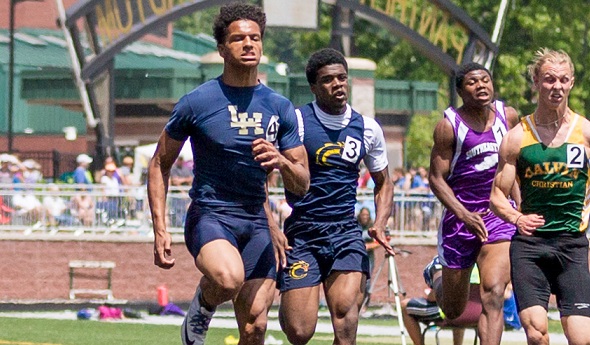
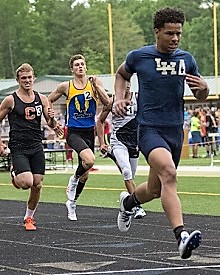
Robinson, a four-time MHSAA Finals sprints champion, is off to another fast start. He swept the 100 and 200 championships at Saturday’s Fred Solis Invitational with two of the fastest times statewide this season to earn the Michigan Army National Guard’s “Performance of the Week.”
The two-time reigning Lower Peninsula Division 3 champ in both races, Robinson ran an 11-second flat 100 and 22.14-second 200 on Saturday and also helped Lee’s 400 and 800 relays to runner-up finishes. The 200 time ranks as the state’s fastest across all divisions this spring, and his 100 time is tied for fourth; he then ran the 100 in a hand-timed 10.84 seconds Tuesday. Over his first two seasons and the first month of this one, Robinson has won all but four of his 100 and 200-meter races – and his only finish lower than second came in a preliminary where he came back to win an MHSAA championship.
 Robinson set the LPD3 Finals record with a 21.76 in the 200 last season. His 21.74 in that race is a school record, and is his best of 10.74 in the 100 – both broke previous records set in 1976 – and he also set a school record of 43.97 with the 400 relay team including Tino Savala, Aridel Torres and Gio Santiago. Robinson’s first MHSAA title in 2016 was the program’s first in the sport since 2006, and he also was a receiver and defensive back on a football team that finished 3-6 in the fall – tying its best record since 2007 with more wins than the previous four seasons combined. Robinson carries a 3.38 grade-point average – he earned academic all-state in track last year – and has accepted a full scholarship to Michigan State University, where he’s interested in studying computer, mechanical or electrical engineering. It’s been quite a rise – he didn’t run track for the first time until his sophomore year.
Lee sprints and football coach Tom DeGennaro said: “(Thomas) was always a good student. He is naturally fast. When he was a sophomore, I was coaching at Kelloggsville High School and watched him run in our conference meets. His first race he did not even know how to use blocks and was very raw. I came here last year, and we worked on simple things like arm placement and running form – spent a ton of time on block work and attended track camps. He can go faster with some additional form clean up. … Thomas is a natural talent who works hard in the weight room in the offseason. He squats close to 500 pounds, which is a lot considering he only weighs 180 pounds.”
Performance Point: “Usually for me, I don't really run (early in the season) what I expect to run. I really expect to run 10s (10 seconds in the 100) but I haven't really been trying to hit a 10 this season yet. I expect to hit a 10 later on this season when the weather gets warmer. (I) just keep going to practice every day, just keep doing every drill 100 percent. … I just want to get faster and (personal record) in all my events. In the 100, I want to run at least a 10.4 and the 200 at least the low 21s.”
Putting Lee on the map: “People, when they look at Lee, they don't see (success) like that coming from here, so it means a lot that I can be that successful at Lee. People always say that everyone who goes there is bad at sports and stuff. I want to show them that's not true. … I always hear teachers and staff (saying) congrats on my races, and just a lot of support from everyone and my athletic director.”
 Catching up: “I was just a stay-at-home kid playing video games. I kinda (knew I was fast), but I never really took it seriously. ... The way I started getting into sports is we got a new football coach (former coach Carlton Brewster). He's all like (talking about my) potential and challenging me. He just told me to do football. I was decent at it my freshman year. And then the second year I got a lot better, and after that season was over he was like, 'You should run track.' I didn't really want to at first – I was like, ‘Nah, I don't want to do it.’ I look at it now; I thank him for making me do it because I've had a lot of success in it.”
Setting an example: “Before, no one really cared about me. But now everyone's looking up to me, like little kids look up to me – 'Oh, you're that really fast kid. I want to be like you when I'm older' – stuff like that. It makes me feel good because I'm a role model for them. Little kids say they want to be like me, my little brother (in eighth grade) too because he just started track this season.”
Following another GR-area star: “Khance Meyers (four-time individual LPD1 champ for East Kentwood, now at Hinds Community College in Mississippi) – I want to follow his steps because he’s really successful in track right now in college. He won a national title for the 200 meters already his first year as a freshman. (He taught me) to just always work hard and stuff like that – set your mind to it, and it will happen.”
- Geoff Kimmerly, Second Half editor
Every week during the 2017-18 school year, Second Half and the Michigan Army National Guard will recognize a “Performance of the Week" from among the MHSAA's 750 member high schools.
The Michigan Army National Guard provides trained and ready forces in support of the National Military Strategy, and responds as needed to state, local, and regional emergencies to ensure peace, order, and public safety. The Guard adds value to our communities through continuous interaction. National Guard soldiers are part of the local community. Guardsmen typically train one weekend per month and two weeks in the summer. This training maintains readiness when needed, be it either to defend our nation's freedom or protect lives and property of Michigan citizens during a local natural disaster.
Previous 2017-18 honorees:
March 29: Carlos Johnson, Benton Harbor basketball - Read
March 22: Shine Strickland-Gills, Saginaw Heritage basketball - Read
March 15: Skyler Cook-Weeks, Holland Christian swimming - Read
March 8: Dakota Greer, Howard City Tri-County wrestling - Read
March 1: Camree' Clegg, Wayne Memorial basketball - Read
February 23: Aliah Robertson, Sault Ste. Marie swimming - Read
February 16: Austin O'Hearon, Eaton Rapids wrestling - Read
February 9: Sophia Wiard, Muskegon Oakridge basketball - Read
February 2: Brenden Tulpa, Hartland hockey - Read
January 25: Brandon Whitman, Dundee wrestling - Read
January 18: Derek Maas, Holland West Ottawa swimming - Read
January 11: Lexi Niepoth, Bellaire basketball - Read
November 30: La'Darius Jefferson, Muskegon football - Read
November 23: Ashley Turak, Farmington Hills Harrison swimming - Read
November 16: Bryce Veasley, West Bloomfield football - Read
November 9: Jose Penaloza, Holland soccer - Read
November 2: Karenna Duffey, Macomb L'Anse Creuse North cross country - Read
October 26: Anika Dy, Traverse City West golf - Read
October 19: Andrew Zhang, Bloomfield Hills tennis - Read
October 12: Nolan Fugate, Grand Rapids Catholic Central football - Read
October 5: Marissa Ackerman, Munising tennis - Read
September 28: Minh Le, Portage Central soccer - Read
September 21: Olivia Theis, Lansing Catholic cross country - Read
September 14: Maddy Chinn, Pontiac Notre Dame Prep volleyball - Read
PHOTOS: (Top) Wyoming Lee’s Thomas Robinson (far left) leads on the way to winning the 100-meter championship in Lower Peninsula Division 3 last spring. (Middle) Robinson crosses the finish line in the 200 championship race last year well ahead of the pack. (Click for more from RunMichigan.com.)