


Classes Still Create Hoosier Hysteria
July 27, 2017
By Rob Kaminski
MHSAA benchmarks editor
This is the fourth part in a series on MHSAA tournament classification, past and present, that will be published over the next two weeks. This series originally ran in this spring's edition of MHSAA benchmarks.
Twenty years ago, Bloomington North High School won the Indiana High School Athletic Association boys basketball championship, defeating Delta 75-54 at the RCA Dome in Indianapolis.
The date, March 22, 1997, is at the same time revered and disdained by traditionalists in the state who saw it as the last schoolboy championship game the state would ever host.
That’s how devout the game of basketball, particularly interscholastic basketball, had become in the Hoosier state during the 87 years a state champion – one state champion, to be precise – was crowned.
Following that 1997 season, the IHSAA moved to a four-class system for its roundball tournaments, like so many of its state association counterparts had done years earlier.
It would be shocking to find more than a small percentage of current high school basketball players around the country unfamiliar with the iconic movie Hoosiers, even though the film is now more than 30 years old.
And, the storyline for that blockbuster unfolded more than 30 years prior to its release, when small-town, undermanned Milan High School defeated Muncie Central High School 32-30 in the 1954 IHSAA title game.
Perhaps it’s because of the David vs Goliath notion, or the fame of the movie that replaced Milan with the fictional Hickory and real-life star Bobby Plump with Hollywood hero Jimmy Chitwood, or the simple fact that Indiana had something other states didn’t.
Whatever the reason, plenty of opposition remains to this day to basketball classification in the state.
The fact is, the small rural schools were regularly being beaten handily by the much larger suburban and city schools as the tournament progressed each season.
Small schools also were closing at a rapid rate following the state’s School Reorganization Act in 1959, as students converged on larger, centralized county schools. From 1960 to 2000, the number of schools entering the tournament dropped from 694 to 381, and in 1997 a total of 382 schools and 4,584 athletes began competition at the Sectional level (the first level of the IHSAA Basketball Tournament).
It was at the entry level of the tournament where school administrators felt the pain of the new class system, but not necessarily for the same nostalgic reasons as the fans who either attended or boycotted the tournament.
At the Sectional round of the tournament, the IHSAA was culling just 2 percent of the revenue, with the participating schools splitting the balance. So, when Sectional attendance dropped by 14 percent in that first year of class basketball, many schools realized a financial loss. It was money they had grown to count on in prior years to help fund various aspects of the department.
Schools cumulatively received more than $900,000 from Sectional competition in 1998, but that total was down from more than $1 million in the last year of the single-class tournament.
Yet, the current format provides a great deal more opportunity and realistic chances at championship runs for schools of all enrollments.
To date, 60 additional teams have championship or runner-up trophies on display in school trophy cases around Indiana.
That was the mission in front of then-IHSAA commissioner Bob Gardner (now National Federation executive director) once the board made its decision: to give thousands more student-athletes the opportunity for once-in-a-lifetime experiences.
As any statistician knows, figures can be manipulated to tell any side of a story. Declining attendance in year one of class basketball is such a number.
The truth is tournament attendance had been on a steady downward spiral since its peak of just over 1.5 million in 1962. By the last single-class event in 1997, the total attendance was half that.
The challenge then and today, as it is for all state associations, is to find that delicate balance for those holding onto tradition, those holding onto trophies, and the number of trophies to hand out.
Editor’s Note: Stories from the Fort Wayne Journal Gazette in 1998 and from a 2007 issue of Indianapolis Monthly provided facts in this article.
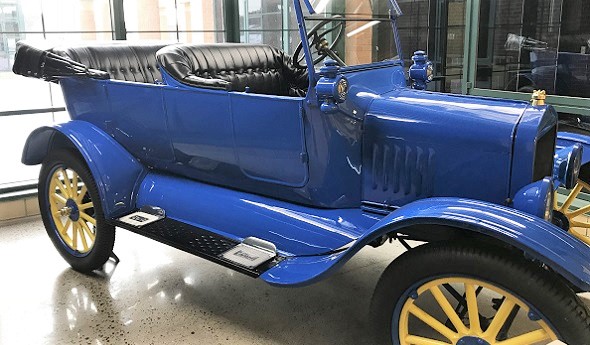
Flivver Finds Home at Home of the Flivvers
April 25, 2018
By Dennis Grall
Special for Second Half
KINGSFORD – A wide variety of animals exist as high school mascots in Michigan, ranging from Bison to Gators, to Eagles and Hawks and to Tigers and Panthers.
 You can also watch a variety of fighters prowl the sidelines, from Patriots to Warriors, Titans to Swordsmen, to Nimrods and Roughriders, Crusaders and Fighting Irish, and Knights and Trojans and Gladiators.
There are also unusual mascots like Dux and Chix, Wykons and Hematites, Pharaohs and Technicians, Navigators and Gryphons, Achievers and Dreadnaughts, Saddlelites and Railsplitters, Battling Bathers and Flying Gs, Griffons and Shorians.
But Kingsford is among the few schools with a genuine vehicle for a mascot, which maybe could be used to transport any of these others to the playing field.
The Flivvers are the mascot of the Upper Peninsula school on the northern border of Wisconsin, just blocks from the neighboring Mountaineers of Iron Mountain. Two downstate schools – Boyne City and Perry – have Ramblers as their mascot in honor of the old Nash car.
"This was one of the best days I've had at Kingsford," Flivvers' athletic director Al Unger said of having a restored 1923 Ford Model T brought into the middle school building by the main entrance in September 2017.
The idea began to chug along two years ago when a handful of people were chatting about a school mascot. Unger said the group thought "how cool it would be to have a real-deal mascot" for the school.
The Berlinski/Hosking family happened to have an old Model T and were willing to donate it to the school. Unger's uncle, Clyde Unger of nearby Spread Eagle, Wis., was asked to use his restoration and rebuilding skills to renovate the car. He spent about 1,200 hours tearing it down and putting everything back together.
"The car really came back together," said Al Unger.
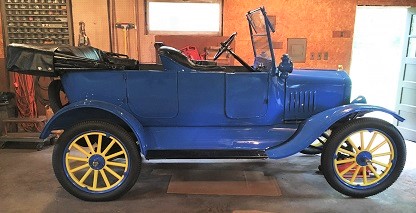 The Flivvers have been Kingsford's nickname since the early 1930s, coming from the old Ford Motor Co. plant in the area. The plant, which opened in 1925 and once employed 7,000 people, built cars and later used leftover wood to make Kingsford charcoal barbecue briquettes.
Al Unger said an Iron Mountain Daily News sportswriter during that time began using Fords as the school nickname, and it soon adjusted to Flivvers, or Flivs – a nickname for the old Model T vehicles.
Developing school spirit was one of the goals the group talked about when it discussed finding an old vehicle, Unger said.
The car's renovation included a new paint job, breaking from the standard Henry Ford refrain of all black to a spiffy blue to match the maize and royal blue school colors. "There have been a lot of positive reviews," said the Kingsford athletic director.
The car was unveiled to the students and some community members at the adjoining football field/track, perhaps the first time all of the students in the three buildings were released for a specific event, Unger said.
It was then shown to the public when the Flivvers hosted the Escanaba Eskymos for the regular-season finale football game in October. "It was awesome," Unger said of the night that included coverage from the Upper Peninsula's three television stations.
The vehicle now is displayed in a three-sided glass enclosure with a gate. Unger said plans are in the works to place the vehicle in the community’s July 4 parade "and we will consider rolling it out for special occasions.
"You can't help but walk by and stare at it and feel a sense of pride," he said.
Unger said 95 percent of the project was donated. "We spent a few dollars on the enclosure," adding everyone "has been ecstatic" about the unique mascot.
 Denny Grall retired in 2012 after 39 years at the Escanaba Daily Press and four at the Green Bay Press-Gazette, plus 15 months for WLST radio in Escanaba; he served as the Daily Press sports editor from 1970-80 and again from 1984-2012. Grall was inducted into the Upper Peninsula Sports Hall of Fame in 2002 and serves as its executive secretary. E-mail him at [email protected] with story ideas for the Upper Peninsula.
PHOTOS: (Top) The Flivver, on display at the Kingsford middle school building. (Middle) Kingsford’s restored Model T, a 1923 “Flivver.” (Photos courtesy of the Kingsford athletic department.)