


Classes Still Create Hoosier Hysteria
July 27, 2017
By Rob Kaminski
MHSAA benchmarks editor
This is the fourth part in a series on MHSAA tournament classification, past and present, that will be published over the next two weeks. This series originally ran in this spring's edition of MHSAA benchmarks.
Twenty years ago, Bloomington North High School won the Indiana High School Athletic Association boys basketball championship, defeating Delta 75-54 at the RCA Dome in Indianapolis.
The date, March 22, 1997, is at the same time revered and disdained by traditionalists in the state who saw it as the last schoolboy championship game the state would ever host.
That’s how devout the game of basketball, particularly interscholastic basketball, had become in the Hoosier state during the 87 years a state champion – one state champion, to be precise – was crowned.
Following that 1997 season, the IHSAA moved to a four-class system for its roundball tournaments, like so many of its state association counterparts had done years earlier.
It would be shocking to find more than a small percentage of current high school basketball players around the country unfamiliar with the iconic movie Hoosiers, even though the film is now more than 30 years old.
And, the storyline for that blockbuster unfolded more than 30 years prior to its release, when small-town, undermanned Milan High School defeated Muncie Central High School 32-30 in the 1954 IHSAA title game.
Perhaps it’s because of the David vs Goliath notion, or the fame of the movie that replaced Milan with the fictional Hickory and real-life star Bobby Plump with Hollywood hero Jimmy Chitwood, or the simple fact that Indiana had something other states didn’t.
Whatever the reason, plenty of opposition remains to this day to basketball classification in the state.
The fact is, the small rural schools were regularly being beaten handily by the much larger suburban and city schools as the tournament progressed each season.
Small schools also were closing at a rapid rate following the state’s School Reorganization Act in 1959, as students converged on larger, centralized county schools. From 1960 to 2000, the number of schools entering the tournament dropped from 694 to 381, and in 1997 a total of 382 schools and 4,584 athletes began competition at the Sectional level (the first level of the IHSAA Basketball Tournament).
It was at the entry level of the tournament where school administrators felt the pain of the new class system, but not necessarily for the same nostalgic reasons as the fans who either attended or boycotted the tournament.
At the Sectional round of the tournament, the IHSAA was culling just 2 percent of the revenue, with the participating schools splitting the balance. So, when Sectional attendance dropped by 14 percent in that first year of class basketball, many schools realized a financial loss. It was money they had grown to count on in prior years to help fund various aspects of the department.
Schools cumulatively received more than $900,000 from Sectional competition in 1998, but that total was down from more than $1 million in the last year of the single-class tournament.
Yet, the current format provides a great deal more opportunity and realistic chances at championship runs for schools of all enrollments.
To date, 60 additional teams have championship or runner-up trophies on display in school trophy cases around Indiana.
That was the mission in front of then-IHSAA commissioner Bob Gardner (now National Federation executive director) once the board made its decision: to give thousands more student-athletes the opportunity for once-in-a-lifetime experiences.
As any statistician knows, figures can be manipulated to tell any side of a story. Declining attendance in year one of class basketball is such a number.
The truth is tournament attendance had been on a steady downward spiral since its peak of just over 1.5 million in 1962. By the last single-class event in 1997, the total attendance was half that.
The challenge then and today, as it is for all state associations, is to find that delicate balance for those holding onto tradition, those holding onto trophies, and the number of trophies to hand out.
Editor’s Note: Stories from the Fort Wayne Journal Gazette in 1998 and from a 2007 issue of Indianapolis Monthly provided facts in this article.
Kloss Raring to Make His Move in D3
April 20, 2018
By Dennis Chase
Special for Second Half
HARBOR SPRINGS – Jeremy Kloss is growing weary of northern Michigan’s cold, snowy spring.
 “I’m a little frustrated,” said the Harbor Springs junior, who won the 1,600 and 3,200 meters at last June’s MHSAA Lower Peninsula Division 4 Track & Field Finals. “I really want to get a meet in.”
A mid-April snowstorm blasted the area with more than a foot of snow last weekend. Most schools were closed Monday – and some Tuesday.
Kloss used the extended weekend break to put in an eight-mile run – his longest of the year.
“I had to find roads that weren’t as snow-covered as others,” he said. “It wasn’t the best footing.”
No sport has been able to gain traction.
According to the National Weather Service in Gaylord, this is the coldest and snowiest April on record in the northern Lower Peninsula. Some 37.3 inches of snow has fallen in Gaylord this month, eclipsing the previous record of 27 inches in 1923. Traverse City has had 27.1 inches, surpassing the mark of 17.3 in 2007. In addition, the average daytime temperature has been running 18 degrees below normal in this part of the state.
Harbor Springs had its first three track meets cancelled or postponed. The weather is expected to start turning this weekend, so there is hope the season will get underway next week, about three weeks from Regionals.
“I looked on athletic.net and it appears most schools, even downstate, haven’t had too many meets,” said Mike Kloss, Jeremy’s father and the longtime Rams boys track coach. “That makes me feel a little better. If they’re running downstate, and you’re not, then you feel like you’re behind the 8 ball.
“The weather’s got to give us a break.”
Jeremy sure hopes so.
“I don’t know if my mom (Emily, the girls track coach) has taken the snow tires off her vehicle yet,” he said. “I haven’t taken the sand bags out of my truck.”
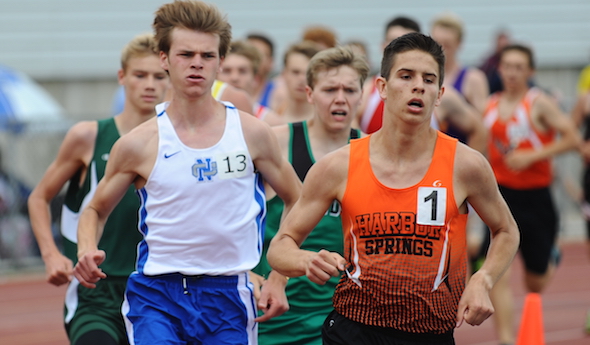
Once the season starts, Jeremy Kloss is hoping to build off last year’s accomplishments when he set personal bests in capturing the 1,600 (4:25.73) and 3,200 (9:46.25) at the Finals. He was also on the 3,200 relay team that took third and the 1,600 relay that placed seventh. That helped spark the Rams to a third-place team finish.
Kloss, whose three older brothers previously ran for the Rams, jokingly noted last June before the championship meet that his brothers always had one question for him – “Why aren’t you running faster?”
“If you’ve been around us, you know it’s not an easy crowd at times,” said Mike with a laugh.
The 17-year-old put that to rest and now owns bragging rights in the family with the fastest 1,600 and 3,200 times.
Now he’s hoping to keep dropping and challenge school marks in the 800 (Jacques Henning, 1:56.36), 1,600 (Tec Adams, 4:16) and 3,200 (Adams, 9:24).
“My goals are ambitious,” he said. “Aim high.”
“He’s self-motivated,” added his father. “Like (Monday), he went out and ran eight miles in crappy weather. He has big goals in what he wants to do, and that’s what drives him. He wants to be good. He works hard.”
Kloss finished second to Caro’s Yami Albrecht (15:44.7 to 15:47.1) at the LP Division 3 Cross Country Final in the fall. Then, for the most part, he put training on hold to play basketball during the winter.
“Toward the end of the (basketball) season I would wake up at 6 a.m. and run three times a week, and then on the other two mornings I would go to the gym with a couple buddies for workouts (before school),” he said.
All in hopes of getting off to a fast start in track.
Then, Mother Nature intervened.
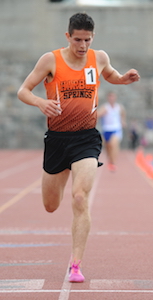 Kloss is motivated since he’ll have to now prove himself in Division 3.
“There’s a really good group of (distance runners) in Division 3,” he said. “It’s a tough group to hop in with, but I’m looking forward to the challenge.”
The field includes Albrecht, Hanover-Horton’s Landon Melling, Cass City’s CarLee Stimpfel, Saugatuck’s Corey Gorgas and Kent City’s Fraser Wilson. Gorgas was second (9:20.16), Stimpfel third (9:30.77) and Wilson fourth (9:36.23) in the Division 3 3,200 last June. In the 1,600, Melling finished second (4:17.04), Albrecht third (4:18.49), and Stimpfel fourth (4:19.55).
“That 9:20 Corey (Gorgas) ran in the 3,200 is fast, and I think he ran that fast indoors (over the winter),” said Mike Kloss. “D-3 is a lot different. In D-4 you might have one or two (vying for the title), but in D-3 you’ll have five or six. It’s another challenge, another step.”
In D-4 a year ago, Kloss won the 1,600 by nearly three seconds and the 3,200 by nearly eight.
“I think Jeremy could have gone 4:20 (in the 1,600) in the right type race,” said his father.
East Jordan coach Matt Peterson agrees that Kloss will face a stiffer challenge in Division 3.
“The times will be quicker and the fields will be deeper,“ he said. “But having said that, he was close to winning the D-3 cross country title. It wouldn’t surprise me if he placed very well or won at the state track meet.
“It goes back to his persistence. That’s the one word I would use to describe him. I’ve seen him run since middle school and I’ve never seen him run what I consider a bad race. I’ve never seen him mentally quit in a race, no matter how he feels. Every runner has an off day where they don’t feel right. He runs through that. That’s huge in anything, including life.”
Peterson and Mike Kloss were college teammates at Ferris State in the mid-1980s. He’s watched Jeremy grow up, starting when Jeremy was just weeks old and his parents brought him along to the state cross country meet.
“He’s a nice kid,” said Peterson. “I’ve watched him run at numerous state meets and the way he conducts himself, his attitude, is unbelievable. I was at the D-4 track meet last spring, and after he won the 3,200 he ran across the track and hugged me – and I’m an opposing coach. I can’t say enough good things about him.”
Mike Kloss will let the next few weeks play out to see what events Jeremy will run come Regionals and, most likely, the Division 3 Finals.
“It’s way too early to make those decisions,” Mike said.
Jeremy, meanwhile, is excited to see what the 3,200 relay can do. Senior Max Sydow and sophomore David Harrell return from a unit that posted a podium finish last year. Sophomore Austin Smar will join the mix.
“If we all drop our times, which I think we can, we can be pretty good,” Jeremy Kloss said.
It will be an important few weeks for Kloss as he also tries to showcase his talents for college coaches. He’s received attention from some Division I schools outside the state, although his preference is to remain in-state.
“I would like to be closer to home,” he said.
For Mike and Emily Kloss, this is their 28th year coaching in the Harbor Springs system. They also lead the cross country programs. Mike recently celebrated his 30th anniversary with the Michigan State Police. Most of those years were spent working the nightshift. Now, he’s working days as a court officer.
His training regimen for distance runners is based on low mileage, high intensity workouts.
“It’s not that we went in with that thought,” he said. “We adapted to it. If I ran kids big miles, we would lose them and we don’t have many spares.
“Jeremy has been gradually increasing (his miles), but I don’t want him to run college workouts in high school. It seems to be working for him.”
Jeremy said there’s another benefit to lower mileage.
“Kids are not getting hurt,” he said. “I can’t remember anyone having a stress fracture. The closest thing we’ve had is a couple kids with shin splints for a week or so. We’re staying healthy.”
As a trade-off, runners are asked to test themselves when they do work out.
“My dad likes to say, ‘A little faster if you can stand it,’” Jeremy said. “We have that quote on our sweatshirts and T-shirts.”
Now, if they just had better weather to start applying it.
 Dennis Chase worked 32 years as a sportswriter at the Traverse City Record-Eagle, including as sports editor from 2000-14. He can be reached at [email protected] with story ideas for Manistee, Wexford, Missaukee, Roscommon, Ogemaw, Iosco, Alcona, Oscoda, Crawford, Kalkaska, Grand Traverse, Benzie, Leelanau, Antrim, Otsego, Montmorency, Alpena, Presque Isle, Cheboygan, Charlevoix and Emmet counties.
PHOTOS: (Top) Harbor Springs’ Jeremy Kloss leads the pack during last season’s 1,600 championship race at the LP Division 4 Finals. (Middle) Kloss crosses first to win the 3,200 title. (Click for more from RunMichigan.com.)