


Classes Still Create Hoosier Hysteria
July 27, 2017
By Rob Kaminski
MHSAA benchmarks editor
This is the fourth part in a series on MHSAA tournament classification, past and present, that will be published over the next two weeks. This series originally ran in this spring's edition of MHSAA benchmarks.
Twenty years ago, Bloomington North High School won the Indiana High School Athletic Association boys basketball championship, defeating Delta 75-54 at the RCA Dome in Indianapolis.
The date, March 22, 1997, is at the same time revered and disdained by traditionalists in the state who saw it as the last schoolboy championship game the state would ever host.
That’s how devout the game of basketball, particularly interscholastic basketball, had become in the Hoosier state during the 87 years a state champion – one state champion, to be precise – was crowned.
Following that 1997 season, the IHSAA moved to a four-class system for its roundball tournaments, like so many of its state association counterparts had done years earlier.
It would be shocking to find more than a small percentage of current high school basketball players around the country unfamiliar with the iconic movie Hoosiers, even though the film is now more than 30 years old.
And, the storyline for that blockbuster unfolded more than 30 years prior to its release, when small-town, undermanned Milan High School defeated Muncie Central High School 32-30 in the 1954 IHSAA title game.
Perhaps it’s because of the David vs Goliath notion, or the fame of the movie that replaced Milan with the fictional Hickory and real-life star Bobby Plump with Hollywood hero Jimmy Chitwood, or the simple fact that Indiana had something other states didn’t.
Whatever the reason, plenty of opposition remains to this day to basketball classification in the state.
The fact is, the small rural schools were regularly being beaten handily by the much larger suburban and city schools as the tournament progressed each season.
Small schools also were closing at a rapid rate following the state’s School Reorganization Act in 1959, as students converged on larger, centralized county schools. From 1960 to 2000, the number of schools entering the tournament dropped from 694 to 381, and in 1997 a total of 382 schools and 4,584 athletes began competition at the Sectional level (the first level of the IHSAA Basketball Tournament).
It was at the entry level of the tournament where school administrators felt the pain of the new class system, but not necessarily for the same nostalgic reasons as the fans who either attended or boycotted the tournament.
At the Sectional round of the tournament, the IHSAA was culling just 2 percent of the revenue, with the participating schools splitting the balance. So, when Sectional attendance dropped by 14 percent in that first year of class basketball, many schools realized a financial loss. It was money they had grown to count on in prior years to help fund various aspects of the department.
Schools cumulatively received more than $900,000 from Sectional competition in 1998, but that total was down from more than $1 million in the last year of the single-class tournament.
Yet, the current format provides a great deal more opportunity and realistic chances at championship runs for schools of all enrollments.
To date, 60 additional teams have championship or runner-up trophies on display in school trophy cases around Indiana.
That was the mission in front of then-IHSAA commissioner Bob Gardner (now National Federation executive director) once the board made its decision: to give thousands more student-athletes the opportunity for once-in-a-lifetime experiences.
As any statistician knows, figures can be manipulated to tell any side of a story. Declining attendance in year one of class basketball is such a number.
The truth is tournament attendance had been on a steady downward spiral since its peak of just over 1.5 million in 1962. By the last single-class event in 1997, the total attendance was half that.
The challenge then and today, as it is for all state associations, is to find that delicate balance for those holding onto tradition, those holding onto trophies, and the number of trophies to hand out.
Editor’s Note: Stories from the Fort Wayne Journal Gazette in 1998 and from a 2007 issue of Indianapolis Monthly provided facts in this article.
Brighton 'Connects' For Repeat Run
April 12, 2018
By Geoff Kimmerly
Second Half editor
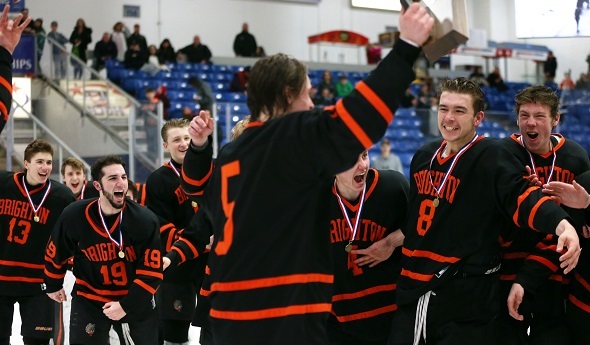
In the moment, Brighton’s run last month to its latest Division 1 ice hockey championship felt a lot like the successful title chases in 2012, 2013 and 2017.
 But now that the most recent victory has had some time to marinate, there’s no question – what the Bulldogs accomplished to close this winter was just a little different.
One team generally isn’t a measuring stick for the rest. But most aren’t the Detroit Catholic Central hockey program. The Shamrocks entered the Division 1 Semifinals on March 9 at USA Hockey Arena perfect against in-state competition this winter and riding a six-game shutout streak that began with an 8-0 win over eventual Division 2 champion Hartland. DCC had won 10 of the last 18 Division 1 titles and finished runner-up in 2017 to Brighton, the last Michigan high school team to topple the Shamrocks.
DCC wasn’t expected to have trouble this time – many of its scores against other top Michigan teams this season were jaw dropping. And Brighton, although the reigning champion, had lost twice to Hartland this winter, and the Eagles clearly had their troubles with the Shamrocks.
Yet the Bulldogs believed, and they pulled it off – avenging an earlier 3-0 loss and stunning the top-ranked Shamrocks 2-1 in a Semifinal. Emotionally running toward empty, the MHSAA/Applebee’s March “Team of the Month” then came back the next day and defeated Saginaw Heritage 5-2 to repeat as Division 1 champion.
“Catholic Central always has been the team. Just look at what they’ve accomplished,” Brighton coach Paul Moggach said. “That’s the bar. You can get over it once in a while. But we’re starting to feel like we are at that level … that maybe we can be that team. The belief in yourself maybe has arrived, that we’re good enough to do this on a regular basis.”
Brighton, which entered the postseason ranked No. 3 in Division 1, finished 25-6-1 this winter. Its lone losses were to DCC on Dec. 16, twice to league rival Hartland, and once apiece to Northville, Livonia Stevenson and Cleveland St. Ignatius.
The Bulldogs are used to facing Orchard Lake St. Mary’s and then DCC during the Division 1 tournament – they previously beat DCC in the 2013 and 2017 championship games and finished runners-up to the Shamrocks in 2014 and 2016. This time, Brighton beat No. 2 St. Mary’s 3-1 in a Regional Final and got DCC one game earlier than usual.
Boasting 10 seniors – including four who had goals or assists in the 2017 Final – Brighton took on the underdog “mask,” as Moggach put it, but despite the expected nerves also had “an incredible level of confidence in ourselves and to give to each other.”
Seniors Adam Conquest and Mathew Kahra scored Brighton’s goals in the Semifinal, both on power plays, and Kahra scored again in the championship game. Sophomore Will Jentz had two goals in the Final, and junior Evan MacDonald and freshman Nate Przysiecki both added one. Junior goalie Harrison Fleming had a combined 44 saves on 47 shots over the weekend.
With time to reflect the last few weeks, Moggach has begun to notice a few things about this run that maybe didn’t pop out entirely at the time – like Brighton’s incredible 17-2 record in road or neutral-site games. He also is able to look back fondly on the “connection” among members of this team – something built on the ice, sure, and during trips like the one to the Upper Peninsula featured on Second Half in January. But he found it created most during off-ice strength and conditioning workouts where a culture of togetherness was emphasized and formed – and that surely paid off in last month’s repeat rise.
“That’s the difference maker,” said Moggach, who has led the program 23 seasons. “I’ve been around the game a long time. I think early in my coaching career, and in most coaching careers, you’re figuring out how to get the Xs and Os done, figuring out power plays and penalty kills and things. And then, how to beat teams (that are more) talented.
“But how to bring it together, it’s a maturation of ideas. … The last couple of years, we’ve really built to a point; we put the work in, we enjoy each other, we complement each other, and I think that brings connections. Then we do things like the trip to the U.P. – we’re not celebrating ourselves, but each other. You start giving more to each other, it comes back in spades, and we’re realizing that as a group and as a program.”
Past Teams of the Month, 2017-18
February: Marquette girls and boys skiing - Report
January: Sterling Heights Stevenson competitive cheer - Report
December: Cadillac boys bowling - Report
November: Ottawa Lake Whiteford football - Report
October: Beaverton volleyball - Report
September: Shepherd girls golf - Report
PHOTO: Brighton co-captain Sam Brennan (5) presents the championship trophy to his teammates after last month’s Division 1 Final at USA Hockey Arena.