


Classes Still Create Hoosier Hysteria
July 27, 2017
By Rob Kaminski
MHSAA benchmarks editor
This is the fourth part in a series on MHSAA tournament classification, past and present, that will be published over the next two weeks. This series originally ran in this spring's edition of MHSAA benchmarks.
Twenty years ago, Bloomington North High School won the Indiana High School Athletic Association boys basketball championship, defeating Delta 75-54 at the RCA Dome in Indianapolis.
The date, March 22, 1997, is at the same time revered and disdained by traditionalists in the state who saw it as the last schoolboy championship game the state would ever host.
That’s how devout the game of basketball, particularly interscholastic basketball, had become in the Hoosier state during the 87 years a state champion – one state champion, to be precise – was crowned.
Following that 1997 season, the IHSAA moved to a four-class system for its roundball tournaments, like so many of its state association counterparts had done years earlier.
It would be shocking to find more than a small percentage of current high school basketball players around the country unfamiliar with the iconic movie Hoosiers, even though the film is now more than 30 years old.
And, the storyline for that blockbuster unfolded more than 30 years prior to its release, when small-town, undermanned Milan High School defeated Muncie Central High School 32-30 in the 1954 IHSAA title game.
Perhaps it’s because of the David vs Goliath notion, or the fame of the movie that replaced Milan with the fictional Hickory and real-life star Bobby Plump with Hollywood hero Jimmy Chitwood, or the simple fact that Indiana had something other states didn’t.
Whatever the reason, plenty of opposition remains to this day to basketball classification in the state.
The fact is, the small rural schools were regularly being beaten handily by the much larger suburban and city schools as the tournament progressed each season.
Small schools also were closing at a rapid rate following the state’s School Reorganization Act in 1959, as students converged on larger, centralized county schools. From 1960 to 2000, the number of schools entering the tournament dropped from 694 to 381, and in 1997 a total of 382 schools and 4,584 athletes began competition at the Sectional level (the first level of the IHSAA Basketball Tournament).
It was at the entry level of the tournament where school administrators felt the pain of the new class system, but not necessarily for the same nostalgic reasons as the fans who either attended or boycotted the tournament.
At the Sectional round of the tournament, the IHSAA was culling just 2 percent of the revenue, with the participating schools splitting the balance. So, when Sectional attendance dropped by 14 percent in that first year of class basketball, many schools realized a financial loss. It was money they had grown to count on in prior years to help fund various aspects of the department.
Schools cumulatively received more than $900,000 from Sectional competition in 1998, but that total was down from more than $1 million in the last year of the single-class tournament.
Yet, the current format provides a great deal more opportunity and realistic chances at championship runs for schools of all enrollments.
To date, 60 additional teams have championship or runner-up trophies on display in school trophy cases around Indiana.
That was the mission in front of then-IHSAA commissioner Bob Gardner (now National Federation executive director) once the board made its decision: to give thousands more student-athletes the opportunity for once-in-a-lifetime experiences.
As any statistician knows, figures can be manipulated to tell any side of a story. Declining attendance in year one of class basketball is such a number.
The truth is tournament attendance had been on a steady downward spiral since its peak of just over 1.5 million in 1962. By the last single-class event in 1997, the total attendance was half that.
The challenge then and today, as it is for all state associations, is to find that delicate balance for those holding onto tradition, those holding onto trophies, and the number of trophies to hand out.
Editor’s Note: Stories from the Fort Wayne Journal Gazette in 1998 and from a 2007 issue of Indianapolis Monthly provided facts in this article.
Re-focused Hanson Ready to Climb Again
By
Paul Costanzo
Special for MHSAA.com
April 6, 2018
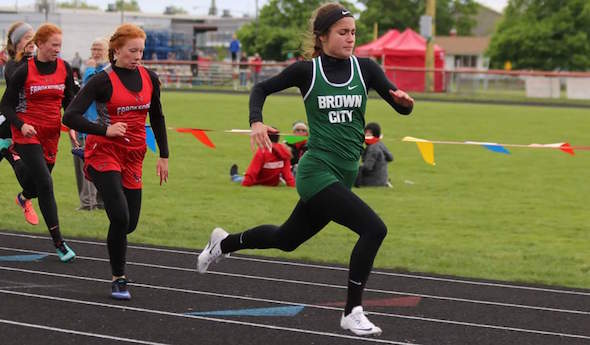
By most any standard, Alexandra Hanson had a tremendous junior track season.
 The Brown City star didn’t lose a 100, 200 or 400-meter race in a dual or tri meet, and only finished lower than second twice prior to the MHSAA Lower Peninsula Division 3 championships, where she was all-state in all three events – fifth in the 200 and 400, and eighth in the 100.
That great season was not up to the standards of one very important person, however – Hanson – and not just because she was coming off a sophomore season that saw her win a Division 4 title in the 400 and finish second in the 200.
“I just feel like I should have at least improved a little from my previous year, and I didn’t,” said Hanson, who didn’t match any of her personal records as a junior. “I know that was because I didn’t do anything during the winter. I was just super naive about it. I thought, ‘I won a state championship, I can just do it next year.’ I definitely had the completely wrong mindset. I think I got comfortable and was not pushing myself like I should have.
“I’m trying to take it as a lesson learned. Take it as a positive.”
Hanson’s disappointment has fueled her this offseason, as she looks to finish her high school career strong and transition to Saginaw Valley State University, where she will run collegiately.
While the Green Devils don’t have a meet scheduled until April 10, and practices have been hampered by early-spring weather, the difference in Hanson can already be seen by those who know her best.
“When she won the state, she didn’t run again until we started track practice the next year, and right in the middle of track season, she got a really bad cold and missed two or three meets,” Brown City coach Don Twiss said. “When you’re an elite runner, you have to stay at that training level, you can’t afford to take that amount of time off. I’m excited about her this year, just because her motivation seems to be totally different this year.”
Hanson spent much of her summer going through workouts she had taken from the Saginaw Valley coaching staff and her other college visits. She ran cross country for Brown City in the fall, and in the winter she continued to run, albeit mostly on a treadmill.
“I feel like I’m in better shape than where I was a year ago,” Hanson said. “Every time I’m like, ‘I don’t feel like running today,’ I tell myself, ‘Well, you don’t want to be like last year.’”
Hanson’s success this season won’t be measured in how many times she crosses the finish line first – although if she is successful in meeting her goals, she’ll do that plenty.
 She’s eyeing her personal best times – 58.03 seconds in the 400, 26.01 in the 200 and 12.71 in the 100 – meaning she’ll spend most of her season running against the clock. Fortunately for her, this is something she’s grown accustomed to, as many of her races aren’t particularly close throughout the season.
“It’s hard, especially when you’re in meets where you don’t have someone pushing you,” she said. “It’s definitely hard when you’re racing against the clock. I’m not the most personally motivated person, so my dad has to be standing there at around the 300-meter mark, and he has to scream at me. That motivates me. I have to have someone there motivating me.”
She also has her eye on a new race, as at Saginaw Valley the plan is for her to transition to middle distance and add the 800 meters to her repertoire. She ran it once as a junior, and will try it a little more this season as opportunities present themselves.
“I still think (team) points wise, I’m going to have to run the 200,” Hanson said. “But I’ll definitely run (the 800) more than last year. I’ll be able to run it more because my sister (Juliana) is here now, and she’s fast, too, so she’ll be able to take over the 100.”
Hanson is excited about the transition to middle distance, as she said the 400 has been her favorite race since she was in middle school. She’s also self aware, and said she has a better chance to get her 400 and 800 times to a level where she can compete in college, as opposed to her 100 and 200 times.
“Coming from a small town, the shorter distances I did really well in, so that’s what I did,” she said. “I talked to college coaches, and they started explaining what most 400 runners do – they go up.”
Twiss believes the potential is there for Hanson to transition to the 800 and be successful. He also believes the 400 is where she’s at her best, and that could lead to another trip to the top of the MHSAA podium in June.
“She’s like a gazelle when she gets out there and goes,” he said. “She’s such a natural middle sprinter, or like I call them, long sprints. She’s capable of running an upper 56-second (400 meters). If she does that, that will win it.”
 Paul Costanzo served as a sportswriter at The Port Huron Times Herald from 2006-15, including three years as lead sportswriter, and prior to that as sports editor at the Hillsdale Daily News from 2005-06. He can be reached at [email protected] with story ideas for Genesee, Lapeer, St. Clair, Sanilac, Huron, Tuscola, Saginaw, Bay, Arenac, Midland and Gladwin counties.
PHOTOS: (Top) Brown City’s Alexandra Hanson pulls away from a pack of runners during a race last season. (Middle) Hanson sprints down the stretch. (Photos courtesy of the Brown City girls track & field program.)