


Classes Still Create Hoosier Hysteria
July 27, 2017
By Rob Kaminski
MHSAA benchmarks editor
This is the fourth part in a series on MHSAA tournament classification, past and present, that will be published over the next two weeks. This series originally ran in this spring's edition of MHSAA benchmarks.
Twenty years ago, Bloomington North High School won the Indiana High School Athletic Association boys basketball championship, defeating Delta 75-54 at the RCA Dome in Indianapolis.
The date, March 22, 1997, is at the same time revered and disdained by traditionalists in the state who saw it as the last schoolboy championship game the state would ever host.
That’s how devout the game of basketball, particularly interscholastic basketball, had become in the Hoosier state during the 87 years a state champion – one state champion, to be precise – was crowned.
Following that 1997 season, the IHSAA moved to a four-class system for its roundball tournaments, like so many of its state association counterparts had done years earlier.
It would be shocking to find more than a small percentage of current high school basketball players around the country unfamiliar with the iconic movie Hoosiers, even though the film is now more than 30 years old.
And, the storyline for that blockbuster unfolded more than 30 years prior to its release, when small-town, undermanned Milan High School defeated Muncie Central High School 32-30 in the 1954 IHSAA title game.
Perhaps it’s because of the David vs Goliath notion, or the fame of the movie that replaced Milan with the fictional Hickory and real-life star Bobby Plump with Hollywood hero Jimmy Chitwood, or the simple fact that Indiana had something other states didn’t.
Whatever the reason, plenty of opposition remains to this day to basketball classification in the state.
The fact is, the small rural schools were regularly being beaten handily by the much larger suburban and city schools as the tournament progressed each season.
Small schools also were closing at a rapid rate following the state’s School Reorganization Act in 1959, as students converged on larger, centralized county schools. From 1960 to 2000, the number of schools entering the tournament dropped from 694 to 381, and in 1997 a total of 382 schools and 4,584 athletes began competition at the Sectional level (the first level of the IHSAA Basketball Tournament).
It was at the entry level of the tournament where school administrators felt the pain of the new class system, but not necessarily for the same nostalgic reasons as the fans who either attended or boycotted the tournament.
At the Sectional round of the tournament, the IHSAA was culling just 2 percent of the revenue, with the participating schools splitting the balance. So, when Sectional attendance dropped by 14 percent in that first year of class basketball, many schools realized a financial loss. It was money they had grown to count on in prior years to help fund various aspects of the department.
Schools cumulatively received more than $900,000 from Sectional competition in 1998, but that total was down from more than $1 million in the last year of the single-class tournament.
Yet, the current format provides a great deal more opportunity and realistic chances at championship runs for schools of all enrollments.
To date, 60 additional teams have championship or runner-up trophies on display in school trophy cases around Indiana.
That was the mission in front of then-IHSAA commissioner Bob Gardner (now National Federation executive director) once the board made its decision: to give thousands more student-athletes the opportunity for once-in-a-lifetime experiences.
As any statistician knows, figures can be manipulated to tell any side of a story. Declining attendance in year one of class basketball is such a number.
The truth is tournament attendance had been on a steady downward spiral since its peak of just over 1.5 million in 1962. By the last single-class event in 1997, the total attendance was half that.
The challenge then and today, as it is for all state associations, is to find that delicate balance for those holding onto tradition, those holding onto trophies, and the number of trophies to hand out.
Editor’s Note: Stories from the Fort Wayne Journal Gazette in 1998 and from a 2007 issue of Indianapolis Monthly provided facts in this article.
Bush Legacy: Culture of Opportunity
By
Doug Donnelly
Special for MHSAA.com
April 6, 2018
By Doug Donnelly
Special for Second Half
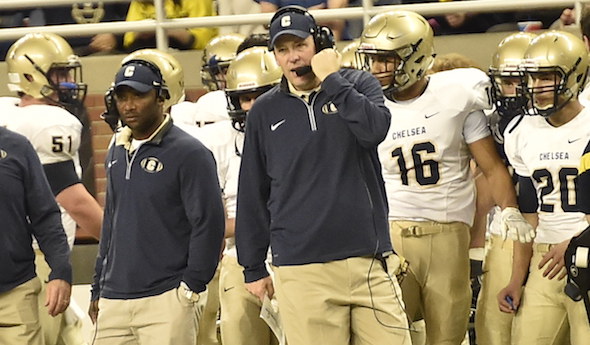
CHELSEA – For the first time as Chelsea High School athletic director, Brad Bush has to hire a football coach.
 What’s more, he has the unenviable task of replacing himself.
“I would say that nobody cares more about Chelsea football than I do,” Bush said. “It’s important to me that we find the very best person we can.”
Bush has coached the Bulldogs for 21 seasons. But, his coaching background goes much deeper than that.
He played at Ypsilanti High School for Hall of Fame coach Bill Giarmo, graduating in 1988. After playing quarterback at Cornell University in the Ivy League, he returned to Michigan, graduating from Eastern Michigan University, and started coaching for Bill Kohn, another inductee to the Michigan High School Football Coaches Association Hall of Fame. Bush then went to East Kentwood to coach with Giarmo.
Through his own playing days, coaching with those legends of the game and absorbing everything he could from afar, Bush has developed an impressive culture at Chelsea.
“Friday nights in Chelsea are a big deal,” he said. “We want to keep that tradition.”
Bush became the varsity head coach at Chelsea in 1997. At the time, Chelsea had only two playoff appearances. Bush’s Bulldogs went 3-6 that first season. After that, Chelsea didn’t have a sub-.500 finish for 15 years. The Bulldogs have been kept out of the playoffs only once since 1998.
Chelsea has had only three head coaches since 1965.
“I’m fortunate,” Bush said. “I went for a few more years than the other guys. It’s a great place to coach.”
Temperance Bedford head coach Jeff Wood was an assistant with Bush at Ypsilanti during the 1990s and said he thought then that Bush was going to develop into a great head coach.
“We knew he was going to accomplish greatness, not only as a football coach, but as a father, husband and professional in education,” Wood said. “Brad has always won and lost with great class and dignity. He’s a true Hall of Famer.”
If Bush never coaches at Chelsea again, his lasting legacy might be that culture surrounding the Bulldogs program. It’s known for its large number of football players, from middle school through the varsity, and a system that ensures every student athlete on every team leading to the varsity will play in every game. Teams at the middle school, freshman and junior varsity levels all start 22 players each game – with no two-way starters. For a Class B/Division 3 school, that isn’t the norm.
“We’ve had the same philosophy for 20 years,” he said. “Everybody plays in every middle school, freshman and junior varsity game. That’s how we do it. We start 22 kids on every level. Our kids know they will have the opportunity to play.
“Every kid on every level is going to play in every game. On most nights, we play more kids than the other team has players.”
While every school loses some athletes, or potential athletes, along the way, Bush said this system helps maintain a student’s interest in the sport. Often, he said, a player who may not necessarily be a starter as a freshman will learn the game, develop and turn into a starter by senior year.
“We feel that, over time, with repetition and practice, a kid will become an expert at his position,” he said. “For us, this is a big piece. … That was my thing here. I didn’t invent it. I absorbed it, watched it at other places.”
It’s tough to argue with the results. Chelsea won or shared Southeastern Conference championships in 1999, 2000, 2001, 2003, 2004, 2006, 2007, 2008, 2011, 2012, 2015, 2016 and 2017. The Bulldogs won seven District championships during the Bush era and played in the 2015 Division 3 championship game, falling to Orchard Lake St. Mary’s at Ford Field
He said he learned how to build a program from Giarmo and how to coach a football team under Kohn. Bush was quick to credit his assistant coaches who have remained with the program for years and helped build the culture. He said the program has sacrificed win-at-all-cost at the lower levels with the goal of developing varsity football players.
“You have to manage it,” he said. “That’s why you need a great staff. We have been lucky here with a great, dedicated group of guys. They always have the ultimate goal in mind.”
Bush said he won’t hamstring the next coach into running his system, but anticipates whoever is hired will buy into the culture after seeing what it’s about.
“The next coach has to run it the way he wants to run it, but I do believe we have created a culture here and we’d like to maintain that. You want to hire the right person who is going to handle the kids the right way.”
In addition to coaching at Chelsea and leading the entire athletic program, Bush also is heavily involved in the Michigan High School Football Coaches Association as a past president, serves on the Michigan High School Athletic Association football committee and has served on the National Federation football rules committee. He’s coached in all-star games and is a true believer in high school sports.
His record at Chelsea is 169-60.
“I have great energy,” Bush said. “I love coaching. I have a great passion for it, but I also know when you need to do certain things. I felt this was just the right time for the athletic department and the football team. It wasn’t one thing that led me to this.
“I love the game. I’m going to be very much involved.”
 Doug Donnelly has served as a sports and news reporter and city editor over 25 years, writing for the Daily Chief-Union in Upper Sandusky, Ohio from 1992-1995, the Monroe Evening News from 1995-2012 and the Adrian Daily Telegram since 2013. He's also written a book on high school basketball in Monroe County and compiles record books for various schools in southeast Michigan. E-mail him at [email protected] with story ideas for Jackson, Washtenaw, Hillsdale, Lenawee and Monroe counties.
PHOTO: Chelsea's Brad Bush coaches his team during the 2015 Division 3 Final at Ford Field.