


Classes Still Create Hoosier Hysteria
July 27, 2017
By Rob Kaminski
MHSAA benchmarks editor
This is the fourth part in a series on MHSAA tournament classification, past and present, that will be published over the next two weeks. This series originally ran in this spring's edition of MHSAA benchmarks.
Twenty years ago, Bloomington North High School won the Indiana High School Athletic Association boys basketball championship, defeating Delta 75-54 at the RCA Dome in Indianapolis.
The date, March 22, 1997, is at the same time revered and disdained by traditionalists in the state who saw it as the last schoolboy championship game the state would ever host.
That’s how devout the game of basketball, particularly interscholastic basketball, had become in the Hoosier state during the 87 years a state champion – one state champion, to be precise – was crowned.
Following that 1997 season, the IHSAA moved to a four-class system for its roundball tournaments, like so many of its state association counterparts had done years earlier.
It would be shocking to find more than a small percentage of current high school basketball players around the country unfamiliar with the iconic movie Hoosiers, even though the film is now more than 30 years old.
And, the storyline for that blockbuster unfolded more than 30 years prior to its release, when small-town, undermanned Milan High School defeated Muncie Central High School 32-30 in the 1954 IHSAA title game.
Perhaps it’s because of the David vs Goliath notion, or the fame of the movie that replaced Milan with the fictional Hickory and real-life star Bobby Plump with Hollywood hero Jimmy Chitwood, or the simple fact that Indiana had something other states didn’t.
Whatever the reason, plenty of opposition remains to this day to basketball classification in the state.
The fact is, the small rural schools were regularly being beaten handily by the much larger suburban and city schools as the tournament progressed each season.
Small schools also were closing at a rapid rate following the state’s School Reorganization Act in 1959, as students converged on larger, centralized county schools. From 1960 to 2000, the number of schools entering the tournament dropped from 694 to 381, and in 1997 a total of 382 schools and 4,584 athletes began competition at the Sectional level (the first level of the IHSAA Basketball Tournament).
It was at the entry level of the tournament where school administrators felt the pain of the new class system, but not necessarily for the same nostalgic reasons as the fans who either attended or boycotted the tournament.
At the Sectional round of the tournament, the IHSAA was culling just 2 percent of the revenue, with the participating schools splitting the balance. So, when Sectional attendance dropped by 14 percent in that first year of class basketball, many schools realized a financial loss. It was money they had grown to count on in prior years to help fund various aspects of the department.
Schools cumulatively received more than $900,000 from Sectional competition in 1998, but that total was down from more than $1 million in the last year of the single-class tournament.
Yet, the current format provides a great deal more opportunity and realistic chances at championship runs for schools of all enrollments.
To date, 60 additional teams have championship or runner-up trophies on display in school trophy cases around Indiana.
That was the mission in front of then-IHSAA commissioner Bob Gardner (now National Federation executive director) once the board made its decision: to give thousands more student-athletes the opportunity for once-in-a-lifetime experiences.
As any statistician knows, figures can be manipulated to tell any side of a story. Declining attendance in year one of class basketball is such a number.
The truth is tournament attendance had been on a steady downward spiral since its peak of just over 1.5 million in 1962. By the last single-class event in 1997, the total attendance was half that.
The challenge then and today, as it is for all state associations, is to find that delicate balance for those holding onto tradition, those holding onto trophies, and the number of trophies to hand out.
Editor’s Note: Stories from the Fort Wayne Journal Gazette in 1998 and from a 2007 issue of Indianapolis Monthly provided facts in this article.
Veteran Comets Prepping for Title Run
By
Pam Shebest
Special for MHSAA.com
March 27, 2018
KALAMAZOO – Golf, barbeque and honoring Martin Luther King Jr. are on the agenda for Kalamazoo Christian’s boys golf team during spring break.
 The six varsity players, coach Brian Seifert and their families are headed to Memphis next week.
“We plan to take in a couple of golf courses down there and also have the opportunity to play the TPC Southwind that hosts the FEDEX St. Jude Classic, so we’re excited about that,” Seifert said.
“We’re going to be at the Martin Luther King Jr. 50th anniversary of his assassination on the actual day, April 4, so it’s a little bit of an inspiration trip along with the golf to get us focused for a big run on the year.
“We’ll be down there to play some golf and eat some barbeque.”
Three of the Comets, who as a team finished third at the Lower Peninsula Division 4 Final last year, had a bit of a delay in starting this season.
They were part of the K-Christian basketball team that lost in the Class D Quarterfinals last Tuesday.
While the rest of the golfers were already practicing, seniors Colin Sikkenga and John Cramer plus junior Ben Cramer did not pick up the clubs until Wednesday.
“The speeds are a lot different,” John Cramer said of the two sports. “After a little bit, you start to get used to golf again. The first week and a half or so, it’s a little tough to make that transition.”
Next sport, new home
Once they make that transition, the team will start the journey to what it hopes is another shot at an MHSAA title.
 “It’s tough to win,” Sikkenga said. “It’s just two days of 18 holes. You’ve just got to get really hot those two days.
“That’s what it comes down to. Anyone can really win it. It just depends on how well you play those two days.”
Last season’s three other varsity golfers also are back: senior Derek Block and juniors Elijah Devries and Josh Bouma.
Although they lost their former home course when Thornapple Creek Golf Club closed last year, they moved to a closer one: Kalamazoo Country Club.
“That is pretty awesome,” said Sikkenga, a finalist for the coaches association’s Mr. Golf Award last year. “I’m excited. Hackett (Catholic Prep) would do their invite there, and I’ve done that since freshman year.”
The country club has not been home to a high school team in 40 years, according to Seifert.
“After 40 years, they said maybe this is the year to do it, and our ‘ask’ was at the right time,” he said. “It’s a matter of timing.”
Two of the golfers, Ben Cramer and Bouma, both caddy there in the summer and know the course layout very well.
“That will help,” Cramer said. “But most of us on the team have played the course quite a few times.”
Valuable experiences
Sikkenga and the Cramer brothers all started swinging the clubs at a very young age, but in different ways.
Sikkenga’s parents do not play golf, while dad Rick Cramer had a membership at Thornapple and started his sons in the sport.
“I had the Little Tike’s blue plastic club and I just started hitting balls,” Sikkenga said. “I loved to hit the ball really far. I think that’s why I liked it so much.”
Hitting the long ball is just one asset that put the scratch golfer on varsity all four years.
“The thing about Colin that is good for everybody else in his leadership is that he is so patient playing golf,” Seifert said of his senior captain. “That’s a real important asset to have in golf because it just takes so long to get around, and you get groups that get stacked up on top of each other.
“Nothing rattles him. That’s a real bonus when you’re playing golf.”
 Sikkenga will attend Oakland University on a golf scholarship with an eye on a pro career.
“My goal since I’ve been little has been to play professionally,” he said. “It’s definitely a goal that is not easy by any stretch of the imagination.”
Oakland golf coach Nick Pumford talked about Sikkenga on the college’s web site.
"Colin brings a lot of national exposure and experience to our program,” he said. “Not only has Colin tested his game against the best players in the country, he's had success doing so.
“I'm looking forward to Colin carrying over that success and experience into our program next season.”
Besides playing their opponents, the Cramers also compete against each other.
“Oh yeah, there’s always a competition with my brother,” John Cramer said. “We always compare scores after the round. I usually win.”
But when a threesome includes their dad, “We’re pretty competitive because we’re all pretty much around the same kind of scoring level,” Ben Cramer said.
“It’s all fun, but our dad usually wins. He’s better than both of us.”
Let the fun begin
While the brothers share camaraderie on the course, one thing they do not share is their clubs.
“His are too short for me,” the 6-foot-5 Ben Cramer said. “(John) is 5-7.”
Seifert calls John Cramer the Magic Man.
“He can get up and down from spaces that most people can’t,” the coach said. “He likes to scramble when he plays golf. It’s not uncommon for him to run together five, six long putts in a row for par or birdie just to keep the round going.
“Golf’s a matter of streaks sometimes. You get on a roll, and he can find those sometimes and put quality rounds together.”
It is also a mental game, Ben Cramer said.
 “You have to be focused all the time when you’re around the ball. You have to focus on how far you’re hitting, what the wind’s doing.”
Cramer describes himself as the jokester of the team.
“I joke around a lot,” he said. “I lighten the mood. I’m never really sad.”
Seifert agreed.
“Ben carries us well with his humor,” he said. “The whole team is a load of fun to be with. For him, he’s so quiet and unassuming that you would never know if he’s having a good round or a bad round. It’s kind of like calling him patient.
“He doesn’t get down on himself. I think that’s where I noticed him being the most improved last year. He got better with each shot. Even if he did hit a bad shot, the next one was right on the money.”
None of the three boys have had hole-in-one, but their coach, who is a pastor at Milwood Community Church, has had two.
“My mom taught me to play golf when I was 5, and I haven’t stopped since,” said Seifert, who grew up outside of Seattle.
“For a number of years I managed a golf resort, so I played a lot of golf that way.”
In addition to his two aces, “I also had a double eagle, an albatross,” he said. “I’ll take that.
“Golf’s meant to be having fun, and it’s hard to score when you’re not having fun. If you’re not enjoying it, there’s no point doing it.”
 Pam Shebest served as a sportswriter at the Kalamazoo Gazette from 1985-2009 after 11 years part-time with the Gazette while teaching French and English at White Pigeon High School. She can be reached at [email protected] with story ideas for Calhoun, Kalamazoo and Van Buren counties.
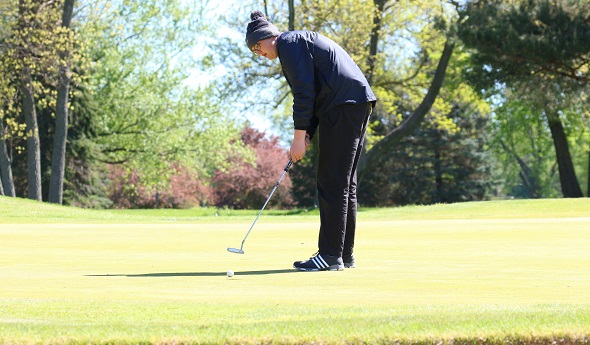
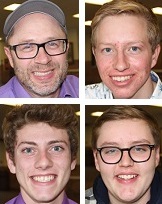
PHOTOS: (Top) Kalamazoo Christian’s Ben Cramer lines up a putt. (Middle top) Clockwise from top left: Kalamazoo Christian coach Brian Seifert, senior Colin Sikkenga, senior John Cramer and junior Ben Cramer. (Middle) Seifert, left, and Sikkenga survey the scene during play last season. (Below) John Cramer putts last spring. (Action photos by Daniel J. Cooke [top two] and Cheryl TenBrink, head shots by Pam Shebest.)