


Classes Still Create Hoosier Hysteria
July 27, 2017
By Rob Kaminski
MHSAA benchmarks editor
This is the fourth part in a series on MHSAA tournament classification, past and present, that will be published over the next two weeks. This series originally ran in this spring's edition of MHSAA benchmarks.
Twenty years ago, Bloomington North High School won the Indiana High School Athletic Association boys basketball championship, defeating Delta 75-54 at the RCA Dome in Indianapolis.
The date, March 22, 1997, is at the same time revered and disdained by traditionalists in the state who saw it as the last schoolboy championship game the state would ever host.
That’s how devout the game of basketball, particularly interscholastic basketball, had become in the Hoosier state during the 87 years a state champion – one state champion, to be precise – was crowned.
Following that 1997 season, the IHSAA moved to a four-class system for its roundball tournaments, like so many of its state association counterparts had done years earlier.
It would be shocking to find more than a small percentage of current high school basketball players around the country unfamiliar with the iconic movie Hoosiers, even though the film is now more than 30 years old.
And, the storyline for that blockbuster unfolded more than 30 years prior to its release, when small-town, undermanned Milan High School defeated Muncie Central High School 32-30 in the 1954 IHSAA title game.
Perhaps it’s because of the David vs Goliath notion, or the fame of the movie that replaced Milan with the fictional Hickory and real-life star Bobby Plump with Hollywood hero Jimmy Chitwood, or the simple fact that Indiana had something other states didn’t.
Whatever the reason, plenty of opposition remains to this day to basketball classification in the state.
The fact is, the small rural schools were regularly being beaten handily by the much larger suburban and city schools as the tournament progressed each season.
Small schools also were closing at a rapid rate following the state’s School Reorganization Act in 1959, as students converged on larger, centralized county schools. From 1960 to 2000, the number of schools entering the tournament dropped from 694 to 381, and in 1997 a total of 382 schools and 4,584 athletes began competition at the Sectional level (the first level of the IHSAA Basketball Tournament).
It was at the entry level of the tournament where school administrators felt the pain of the new class system, but not necessarily for the same nostalgic reasons as the fans who either attended or boycotted the tournament.
At the Sectional round of the tournament, the IHSAA was culling just 2 percent of the revenue, with the participating schools splitting the balance. So, when Sectional attendance dropped by 14 percent in that first year of class basketball, many schools realized a financial loss. It was money they had grown to count on in prior years to help fund various aspects of the department.
Schools cumulatively received more than $900,000 from Sectional competition in 1998, but that total was down from more than $1 million in the last year of the single-class tournament.
Yet, the current format provides a great deal more opportunity and realistic chances at championship runs for schools of all enrollments.
To date, 60 additional teams have championship or runner-up trophies on display in school trophy cases around Indiana.
That was the mission in front of then-IHSAA commissioner Bob Gardner (now National Federation executive director) once the board made its decision: to give thousands more student-athletes the opportunity for once-in-a-lifetime experiences.
As any statistician knows, figures can be manipulated to tell any side of a story. Declining attendance in year one of class basketball is such a number.
The truth is tournament attendance had been on a steady downward spiral since its peak of just over 1.5 million in 1962. By the last single-class event in 1997, the total attendance was half that.
The challenge then and today, as it is for all state associations, is to find that delicate balance for those holding onto tradition, those holding onto trophies, and the number of trophies to hand out.
Editor’s Note: Stories from the Fort Wayne Journal Gazette in 1998 and from a 2007 issue of Indianapolis Monthly provided facts in this article.
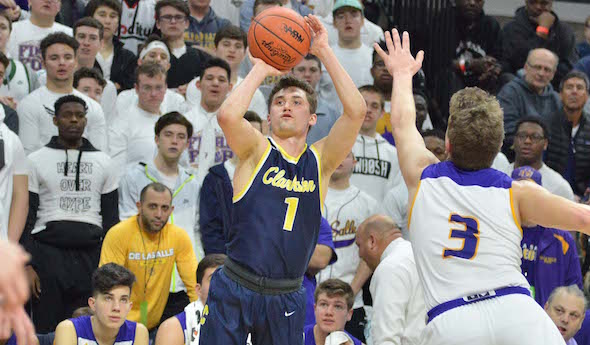
Lights-Out Loyer Leads Clarkston to Final
March 23, 2018
By Geoff Kimmerly
Second Half editor
EAST LANSING – Warm-ups don’t count, but it seemed like Foster Loyer couldn’t miss while getting ready for Friday’s first Semifinal at the Breslin Center.
The last four seasons, that’s been a good sign for Clarkston.
The Wolves’ senior point guard went on to make 12 of 17 shots from the floor and score 42 points – becoming the fifth player ever to drop at least 40 in a boys basketball Semifinal – in leading reigning champ Clarkston back to the Class A Final with a 74-49 win over Warren DeLaSalle.
Loyer scored 17 of his team’s 23 first-quarter points, on 6 for 10 shooting, as the Wolves quickly built a double-digit lead that never fell below nine points the rest of the game.
“When he gets going, there are not a lot of people who can stop him,” Clarkston senior backcourt mate CJ Robinson said. “When he gets going like that, we try to key on getting him the ball. He knocks shots down for us, and it opens things up for others, and he does a good job of finding everybody.”
Clarkston (25-1) will attempt to finish a repeat at 12:15 p.m. Saturday against Holland West Ottawa.
Loyer drained seven 3-pointers among his 12 field goals and all 11 of his free throw attempts – against a DeLaSalle defense focused on slowing down the recently-named Mr. Basketball Award winner and Michigan State recruit.
“I don’t think in 31 years of being a varsity coach that anyone has remotely scored that many points,” Pilots longtime leader Greg Esler said. “I think about when we were here in (20)07, Manny Harris had 13. But the thing about Loyer that’s so good is he’s so deceiving – he reminds you of Cassius Winston in the fact that he’s not the most athletic guy, he might not be the fastest but all of a sudden he’s shooting the 25-footer and getting to the rim and making everybody on his team better. So there’s no question, he’s a winner.”
 Those comparisons, of course, are high praise – Harris, who went on to star at Michigan, had 14 for Detroit Redford in a Semifinal win over the Pilots that season, and DeLaSalle saw its share as well of Detroit U-D Jesuit’s Winston, who’s currently running the point for MSU.
Longtime Clarkston coach Dan Fife extended the praise to include Robinson, who had nine points and five assists while sharing a game-high 31 minutes on the floor.
“When you’ve got two guards who can play like this, it makes it a lot easier to coach,” said Fife, who’s in his 36th season. “My first year coaching, we had a bunch of bigs, and our guards weren’t near like this, we played Flint Central and we just got tattooed because we couldn’t handle the pressure. These guys handle the pressure.
“The two of them feel comfortable, and it makes everybody else relax a little bit.”
As a team, it was a smooth performance. The Wolves had only 10 turnovers to 11 assists and made 53 percent of their shots from the floor.
“I think as a point guard, for both of us, it’s important that we’re in control of the pace of the game, that we play how we want to play,” Loyer said. “Just to come out and throw that first punch and get an early lead is very important for us.”
Of course, Clarkston has more than great guards – senior forward Taylor Currie, headed to Wisconsin after graduation, chipped in 16 points and 12 rebounds and had the first basket of the game. As a team, the Wolves outrebounded the Pilots 36-19.
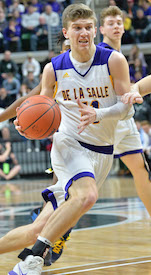
Senior forward Luke Pfromm led DeLaSalle (19-8) with 17 points, while senior forward Jordan Winowiecki had 12 and senior forward Kole Gjonaj had 10. Senior guard Justin Fisher had nine assists.
PHOTOS: (Top) Clarkston’s Foster Loyer launches a shot during Friday’s Semifinal win over Warren DeLaSalle. (Middle) DeLaSalle’s Justin Fisher had nine assists and four points for the Pilots.