

CAP Begins 2014-15 on Record Pace
By
Geoff Kimmerly
MHSAA.com senior editor
August 22, 2014
Gretchen Mohney has come to recognize coaches who think they already know it all.
Then she begins a Coaches Advancement Program lesson by describing an orange banging around inside a fishbowl – a metaphor to explain the brain inside an athlete’s skull when he or she suffers a concussion.
Her most powerful lessons have moved pupils to tears. And it’s always gratifying to witness the “Aha” moments that make the CAP educational experience so powerful.
“My favorite is when they admit that they’ve done something wrong, and they want to know how to do something better,” said Mohney, a highly-respected trainer and strength and conditioning coach who also serves as an instructor for the athletic training program at Western Michigan University. “It’s a pretty awesome moment when they realize there’s more to learn.”
More current and aspiring coaches than ever before are taking advantage of that opportunity as the 2014-15 school year kicks off.
Since this training year began July 25 at Battle Creek Lakeview, 273 current or aspiring coaches have completed CAP sessions – nearly twice as many coaches as this point a year ago and with the last session of August planned for Saturday at New Buffalo. That makes this the busiest start in CAP history, according to MHSAA assistant director Kathy Vruggink Westdorp, who joined the MHSAA staff in 2004, developed CAP for the 2004-05 school year and continues to oversee the program.
This first month’s total attendance also represents 33 percent of the 818 total CAP units completed at high schools and the MHSAA office during all of 2013-14.
“I think the big thing continues to be word of mouth that this is a quality program,” said Hamilton athletic director Jerry Haggerty, a CAP instructor for nine years. “It’s good for all coaches of all experience levels.”
Setting a standard
Since the program’s inception, nearly 6,300 coaches have completed at least the first-level unit. More than 1,000 have advanced through CAP 4.
The CAP program is broken into six levels, each addressing a set of topics:
- CAP 1: Coaches Make the Difference, The Coach as Teacher, Sports Medicine and First Aid.
- CAP 2: Effective Communication, Legal Responsibilities, Psychology of Coaching.
- CAP 3: Additional Coaching Responsibilities, Effectively Working with Parents, The Coach as Performer.
- CAP 4: Understanding Athletic Development, Strength and Conditioning, Preparing for Success.
- CAP 5: Healthy Living, Teaching Emotional Toughness, Resolving Conflicts in Athletics.
- CAP 6: Current Issues and Topics in Educational Athletics.
“Individuals who go through this have a better understanding of their philosophy, their school’s philosophy, their role and responsibility as well as the meaning behind MHSAA rules,” said Westdorp, a former principal, athletic director, teacher and coach in the Grand Rapids area who was named 2013 Coach Educator of the Year by the National Federation of State High School Associations (NFHS) for her work with the program.
She trains and evaluates all presenters and instructors, including those who last school year administered 1,238 CAP sessions at seven universities and colleges across both peninsulas.
The non-college CAP sessions are taught by 20 instructors who pride themselves on being available anywhere there’s interest. CAP has been presented at 10 Lower Peninsula schools over the last month, with Upper Peninsula sessions planned for this fall. August 9 was particularly busy – units were taught at Jonesville, Pontiac Notre Dame Prep and Riverview Gabriel Richard – but Westdorp sees the possibility of presenting at up to five sites on the same day.
Flexibility also is an option; a group of mostly non-school coaches took CAP 2 last week in Baldwin, and were able to complete the course over two days instead of one so they could do so without interrupting their fulltime jobs. For coaches working in schools, CAP units can qualify as continuing education credits with the State Department of Education.
Colleges and universities in Michigan are licensed to present up to five levels through their undergraduate or graduate studies, and the list of those who completed courses the last few years is filled with recognizable names of former high achievers on MHSAA courts and fields. Southwestern Michigan College in Dowagiac will offer courses for the first time this fall.
Certification in the program occurs after completion of CAP 1 and 2, and then after each subsequent unit, with those completing CAP 6 earning Masters Elite Certification.
The topics of CAP sessions “bleed” into each other, Mohney said, and come with plenty of first-person examples to make them relevant to coaches who then realize they aren’t alone facing issues most encounter.
“I talk to them because I’ve been there. … (I say,) ‘Now, let’s talk real.’ I place them in a real situation,” Mohney said. “’The biggest thing is you guys don’t have to know everything. You just need to coach, be aware of this, this and that. And these are some ideas to go about your plan so you can decrease your stress.’
“Any time a coach hears that, it’s a beautiful thing. Because I’m not sure what coach in high school is in coaching for the money.”
Raising the bar
Certainly, some of this month’s heightened CAP participation can be attributed to an MHSAA Representative Council action in March. Beginning Aug. 1, 2016, varsity head coaches hired for the first time at an MHSAA member school must have completed CAP 1 or CAP 2. Westdorp said some who wish to become head coaches in that near future are getting a jump by completing CAP courses now.
But that’s only a slice of the success story.
Haggerty has directed Hamilton’s athletic department for 15 years and said all of his coaches have taken either CAP 1 or 2. Many coaches take the courses on their own; others are required to do so by their athletic directors.
The Capital Area Activities Conference will offer CAP 1 three times this school year, with 100-150 coaches from their 20 member schools expected for each session. Others leagues and conferences are designing similar arrangements.
Michael Roy coached boys basketball at Lawton and girls hoops at Vicksburg and was certified under the predecessor to CAP – the MHSAA’s former Program for Athletic Coaches’ Education (PACE). He’s beginning his 13th year as Vicksburg’s athletic director, and after hosting several CAP classes over the years decided to begin the program himself this month.
“The need for knowledgeable and experienced coaches is greater than ever before. I thought if I was going to make it mandatory for my coaches to become CAP certified, that I needed to get CAP certified and lead by example,” Roy said. “The heart of any athletic team or program is its coaching staff. CAP is the surest way for coaches to access everything they need to know how to be a good coach. They learn the art of effective coaching through one of the best-designed coaches education programs in the country. CAP is second to none.”
Haggerty has spoken with athletic directors who have completed the program and then recognize when their coaches employ strategies learned at CAP sessions. An increasing pool of coaching candidates are heading into interviews with CAP certification in hand, and Westdorp has seen coaches bringing their CAP binders to practices to have those lessons available for quick reference. She’s also watched many CAP graduates using their skills at the highest level – the MHSAA Finals.
A comment by Duke men’s basketball coach Mike Krzyzewski sits at the front of those CAP binders: “A common mistake among those who work in sport is spending a disproportional amount of time on x’s and o’s as compared to time spent learning about people.”
Haggerty starts each session telling his pupils, “I do this for two reasons; one because I think it’s important to look at the non-x and o coaching realms; and two, because this is great fun for me.’”
And those coaches who come into CAP thinking they know enough? Mohney said most finish the first unit looking forward to beginning the next.
“CAP has a lot to do with understanding what you’re about, understanding your role and responsibility in athletics and your leadership role,” Westdorp said. “When I start programs, I talk about my work roles in life, and then (I tell coaches), ‘I want to tell you where I felt I was more influential, and that was as a coach.
“’And don’t ever forget it..’”
Click for more on the Coaches Advancement Program.
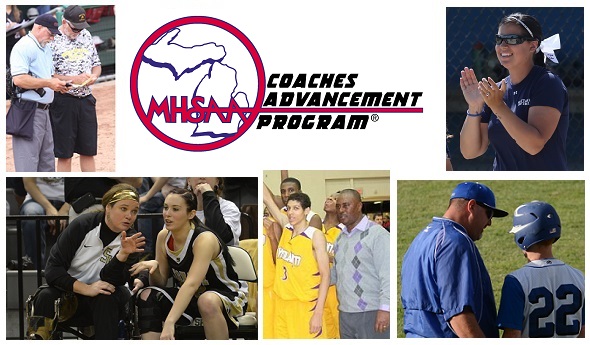
PHOTOS: These coaches, counter-clockwise from top left, all have completed at least one CAP unit: Bay City Western softball coach Rick Garlinghouse, St. Ignace girls basketball coach Dorene Ingalls, Ypsilanti Community boys basketball coach Steve Brooks, Beal City baseball coach Brad Antcliff and Mattawan softball coach Alicia Smith.
Heartfelt Thanks for a Life Saved
By
Geoff Kimmerly
MHSAA.com senior editor
November 13, 2012
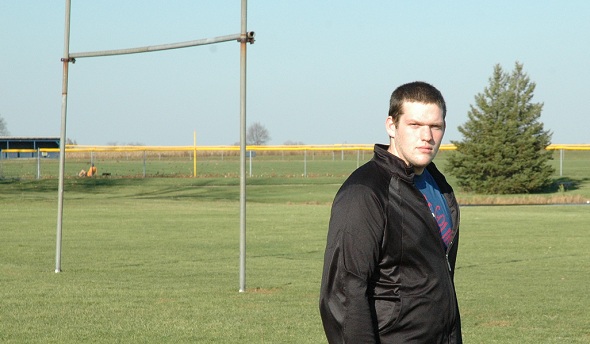
ELSIE – Like many who have played high school football, the practice field will always be more than just another piece of lawn to Ovid-Elsie’s Chris Fowler.
Over his right shoulder, beyond a few of the fields that surround his high school, sits his family’s house. To his left is the finish to the school’s cross country course his younger sister was preparing to run the day his heart stopped beating.
In this spot, on Oct. 9, the 16-year-old Fowler collapsed while he and his teammates ran 40-yard sprints. His heart, for reasons doctors could not explain, went into an irregular rhythm that caused him to go into cardiac arrest.
“It still doesn’t (make sense),” Fowler said two weeks later. “I try to forget it as much as I can. It’s not worth remembering. I don’t want to think about it.”
But the Marauders sophomore will always remember those who brought him back to life that day.
Thanks to the quick, calm response of Ovid-Elsie football coach Travis Long and his staff, and the speedy work of athletic director Sonya Latz to retrieve the school’s AED device, Fowler’s heart was shocked back to life.
Unlike too many national news stories lately of athletes who died far too soon of similar circumstances, this story ends well.
Fowler’s father Dave knows it is because every detail was carried out to perfection. Standing near the cross country finish line, he was there to watch it all.
“Truthfully,” Dave said, “I thought it was the end of my world.”
Trying to remember, trying to forget
Both father and son knew the story of Fennville’s Wes Leonard, who died from sudden cardiac arrest after making the game-winning shot in a basketball game March 3, 2011.
They hadn’t heard of the all-state football and basketball player before that day, but Dave began following the story as it became national news and spurred an effort to have AEDs in every school.
AED stands for automated external defibrillator. The device combats sudden cardiac arrest by detecting an irregular heart beat and delivering a shock that can put the heart back into correct rhythm. Ovid-Elsie High School has two. The first was purchased through the Kimberly Anne Gillary Foundation, which was started after Gillary, a student at Troy Athens, died of sudden cardiac arrest during a water polo game in 2000. The second was donated by alum and former basketball player Daryl Melvin, now a cardiologist in Lansing.
Chris remembers reading about Leonard’s death the day after and thinking there was no way it could happen again to someone like him.
Dave Fowler recounts in his head daily how it nearly did.
The image he can’t get out of his mind is that of Chris’ coaches flipping him over and starting chest compressions.
“It’s just like it was unreal. It was like a bad dream I was waiting to wake up from,” Dave said.
Chris remembers none of it.
He’s a strong student who even before this was considering becoming a doctor. He’s the middle child of three – sister Maria graduated in the spring, and Morgan is in eighth grade. Basketball is Chris’ favorite sport, and he also played soccer growing up – but frequently was carded for running over opponents.
 So logically, in eighth grade, he gave football a try. Two years later, at 6-foot-3 and 265 pounds, Fowler was a starting offensive tackle on the varsity.
The Marauders’ Oct. 9 practice was dedicated to defense. Fowler took a shot to the ankle and rolled it, and remembers mentioning it to quarterback Jake Helms. That was probably about 25 minutes before the team began its daily conditioning, a set of 20 short sprints run at half to three-quarters speed.
Dave watched his son run while waiting for Morgan’s race to begin. Her mom Amy was at the starting line, and their grandparents also were in attendance, part of a larger crowd because the cross country jamboree included multiple teams from all eight schools in Ovid-Elsie’s league.
And then shock. “I knew what was going on,” Dave said. “But it was denial that I was really seeing what I was seeing.”
Call to quick action
Suddenly, Chris was face down on the ground.
Only moments later, Long and assistant Brad Sutliff were flipping him over. Long, a physical education teacher at the school, began the chest compressions. Another coach blew breaths into Fowler’s lungs.
Dave, perhaps acting on instinct as much as anything, yelled for anyone to find his wife. He took off toward Latz, who also had made her way to the cross country finish area, yelling for her to get the AED.
Word of Fowler's dire situation quickly made its way through the crowd. The Bullock Creek cross country team, surely among many others, began to pray. And Dave will never forget watching Chris’ teammates, standing a short way off, yell at him, “Don’t give up! Keep fighting!”
Latz, in the school’s Mule utility vehicle, raced to the trainer’s room, grabbed the AED and raced back. A parent from another school who is a nurse asked if she could help and took the AED to the coaches, who connected it to Fowler.
The AED gives the user explicit instructions on how to operate it, including where to attach connections and when to step away as to avoid also receiving a shock.
Sutliff was holding Fowler’s head and didn't want to set it down. But he had to – the shock was so strong it lifted Fowler’s body off the ground.
The jolt also reset his heart.
The next thing Fowler remembers, he was in the ambulance on the way to Sparrow Hospital in Lansing, vomiting. And he couldn't see. He flashed his hand in front of his face, trying to find it. It was then that he found out his heart had stopped.
After a night at Sparrow, Fowler was taken to the University of Michigan’s C.S. Mott Hospital, where he spent five days. Fowler went through the battery of tests. No problems were found. The family doesn't have a history of heart trouble. Doctors said there were no blockages.
“They said basically that it’s a miracle. There are no side effects, none whatsoever,” Dave Fowler said. “No heart damage, no organ damage. The neurologist said his brain function is perfect; there’s nothing wrong with it. And they all say that stems from the quick reaction from the coaches. … The doctor said he’s never seen chest compressions done that well.”
Ovid-Elsie has a disaster plan in place for situations like these, but had never had to put it into play for a life-threatening situation as long as Latz has been part of the athletic staff – dating back to her first year coaching in 1989.
It went off without a hitch. The whole process of starting compressions, retrieving and hooking up the AED and restarting Fowler’s heart took maybe a bit more than five minutes.
“The coaching staff is amazing, how smooth and calm everybody kept just to do their jobs. I’m just amazed,” Latz added. “I shouldn't say ‘amazed.’ Because I trust that they are very good. I’m just proud of the way they handled everything.”
She added that Ovid-Elsie’s National Honors Society has asked about raising funds to purchase an AED for a school that doesn't have one.
Many thanks to give
Fowler wears two bracelets he received while at U-M. One reads “Hearts working together,” and the other “And the beat goes on.” He was considering becoming a neurologist some day, but now cardiology seems pretty cool.
 Fowler’s friends don’t ask much about that day. They know he’s trying to block it out of his memory. But others do ask the “ridiculous questions. Like, you know, what did it feel like to be dead?”
His response: “I just say I wasn't getting oxygen to my brain, so I don’t remember anything.”
The questions don’t make him angry. It’s easy to figure out quickly that Fowler is the type to let such things just roll off.
When Fowler does hear his story re-told, he feels like it’s about someone else.
But he’s a smart guy, and he’s heard enough doctor talk to understand what’s going on.
The biggest bummer is he can’t play basketball. His career in contact spots is over. That leaves golf, and he might take it up eventually. This winter, he’s going to be on the bench with his varsity teammates and he’ll help with the freshmen team and perhaps Morgan’s eighth-grade team too.
He still sounds like a football player. “It’s a lame scar,” he said of the small cut under the front of his left shoulder. Embedded in a “pocket” under his skin on the left side of his chest is an implantable cardioverter defibrillator – or ICD – meant to automatically shock his heart back into rhythm if it falls out of beat again.
Fowler came back for a football practice before the Marauders season ended, and also for the parents’ night game. He’ll still be part of that program next year too. “The joke around town is I’ll be the offensive coordinator,” Fowler said.
Dave still asks himself the what-ifs of that day. He looks at his family differently. Too many times during the day he pictures those chest compressions. It’s hard for him to leave home, and he doesn't sleep well. And he’s pretty sure Chris is getting tired of his parents peeking into his room at night to make sure all is well.
Perhaps. But Fowler also has never been one to take anything for granted – although that’s another part of what makes this situation tough. He’s always one to show gratitude, but he can’t remember right now all the people he’d like to thank. He’s just doing his best.
“I can’t remember. There are so many people. I saw some people at the football game, and I just walked up and said thank you,” Fowler said. “Because they were there, praying for me or whatever.
“I’m very fortunate. It’s unbelievable.”
Click to see more from the Wes Leonard Heart Team or the Kimberly Anne Gillary Foundation.
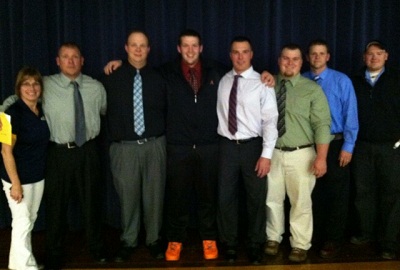
NOTE: Chris Fowler's parents Dave and Amy would like to give special thanks to those pictured with their son (in suit and orange shoes) above: athletic director Soni Latz and football coaches Brad Sutliff, Eric Jones, Jeremy Palus, Cody Staley, Travis Long and Dustin Thiel.
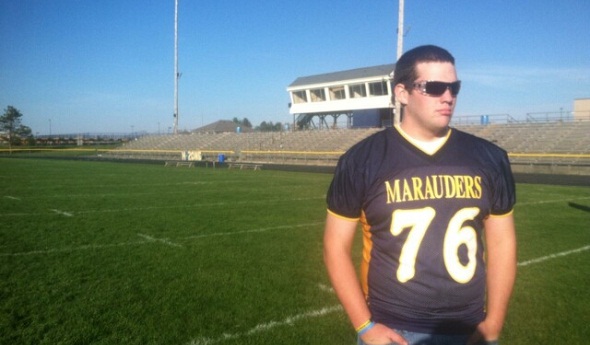
PHOTOS: (Top) Chris Fowler stands in the place on Ovid-Elsie's practice field where coaches worked to restart his heart on Oct. 9. (Middle) Fowler, in his game jersey, stands on Ovid-Elsie's football field. (Bottom two photos courtesy of the Fowler family.)