

A League of Their Own in Illinois
May 20, 2014
By Rob Kaminski
MHSAA benchmarks editor
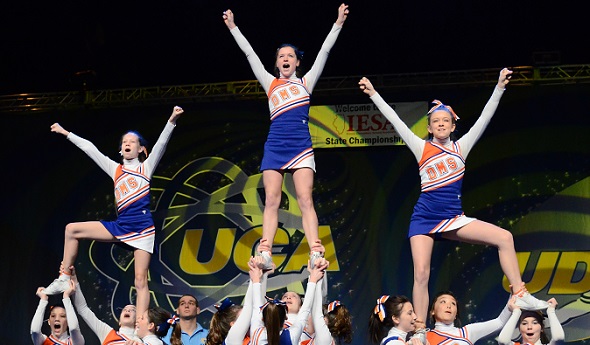
Imagine the scene: thousands of spectators roaring their approval as hundreds of cross country runners hit the finish line. A couple thousand others cascade applause on the wrestling mats as referees raise the hands of 19 champions.
Now, here’s the kicker, imagine this is taking place during postseason play for junior high/middle school student-athletes.
Again, that’s postseason, and junior high/middle school.
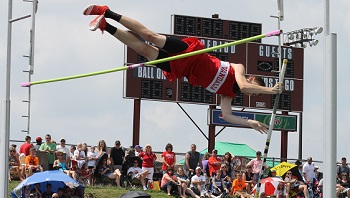
 “I guess when you see a kid cross the finish line in first place and 5,000 people are cheering, or watch a student run a race, throw the shot, or pole vault in front of that many at our track & field series, the proof is in the pudding,” said Steve Endsley, executive director of the Illinois Elementary School Association.
“The environment, the feedback we get; it’s the greatest thing in the world to some who experience our tournaments. But, I temper that in saying this is not the Olympics, the pros, or even high school. Success at our level doesn’t guarantee future success. We want you to do your best, we want to prepare you to do your best, but understand this is junior high.”
If understanding that is difficult for some athletes and parents involved in IESA athletics, it’s also a foreign language to state high school associations across the country. The IESA is the only organization in America which exclusively governs interscholastic activities for grade levels 7-8.
Most states include junior high/middle schools in their rules and regulations, but few, if any, conduct tournaments.
“We’ve been doing it for so long, it’s accepted. Schools know that at the end of the regular season, they enter Regional play. The payoff is we have state series, a culminating activity, and it’s a good thing that’s going on,” Endsley said.
From the organization’s first postseason event in 1930 during which boys basketball tournaments took place in a lightweight (boys less than 100 pounds) and a heavyweight division, the IESA has grown to sponsoring more than 20 boys and girls activities.
 Measures have been taken in recent years to alleviate travel concerns at the end of the season. The IESA has added classifications in some sports, while keeping the number of teams which advance to the Finals the same. So, for instance, where 16 teams might have gone to two different sites in the past, now four different sites host eight schools.
Admittedly, Endsley adds that the tournament series might add to some competitiveness, but since all schools enter the tournament, there might be less emphasis on winning during the regular season, and thus, heightened participation for those of all skill levels.
“If you don’t want the win-at-all-cost mentality, then step up to the plate at your member school and handle it that way,” Endsley said.
The refrain from association leaders around the country is that success in conveying the values and ideals of school sports is totally dependent on those in charge at the local level. Beginning with the 2012-13 school year, the IESA put more of that load squarely on the individual schools by making it a local decision as to whether students could participate with the school team and a club team in the same sport during the same season.
“From an association standpoint, it seemed like only people we were penalizing when had the limitations were the honest schools which self-reported,” Endsley said. “It was difficult to penalize those schools while everyone else knew the school down the street didn’t report.
“In a perfect world, the participation rule would be in place. But, it’s not a perfect world. Club sports schedule in accordance with high school seasons, but disregard our level when it comes to non-school activity. It’s year-round. So it’s practically impossible to equitably enforce it from a state level.”
There are more than 800 member schools in the IESA, which is an affiliate member of the National Federation of State High School Associations, but a separate entity from the Illinois High School Association.
Endsley estimates the IESA comprises 50-60 percent of eligible schools in Illinois, bolstered by unique membership options which differ from the IHSA and many state associations.
“We offer a la carte membership. A school can offer activities and maybe not participate in our state series. It’s only in those activities in which schools participate in the IESA state series that they must abide by our rules and regulations. Schools want some control. I think a la carte way is the way to go.
“If they join the IESA for one sport, they receive all mailings and information, so maybe one sport gets them in, but they may later add activities. If they are not a member, they don’t know about us.”
Yet, while separate bodies, the IESA and IHSA work hand-in-hand in many respects since nearly 100 percent of the IESA’s students will matriculate into IHSA schools.
“We attend the IHSA activity advisory meetings so we can keep a finger on the pulse of topics they are discussing and items they are considering. From the student standpoint, we will take our champions and introduce them in ceremonies at the IHSA Finals when our calendars line up,” Endsley said. “They get tickets, halftime introductions, pictures in the program, and it’s well-received recognition.”
Such activities are possible because the IESA seasons are different than the IHSA’s in some sports, or end sooner. For instance, the IESA plays baseball and softball in the fall, so its champions are recognized at the IHSA Finals in the spring.
“These activities create exposure and help build interests and aspirations for our schools,” Endsley said. “It’s nice P.R. for both associations.”
Whether different seasons or same seasons, the multitude of events throughout Illinois provides ample opportunity for the state’s contest officials as well. That’s another area in which the IESA and IHSA work together.
“We don’t license officials in the IESA, but we require our schools to use IHSA officials,” Endsley said. “We get great cooperation from the IHSA, it’s a good situation for our schools, and it’s a really good thing for officials. There are always plenty of games, and new officials gain valuable experience.”
Now in the midst of its ninth decade, the IESA continues to expand, adding boys and girls bowling and golf to its roster of activities in 2011.
The Association sponsors athletics for 7th- and 8th-graders, but 5th- and 6th-graders enrolled in a member school may participate with 7th-and 8th-grade teams within that building without a waiver. If such students are in an elementary school which feeds a member school, waivers are necessary.

Coaches Get U-M Concussion Training
July 24, 2012
Already administering a strong set of protocols addressing the removal and return to play of young athletes suspected of sustaining concussions in competition, the Michigan High School Athletic Association is further ramping up its concussion education efforts of coaches, student-athletes and parents as the 2012-13 school year approaches.
In partnership with the University of Michigan’s NeuroSport and the Pediatric Trauma Program at C.S. Mott Children’s Hospital, required online rules meetings for coaches and officials will include an education component illustrating the serious nature of concussions; recognition of the signs and symptoms; a review of return to play protocols; applicable MHSAA regulations; and downloadable co-branded resources from NeuroSport, as well as materials produced by a joint effort of the Brian Injury Association of Michigan, the Detroit Lions, the Center for Disease Control and the MHSAA.
This is the second year the MHSAA has included concussion education in its online rules meetings, which are annually viewed by nearly 20,000 coaches and game officials. This year, the Michigan NeuroSport Concussion Education - High School Coach edition, endorsed by the American Academy of Neurology last fall, has been modified for the MHSAA audience. The MHSAA will also promote the availability of the NeuroSport concussion education modules offered specifically for parents and coaches.
“These educational efforts, coupled with protocols addressing concussions when they take place on the field of play, put our schools in the best possible position to minimize the risk to young people,” said John E. “Jack” Roberts, executive director of the MHSAA. “We’re pleased to have our new partnership with University of Michigan NeuroSport and our ongoing partnership with the Brian Injury Association of Michigan which put our state at the forefront of addressing the critical health issue for interscholastic athletes.”
Roberts added that the same educational materials the Association has co-branded with its partners will also be used to help raise concussion awareness in other youth sports by other sponsors in the state.
“We are proud to partner with MHSAA and bring the most up-to-date concussion education to those on the frontline of athletics. Education is a vital component to improving player safety,” says Amy Teddy, injury prevention program manager at C.S. Mott Children’s Hospital. “We believe that ‘It takes a team to keep concussions on the sidelines.’ Parents, coaches, teammates, officials and athletic trainers all have a role in protecting athletes from serious injury.
“In addition to our coach modules, we recently launched our parent edition to help another member of the ‘team’ better recognize and understand concussion.” added Teddy, who also is director of education for Michigan Neurosport.
The NeuroSport online programs for parents, high school coaches and youth sports coaches is now available at http://www.MichiganNeuroSport.com. An online program for athletes will be available soon.
NeuroSport has also produced a 60-second public service announcement in which one of the state’s all-time winningest football coaches – John Herrington of Farmington Hills Harrison – talks about concussions. This video, along with a 30-second PSA recently updated by the MHSAA, “No Such Thing As Just Getting Your Bell Rung,” will be made available to media outlets in time for the coming sports season, and will be shown during MHSAA programming online and on cable television.