

Lessons Passed Down the Coaching Tree
By
Geoff Kimmerly
MHSAA.com senior editor
July 18, 2013
Lessons, like legends, are meant to be passed from generation to generation.
And just as parents hand them down to their children who then do the same, coaches teach athletes the best of what they learned as athletes themselves. Some of those athletes then become coaches as well, and in turn, educate a next group of teenagers growing up in part through their participation in sports.
As we begin to turn our eyes toward another school year beginning next month, here are a few favorite lessons taught by four recent participants of the MHSAA’s Coaches Advancement Program – with back stories on how they learned those lessons themselves and explanations of why passing them on continues to be important.
We are family
Steve Brooks
Ypsilanti boys basketball
Bio: Brooks led the Ypsilanti High School program the last 10 seasons, guiding the Phoenix last winter to its first Regional championship since 1981. He has been selected as the first boys basketball coach for the newly-formed Ypsilanti Community Schools, a merger of the former Ypsilanti and Willow Run districts. Previously, he coached three seasons at Inkster and also led that program to the Quarterfinals.
Lesson learned: Brooks was in fourth grade when he and a friend happened to ride their bike past Flint Northern’s football practice field during one of coach Fred Crawford’s training sessions. The noise and excitement and especially the defensive coaches yelling first caught the kids’ attention; Brooks and his friend ended up watching through the fence until Crawford approached and asked if they’d like a closer look. “He said, ‘Hey, you’re going to be a Viking one day, aren’t ya?’ It was so simple. But it made an impression on me as a young man, the pride and tradition of going there,” Brooks said.
Brooks’ family later moved to a neighborhood in Flint Northwestern’s district. But when the school boundary was redrawn before his junior year – and he had his choice of staying or attending Northern – Brooks remembered saying he would be a Viking one day and made the switch. Building togetherness remains a major focus of Brooks’ Ypsilanti program today, 49 years after Crawford first invited him into Northern’s football family.
Lesson taught: “At any time, our players can come in and talk about personal things and feel like they can let stuff out and it won’t go further than the people it’s entrusted to,” Brooks said. Making a connection to players begins early through his middle school coaches and remains key to building that familial trust.
It’s a philosophy that goes to Brooks’ core. “When you’re starting to coach nephews and younger brothers of players you’ve had, it’s that same type of feeling and promoting of family,” Brooks said.
Do the right thing
Heather Prentice
Portage Northern competitive cheer
Bio: Prentice has coached Portage Northern the last eight seasons and guided the 2007 and 2008 teams to the MHSAA Finals. Total, she’s coached cheer since 1986, including previous tenures at Climax-Scotts and Laingsburg.
Lesson learned: Prentice learned more from what she felt her high school experience lacked. She loved cheering – but decided as a coach to take an active role in the lives of her athletes. “I’ve matured the older I’ve gotten, and I think what’s become more important the older I’ve gotten is putting more of the focus on what I want my kids to leave with,” Prentice said.
“I’m not a parent, and I’m a person in their lives for a very short time,” she added. “But it’s a very significant period in life, and I try to carry myself as I would want them to remember me.”
Lesson taught: To that end, Prentice focuses on mixing plenty of fun with the hard work and lessons she teaches. Integrity ranks high on that list.
She’ll point out during workouts that if an athlete does 23 jumping jacks instead of 25, only that girl will know. But cutting corners, if it continues, tends to catch up with a person.
The payoff is finding out those lessons have paid off.
“The great thing about coaching for so long is you get letters or emails back from kids; ‘I thought of you today when I was disciplining my 3-year-old child,’ things like that. Or, ‘I went in for a job interview and they asked for one of my qualities. And I said I have integrity. I do have integrity, and you taught me that.’ Those are the cool moments,” Prentice said. “They really did hear me; they did hear what I am saying.
Accept responsibility
Duane Enderle
Birch Run girls and boys soccer
Bio: Enderle has coached Birch Run’s girls program since its start, and this spring led the Panthers girls to the District Final for the second time during the program’s six-season history. He also coached the boys for four seasons before taking the last two off, but will return to their sideline this fall.
Lesson learned: Enderle was a sophomore starter on his South Hagerstown, Md., team during one of the first seasons under eventual longtime coach Mike Tesla. At one point that season, Enderle didn’t make a Saturday practice – and during the next Monday’s game never left the bench.
“I learned at an early age it doesn’t matter how good you are. There’s always a consequence,” Enderle said.
Lesson taught: He’s noticed the last few seasons, both on the high school and club soccer fields, a growing number of players unable to control their emotions. “They get yellow cards and come out of a game for 10 minutes, and if it’s one of the good players it ends up hurting the team,” Enderle said.
He said this year’s Birch Run team saw a different side of him as he pushed accountability a little bit harder. It’s a lesson that doesn’t lose significance, even as athletes change over the years and push boundaries in different ways.
“That’s the biggest thing I try to pass on to them, their own self-responsibility and accounting for all of their actions,” Enderle said. “Everything they do always has consequences.”
One for all
Kim Crum
Mattawan girls lacrosse
Bio: Crum is a 2002 Mattawan graduate and played three seasons for the highly-successful softball program led by coach Alicia Smith. Crum just finished her third season coaching the school’s girls lacrosse team after previously coaching the Kalamazoo United team for three seasons.
Lesson learned: Being part of a team is a full commitment to those teammates, something Crum works to instill in her players each spring. She learned that in part as an athlete under Smith – who last season led Mattawan to its second MHSAA championship in three seasons. “With a group of teenage girls, a group of any teenagers for that matter, they form cliques and opinions of people before they get (on a team),” Crum said. “When we were on that team, there were people that didn’t agree, didn’t get along. But when we set foot in practice, for a game, we were part of a team and it didn’t matter what happened outside of there during the day. I try to tell the kids that now.”
Lesson taught: Instead of finishing practices with “1-2-3-Wildcats,” the team’s mascot, Mattawan closes with “1-2-3-Family!” Crum’s emphasis on “team commitment” also has grown through working with her assistant Matt Stephens, the school’s football coach during the fall.
Playing a high school sport often means seeing those coaches and teammates as much or more than family during that three or fourth-month span. Some of Crum’s lacrosse players have played together in the past or together on other sports teams. But she and Stephens are quick to remind them that each team, each season, is a new group with new dynamics to learn.
“Every time we do something, we look at it as how it affects the group,” Crum said. “We have to figure out how each other work. ... Be patient. By the end, we’ll figure things out.”
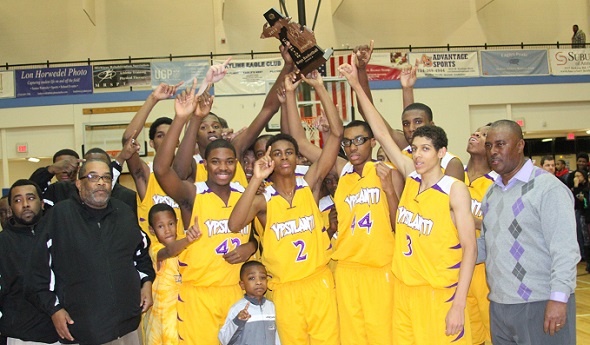
PHOTO: Ypsilanti boys basketball coach Steve Brooks (far right) celebrates with his team this March after leading the Phoenix to its first Regional title since 1981. (Photo courtesy of Randy Castro, Ann Arbor Journal.)
Volleyball Mentors Achieve Milestones
September 26, 2012
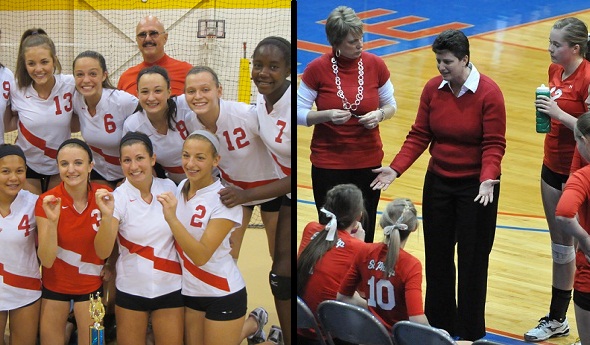
Over the last three weeks, two of Michigan's most successful volleyball coaches ever moved further up the all-time list with milestone victories.
On Sept. 8, Clinton Township Chippewa Valley coach Bill Rice became the fifth volleyball coach in MHSAA history to win 1,000 matches when his team defeated Lutheran Westland at the University of Michigan-Dearborn Invitational. And Battle Creek St. Philip's Vicki Groat became the 12th coach to win 800 matches, earning her monumental win against Jackson Christian on Thursday.
Groat has coached the Tigers since 1998, when she took over for her mother Sheila Guerra. At St. Philip's current pace -- it is again considered the favorite to win the MHSAA Class D championship this fall and has claimed six straight -- she could match her mom's 862 career wins during the 2012 season. St. Philip is 35-1-1 this season.
Rice began at Chippewa Valley in 1980 and has led his team to four league and 11 Class A District championships, plus back-to-back 50-plus win seasons from 2002-04. His team is 10-13-2 this fall.