


Turnaround Coaches: Study their Steps
April 27, 2016
 By Scott Westfall
MSU Institute for the Study of Youth Sports
Turnaround leadership is often a popular topic within sports conversations, as many coaches are revered for their ability to transform a struggling team into a “winner.”
Turnarounds often are discussed in platitudes such as, “That coach has what it takes to turn this program around.”
While often talked about during the offseason, especially in the face of coaching vacancies, turnarounds are difficult to achieve. After all, if transforming a failing team into a successful one were an easy task, there would not be such an abundance of teams that struggle year-in and year-out.
As much as turnaround coaches are celebrated for their abilities to turn a losing program into a winner, very little scientific research has been devoted to analyzing coaches who have proven themselves as turnaround specialists. The steps and intangibles necessary for achieving a coaching turnaround have remained undetermined as this topic had never been examined from a scientific perspective – until now.
For the past year and a half, I have devoted the majority of my time to researching turnaround leadership in high school coaching, undertaking this study as the topic of my doctoral dissertation project. Research participants in this study included 11 high school football coaches from the state of Michigan who led dramatic turnarounds at their high schools within the last decade. The criteria for participant selection were:
• Prior to the coach’s arrival or appointment as head coach, the team finished (at least) three of the previous four seasons with a losing record (below .500 winning percentage), including a losing season immediately before the coach’s arrival or appointment.
• Within five seasons of the coach’s arrival, the team enjoyed (at least) three winning seasons (above .500 winning percentage).
Before their turnarounds occurred, these high schools had not experienced a winning season (on average) in 7.2 years, while five of the 11 schools had never qualified for the MHSAA Playoffs. However, upon being hired, the average time it took the coaches to achieve a winning record was 1.73 seasons. Moreover, the average time it took the coaches to qualify for the MHSAA Playoffs was 1.82 years. On top of this, each of the 11 teams qualified for the playoffs within three years of hiring their new coach.
The circumstances these coaches faced when they arrived were challenging to say the least, as all of the coaches entered a negative situation with poor team culture. These situations were characterized by losing streaks, cancelled seasons, dilapidated facilities, poor role models on the previous coaching staffs and a significant amount of parental pushback. Players and community members often were embarrassed by their football program. One coach described the situation by recounting, “During that time they were a doormat; everybody’s homecoming, a laughing stock. They were like the Bad News Bears.” Additional problems included low numbers, very little player development, and a low amount of commitment to the overall program.
One coach that I interviewed compared entering a turnaround situation to building a well. He stated, “You may not have success on the surface initially, but if you dig nice and deep and build the well right, there is water down there. It’s going to be some work and it might not come up right away – it takes some pumping. But if you build it right, it will happen.” In this article I will attempt to encapsulate 16 months of research, 191 pages of interview transcriptions, 2,278 miles driven across the state of Michigan, and countless hours spent with 11 turnaround coaches, in order to present to you the nucleus of what it takes to turn around a failing high school program.
The coaching philosophies of the majority of the coaches were characterized as “educational athletics.” This involved coaches striving to do things the right way, viewing their job as an extension of the classroom, implementing a character development program, and using football as a vehicle to teach life skills to players. Furthermore, their greatest strengths were revealed to be coaching/leadership skills, along with the ability to develop strong relationships with their players.
Coaches unanimously agreed that upon their arrival immediate changes needed to be made to the team’s culture. These changes included prioritizing team workouts, altering visible elements like the organization of practices, offensive and defensive schematics, team logos, along with placing positive role models in front of the players. Other changes to team culture happened through improved coach-athlete relationships, giving players a better football experience, and purging the program of negative people. One coach used the term, “Weeding the roses,” which means getting rid of the negative people in the program in order to let the better parts grow and prosper.
All of the coaches developed some type of vision for their program. The most common visions involved transforming their team into a top-level program, and for their players to conduct themselves as quality human beings. Winning games, competing with the best teams in their division, and playing for MHSAA championships marked becoming a top program. While winning was a major component of the coaches’ visions, developing quality human beings was revealed to be just as essential. This was evident as several coaches remarked that their most well-behaved kids were also their most productive players, and that doing things right in school and in the community often equates to wins on the football field.
To build upon their visions, each of the coaches formulated some type of plan or “blueprint” to execute their turnarounds. The majority of the coaches’ plans were constructed around developing positive coach-athlete relationships and employing off-season strength and conditioning programs. While all of the coaches’ plans eventually yielded a great amount of success, not all parties bought into them initially. Some of the players needed to see proof that the team could win games before they were completely sold. In order to create buy-in, the coaches used various approaches to connect with players and sell their plan. These methods included team activities, cultivating relationships with players, continuously selling their vision, hiring/retaining quality assistant coaches, and entering the situation with some sort of previous expertise. Although it may take time, the coaches stressed the importance of the players buying into their vision. As one of them decreed to his team, “The quicker you buy in, the quicker we win.”
Early indicators that a turnaround was commencing included winning games or making significant strides off of the field through positive coach-athlete relationships. Sources of sustained changes included a win streak or an increased level of commitment from the players. Clear indicators that the program had undergone a turnaround included the players adopting a new mentality filled with trust and confidence, along with the program reaching unprecedented levels of success, such as competing with the best teams, completing an undefeated season, and/or making the playoffs consistently.
Character development emerged as a strong component of this study, as 100 percent of the coaches reported that it played a significant role in fostering turnarounds. The coaches also indicated that they deliberately teach character in practice and use coaching as a platform for character development.
In hindsight, an outside observer may assume that these coaches were destined to succeed and their plans were met with little resistance. However, after examining their roads to turnaround success, most of them met several barriers along the way. Early obstacles included widespread mental challenges among players such as a lack of confidence and/or trust. Other early barriers included parental pushback and some cases of overt interference. After the turnarounds were complete, the coaches’ problems did not disappear; they simply changed form, as complacency became the new problem on the team. A potential root of this complacency was the addition of younger players who thought that success would happen automatically simply because of the program’s prior achievements.
The coaches were quick to acknowledge that the turnarounds would not have been possible without the excellent support they received. Their greatest source of help came from their assistant coaches who contributed both tangible and psychosocial support. Tangible support was seen through the assistants performing administrative duties and overseeing strength and conditioning sessions. Meanwhile, psychosocial support came in simple ways, such as listening, giving advice, and showing belief in the head coach. As one coach stated, “You’re only as good as the people you have around you.”
Team turnarounds are not officially complete until a team maintains the success it has built. In order to avoid complacency and sustain momentum, the coaches recommended that coaches and players find ways to keep reaching higher. In order to do this, coaches recommended talking to players about their team goals and what they want their legacies to be. To help sustain momentum, coaches stressed that it is often the little things that matter the most, such as effort, team discipline, player accountability, and positive attitudes.
The strongest theme that emerged from this study was the importance of coach-athlete relationships. All of the coaches believed that relationships are imperative to fostering turnarounds. It was also emphasized that relationships are crucial for sustaining long-term success. In essence, coaches may experience some momentary success by taking shortcuts with superior talent, however, strong relationships are the “X-factor” that will sustain the program over the long run. While the approaches of building relationships were diverse, what mattered most was coaches spending time with players in both structured and unstructured team activities, and simply showing players that they cared about them as people as much as they did as football players.
Steps of a Turnaround
(When turnarounds happen, they usually happen in this order)
1. Establish new leadership
2. Assemble a staff of positive role models
3. Gather information about the program
4. Create the vision
5. Make a plan and communicate it
6. Create buy-in from players and other key people
7. Change behavior – This is the impetus of the turnaround
8. Create and celebrate early wins
9. Don’t let up – Keep setting new goals and reaching higher
10. Complacency is the enemy: Make sure change sticks!
Intangibles Checklist
(These are the little things that people cannot see or do not talk about, yet they often matter the most)
1. Positive relationships between coaches and players. Build these by spending time with players and showing them you care about them as a person.
2. Establishment of a strength and conditioning program. All successful turnarounds were led by coaches who implemented a respectable offseason training program.
3. Display an undeniable belief that your vision and the plan will produce successful results. Continuously sell your plan and give players the reasons behind why you do what you do. Be prepared to stand tall and adhere to your vision when adversity strikes.
4. Generate player buy-in through team activities. Remember that sports are supposed to be FUN. Plan structured and non-structured activities to generate fun, excitement and team cohesion!
5. Demand excellence of your players off the field. Promote educational athletics and use your platform as a coach to teach character and life lessons to your players.
6. Outwork your opponents in everything you do. Arrive earlier. Stay later. Go above and beyond what your competitors are doing. Set the tempo that hard work is the new norm and it starts with you.
7. Remember that the little things matter. Take the time to ensure that your team always has the right effort, attitude and discipline, as well as accountability to the program and each other.
Scott Westfall spent 10 years as a teacher, coach, and athletic director in Fort Collins, Colo. He is currently finishing his Doctorate at Michigan State University, with an emphasis in Sport Psychology and Athletic Administration, and assisting the MHSAA with its student leadership programs. Westfall is a former athlete who participated in football, wrestling, tennis and cross country at the high school level, and rugby at the collegiate level. Please feel free to contact Scott if you would like a copy of his full dissertation. Scott also performs speaking engagements at conferences on various topics within educational athletics. He can be reached at [email protected]
Longtime Coach Vlcek has Manchester On Pace to Contend in D4 Title Race
By
Doug Donnelly
Special for MHSAA.com
December 19, 2023
Steve Vlcek is 34 years into his varsity coaching career at Manchester and might have his best team yet.
 The season still has a long way to go, of course, but Vlcek is confident that what is being built right now in the Flying Dutchmen wrestling room is something special.
“I always call this our preseason,” he said. “We’ll have four tournaments before the new year. That’s 26 or 27 matches per kid. That way, we can figure out where we are at, what we need to work on more. Then we can start tweaking stuff a little bit.
“It’s been a really great start. I see a lot of improvement in our team.”
Vlcek, who has won more than 700 meets in his career, and Manchester have been on the cusp before. The Flying Dutchmen have won 18 straight District championships and own a dozen Regional titles. Manchester was the Division 4 runner-up in 2008 and has reached the Semifinals multiple times.
The last two years, they’ve qualified for MHSAA Team Finals weekend but have lost the first day in Quarterfinals.
“It’s been a little frustrating, but you have to keep plugging away,” Vlcek said. “We’re trying. We have a good shot the next couple of years.”
Vlcek was a football guy at Manchester, but when the school didn’t field football in 1981, he turned to wrestling.
“We didn’t have football my freshman year, and I was driving my mom crazy,” Vlcek said. “I took up wrestling.”
During his four years with the varsity, Manchester went through three coaches. It was his final coach, Dan Jordan, who invited Vleck back a couple of years later to work with some of the wrestlers on the team.
 “He called me up and asked if in my free time I would come and work with a couple kids,” Vlcek said. “Two years later, I was the junior high coach, and two years after that he resigned, recommended me for the job and I got it. He did a really good job of bringing up the program.”
Vleck never thought he would be a coach, but it became his passion.
“Once I started working with the kids, I really enjoyed it,” he said. “I wasn’t sure how much I would like it as a 19-year-old, or 20-year-old kid, but I did.”
Some of his early Manchester teams struggled with numbers. They’d often have seven or eight wrestlers win matches but lose in a dual-meet format because of the forfeits. That started to change during the mid-2000s.
“We started getting good classes together, and that made a considerable difference,” he said.
He picked things up from rival coaches, some of whom he has become friends with over the years.
“You pick up little things from each coach you coach against,” he said.
He credits a strong youth program at Manchester with developing wrestlers at a young age.
“We have a very involved youth program,” he said. “They’ve brought a good product to me. I try to stay away from it, let them develop it. We are very lucky to have it.”
He also credits a slew of assistant coaches, such as Mike Bunn.
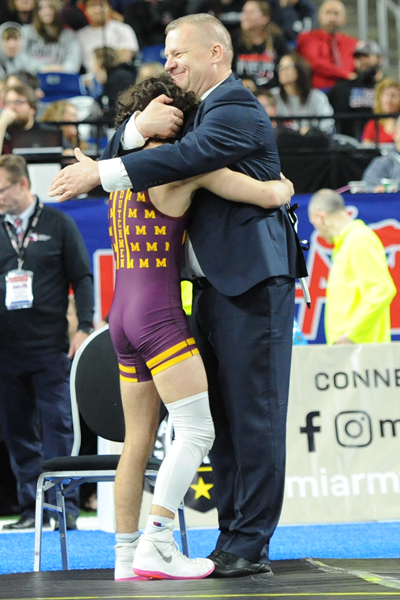
“I can name 20 guys who have come into the room and make the program better every day,” he said. “I have my son (Brock) coaching with me now, and I really enjoy that.”
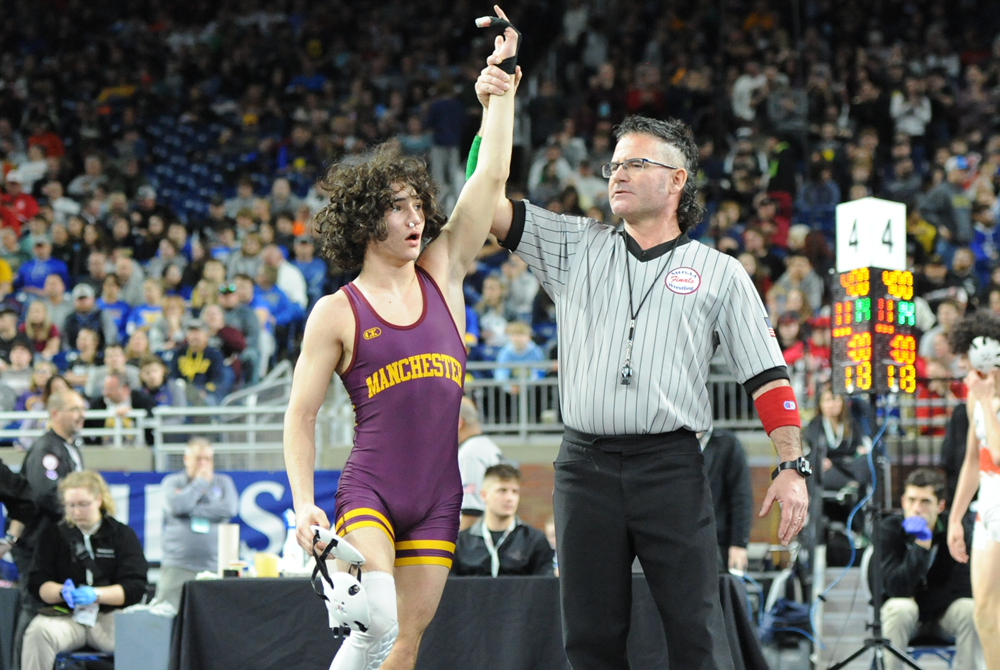
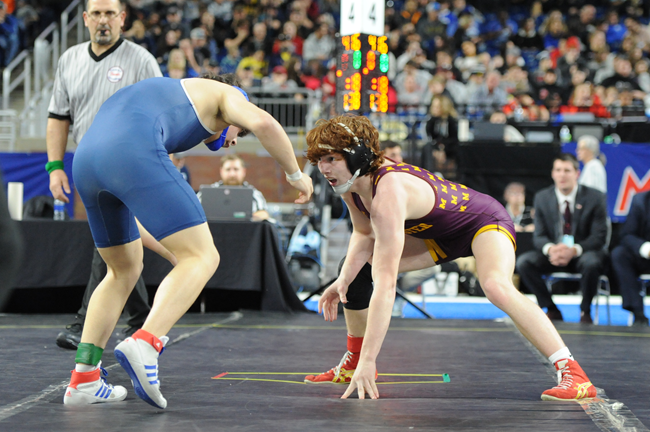
 The Flying Dutchmen have 10 juniors on this year’s squad, including Sammy Stewart, who won an Individual Finals title last year at 113 pounds, and Blake Sloan, who was runner-up at 138.
Stewart missed a good part of the 2022 season while recovering from a hand injury.
“He had a really bad accident in shop class,” Vlcek said. “He almost cut his hand off. He came back in mid-January. He definitely had to overcome some obstacles. He avenged the loss he had (during the regular season) in the state finals.”
Sloan is another of the super sophomores. He’s coming off a record-setting football season in which he rushed for more than 2,100 yards.
“I can’t ask more out of those guys,” Vlcek said. “They put their time in and help their teammates out. We have seven or eight kids who have been state qualifiers. We still have some work to do, but there is improvement.”
Manchester is 10-2 in dual meets to start this season, giving Vlcek 711 career victories. The Flying Dutchmen have played a good schedule and have been ranked anywhere from No. 2 to No. 5 in early-season team rankings.
“I like to be challenged,” Vlcek said. “You don’t get better without wrestling the best.”
 Doug Donnelly has served as a sports and news reporter and city editor over 25 years, writing for the Daily Chief-Union in Upper Sandusky, Ohio from 1992-1995, the Monroe Evening News from 1995-2012 and the Adrian Daily Telegram since 2013. He's also written a book on high school basketball in Monroe County and compiles record books for various schools in southeast Michigan. E-mail him at [email protected] with story ideas for Jackson, Washtenaw, Hillsdale, Lenawee and Monroe counties.
PHOTOS (Top) Sammy Stewart’s hand is raised by the official in victory after the Manchester standout won his championship match at the Individual Finals in March. (Middle) Teammate Blake Sloan, right, considers his next move during his championship match last season. (Below) Coach Steve Vlcek embraces Stewart after the victory. (Click for more from High School Sports Scene.)