

Using Heads in the Heat of Competition
December 20, 2013
By Rob Kaminski
MHSAA benchmarks editor
With so much recent attention to the risks and recognition of concussions in collision sports, athletic leaders have put their heads together to address far more common – but often overlooked – threats to the health of our student-athletes: heat and sudden cardiac arrest.
The No. 1 killer of young athletes is sudden cardiac arrest, while heat stroke victims can surpass that during the year’s hottest months. While the moment of impact leading to a concussion is totally unpredictable, athletic trainers, coaches and administrators have the ability to diminish the occurrences of cardiac arrest and heatstroke. Typically, there is a pre-existing condition, or family history suggesting probabilities for sudden cardiac arrest, which can be treated when detected. And, the perils associated with hot weather – heat stroke, prostration – are almost always completely preventable.
The MHSAA has addressed both issues recently. With assistance from numerous medical governing bodies, the annual pre-participation physical form was revamped and expanded prior to the 2011-12 school year to include comprehensive information regarding participants’ medical history.
In May, the Representative Council adopted a Model Policy for Managing Heat & Humidity (see below), a plan many schools have since adopted at the local level. The plan directs schools to monitor the heat index at an activity site once the air temperature reaches 80 degrees and provides recommendations when the heat index reaches certain levels, including ceasing activities when it rises above 104 degrees.
The topic of heat-related illnesses receives a lot of attention at the start of fall when deaths at the professional, collegiate and interscholastic levels of sport occur, especially since they are preventable in most cases with the proper precautions. In football, data from the National Federation of State High School Associations shows 41 high school players died from heat stroke between 1995 and 2012.
“We know now more than we ever have about when the risk is high and who is most at risk, and we’re now able to communicate that information better than ever before to administrators, coaches, athletes and parents," said Jack Roberts, executive director of the MHSAA. “Heat stroke is almost always preventable, and we encourage everyone to avail themselves of the information on our website.
“Schools need to be vigilant about providing water during practices, making sure that students are partaking of water and educating their teams about the need for good hydration practices.”
All of which is not to say concussions aren’t a serious matter; they are. In fact, leaders in sport safety can take advantage of the concussion spotlight to illuminate these additional health threats.
A recent New York Times story (May 2013) by Bill Pennington featured a February 2013 gathering in Washington organized by the National Athletic Trainers Association. In the article, Dr. Douglas J. Casa, professor of kinesiology at the University of Connecticut and Chief Operating Officer of the Korey Stringer Institute (founded in the late NFL offensive lineman’s name to promote prevention of sudden death in sport), suggests just that.
“All the talk about head injuries can be a gateway for telling people about the other things they need to know about, like cardiac events and heat illness,” said Casa in the article. “It doesn’t really matter how we get through to people as long as we continue to make sports safer.”
Education and prevention methods need to find a permanent place in school programs if those programs are to thrive and avoid becoming targets at which special interest groups can aim budgetary arrows.
Dr. Jonathan Drezner, the president of the American Medical Society for Sports Medicine, said in the New York Times piece that sudden cardiac arrest is “so incredibly tragic and stunning that people aren’t comfortable putting it into the everyday conversation. I do wish, to some extent, it was something people talked more about because we are getting to a place where we could prevent many of these deaths.”
When it comes to heat-related deaths or illnesses, the prevention efforts can be even more successful by educating the masses. And, these efforts can be done at minimal cost to schools.
“That’s the thing about curtailing exertional heat illness: it’s 100 percent preventable, and unlike other health threats to athletes, the solutions can be very low-tech and inexpensive,” said Dr. Michael F. Bergeron, the director of the National Institute for Athletic Health & Performance at the University of South Dakota’s Sanford Medical Center, in the New York Times story.
To assist with cost and data maintenance, the MHSAA has teamed with Sports Health to provide schools with psychrometers (heat measurement instruments) at a discounted rate, and has built online tools to track heat and humidity conditions.
Managing heat and humidity policy
- Thirty minutes prior to the start of an activity, and again 60 minutes after the start of that activity, take temperature and humidity readings at the site of the activity. Using a digital sling psychrometer is recommended. Record the readings in writing and maintain the information in files of school administration. Each school is to designate whose duties these are: generally the athletic director, head coach or certified athletic trainer.
- Factor the temperature and humidity into a Heat Index Calculator and Chart to determine the Heat Index. If a digital sling psychrometer is being used, the calculation is automatic.
If the Heat Index is below 95 degrees:
All Sports
- Provide ample amounts of water. This means that water should always be available and athletes should be able to take in as much water as they desire.
- Optional water breaks every 30 minutes for 10 minutes in duration.
- Ice-down towels for cooling.
- Watch/monitor athletes carefully for necessary action.
If the Heat Index is 95 degrees to 99 degrees:
All Sports
- Provide ample amounts of water. This means that water should always be available and athletes should be able to take in as much water as they desire.
- Optional water breaks every 30 minutes for 10 minutes in duration.
- Ice-down towels for cooling.
- Watch/monitor athletes carefully for necessary action.
Contact sports and activities with additional equipment:
- Helmets and other possible equipment removed while not involved in contact.
- Reduce time of outside activity. Consider postponing practice to later in the day.
- Recheck temperature and humidity every 30 minutes to monitor for increased Heat Index.
If the Heat Index is above 99 degrees to 104 degrees:
All Sports
- Provide ample amounts of water. This means that water should always be available and athletes should be able to take in as much water as they desire.
- Mandatory water breaks every 30 minutes for 10 minutes in duration.
- Ice-down towels for cooling.
- Watch/monitor athletes carefully for necessary action.
- Alter uniform by removing items if possible.
- Allow for changes to dry T-shirts and shorts.
- Reduce time of outside activity as well as indoor activity if air conditioning is unavailable.
- Postpone practice to later in the day.
Contact sports and activities with additional equipment
- Helmets and other possible equipment removed if not involved in contact or necessary for safety.
- If necessary for safety, suspend activity.
Recheck temperature and humidity every 30 minutes to monitor for increased Heat Index.
If the Heat Index is above 104 degrees:
All sports
- Stop all outside activity in practice and/or play, and stop all inside activity if air conditioning is unavailable.
Note: When the temperature is below 80 degrees there is no combination of heat and humidity that will result in need to curtail activity.
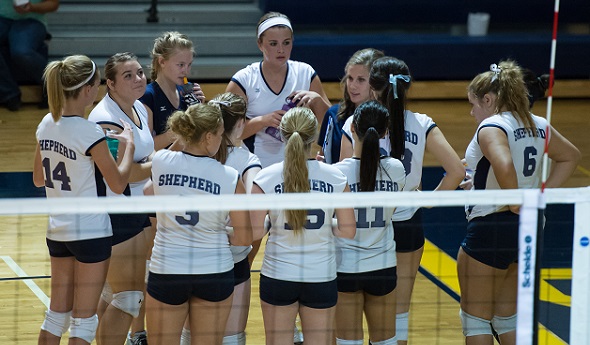
PHOTO: The Shepherd volleyball team includes hydration during a timeout in a match this fall.

Niles' Arnold Remembered as Teacher & Leader, 'Doing Exactly What He was Meant To Do'
By
Scott Hassinger
Special for MHSAA.com
January 13, 2026
NILES – Throughout his 22-year career coaching varsity girls basketball at Niles High School, Jim Arnold required one thing from his players.
 Just have fun.
"Jim always stressed to his players that the one thing he wanted them to do when on the floor was to just have fun playing the game," said George Brawley, who served 15 seasons as one of Arnold's assistant coaches at various levels.
Arnold, 81, died Dec. 9 following an extended illness.
But throughout his career, Arnold's teams did much more than just enjoy themselves. The Benton Harbor native built a highly-successful program at Niles, where he achieved an overall win-loss record of 360-139 from 1986-2008, with 19 winning seasons. Under Arnold's watch, the Vikings captured seven conference titles, 10 District championships – including nine straight from 1997-2005 – and five Regional crowns.
Among Arnold's other accomplishments were being named Class B Coach of The Year by The Associated Press in 1998 and receiving honorable mention in 1997, along with selection by the Basketball Coaches Association of Michigan as Region 5 Coach of the Year in 2002 and 2004. He was also named conference Coach of the Year seven times and received the Herb Quade Memorial Sportsmanship Award for the 2002-2003 season.
Arnold also coached Niles to back-to-back District championships in softball in 1993 and 1994.
As young athlete himself, Arnold excelled on the baseball diamond. A successful player while at Benton Harbor, he also played on Twin City American Legion teams and was known as a team captain and a coach on the field. Arnold later had an invitation to try out at the professional level with the Baltimore Orioles, but an injury ended his pursuit of that dream.
Arnold later played third base for Bargain Center, a slow-pitch softball team that won a regional championship and went on to play in the national title game in St. Louis, Mo.
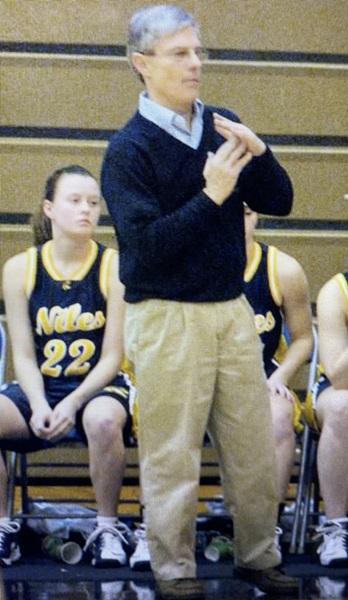 His daughters Sonya and Allison were among the athletes that Arnold mentored during his coaching career. Sonya (Martinez), his oldest daughter, played for her father in eighth grade.
"He made the game fun, and you wanted to do your best because you didn't want to disappoint him. He poured his heart into each and every practice and game because preparation mattered to him. He demanded excellence, and every player became better because of his coaching ability," said Martinez, a 1986 Niles graduate.
Allison (Clay) his youngest daughter, played on the 1990 Niles varsity squad that finished 25-1, winning conference, District and Regional titles. She is a 1991 graduate.
"It was awesome playing for my dad. Some of my best memories in my life were during that time,” Clay said. “He had high standards and inspired others to be the best version of themselves. He put his heart and soul into what he did, and I had a front-row seat to that."
Linda Arnold has fond memories as a coach's wife.
"I loved watching my husband coach because of the joy it brought him. His passion, intensity and the love he had for his players was genuine,” she said. “It was more than a game. It was more about developing players in the area of discipline, teamwork and giving your all. Even in the busiest part of the season, he always made me feel like a priority. I didn't just watch a coach. I watched a man doing exactly what he was meant to do.
"My husband coached with passion, but he loved his family with intention. My girls would go to his practices and we all attended his games, and we had the team over for team dinners. His players were a part of our extended family. He made sure we felt a part. He was the best coach in the world, and he was mine."
Jim Arnold was highly respected by his coaching peers. He was kind and treated everyone with dignity. The community of Niles knew what he stood for and they knew his standards were high. He was admired for his preparation and understanding of the game as well as his commitment to doing things the right way. He was strict but fair and treated everyone the same, whether you were the star player or last one off the bench, Martinez explained.
"Developing his players' character was far more important to him than winning," she said. "Dad lived what he taught. He modeled humility, hard work and lived a life of integrity. He made people better by being a part of their lives."
When Jim Arnold first began his junior high teaching career in Niles, he also coached the boys junior high basketball team. There were no girls basketball teams at the time, so a girl tried out for the boys team. She was good enough to make the team, so Arnold kept her. The following school year, the principal asked Arnold to organize a girls team – and the rest was history.
Former Niles varsity girls basketball coach Jessica Johnson, a teammate of Clay’s, recalls the experience of playing for Coach Arnold.
 "Coach Arnold taught us discipline, resilience and always required 110 percent effort from you. He would instill confidence in you while still holding you accountable," said Johnson, now an assistant women’s basketball coach at Southwestern Michigan College.
Johnson recalls Arnold's use of comic strips as a teaching tool to help his players improve upon their mistakes.
"If you had a game where you didn't shoot very well or took questionable shots, he would place pictures of bricks in the gym the day following the game," Johnson said.
"Coach Arnold went out of his way to build that relationship and trust with his players. He gave us lessons that extended way beyond the court that made us better people."
Mark Haase, a Niles alumnus and the current Vikings head varsity boys basketball coach, also had the privilege of playing for Arnold.
"I played freshman basketball for Coach Arnold. It was one of the most disciplined and well-conditioned teams I ever played on. He ran a tight ship, but it was done out of love and concern for his players. He has a great family and is a Niles legend," Haase said.
Niles athletic director Matt Brawley referred to Arnold as an amazing teacher, coach and individual in the school and community.
"Coach Arnold would never ask you to do anything he wouldn't do. He was very structured and expected a lot out of his players, and he got results without excuses,” Brawley said. “He was a true leader of Niles athletics. He was an unbelievably kind and humble individual.”
 Scott Hassinger is a contributing sportswriter for Leader Publications and previously served as the sports editor for the Three Rivers Commercial-News from 1994-2022. He can be reached at [email protected] with story ideas for Berrien, Cass, St. Joseph and Branch counties.
PHOTOS (Top) Jim Arnold poses for a photo with his granddaughters following a Niles girls basketball game. (Middle) Arnold signals for a timeout. (Below) Linda and Jim Arnold, seated (middle) take a photo with their daughters and their families. (Photos courtesy of the Niles athletic department and Arnold family.)