

Wise Words for Coaches New (and Old)
September 13, 2013
By Geoff Kimmerly
Second Half editor
Every fall brings a new beginning for those who live by the high school calendar. And among those experiencing a new start are first-year high school coaches eager to begin their careers in educational athletics.
But what knowledge do they bring into their first coaching jobs? Most if not all played at the high school level, and many played at the college level as well. Some have served as assistants or coached youth teams. But high school coaching comes with its own set of challenges requiring an advanced set of skills – skills that are passed on annually as part of the Michigan High School Athletic Association’s Coaches Advancement Program.
To assist in giving some of our new coaches a running start, we tapped into the knowledge of three of our Coaches Advancement Program instructors for advice they give those just starting out:
 Jean LaClair began this fall 12th in MHSAA volleyball history with 861 wins since becoming a varsity head coach in 1987. She’s coached at Midland Dow, Pinconning and currently Bronson, where she’s also the athletic director and an assistant principal. She’s also served as an MHSAA official and contributed to the Women in Sports Leadership porgram.
 Ken Semelsberger is a recent inductee into the Michigan High School Football Coaches Hall of Fame and spent 33 years at Port Huron High School as a coach and athletic administrator. He also coached football at Detroit Servite and has led teams in basketball, softball and baseball. Semelsberger returned to the Port Huron sideline four seasons ago as the varsity’s line coach.
 Penny Allen-Cook currently is an athletic consultant and in her fourth season coaching the Freeland varsity volleyball team. She also coached volleyball at Alma College, and is a former assistant commissioner of the Great Lakes Intercollegiate Athletic Conference. She served as an assistant athletic director at Alma College and director of compliance at Saginaw Valley State University.
All were asked the following questions during separate interviews. But not surprisingly, some of their answers were similar – especially those that emphasized dealing with parental pressures and why they as coaches continue to return to the sideline every year.
Many of their answers also segued well into each other, so we’ve blended them for one longer conversation filled with wisdom beneficial to new and veteran coaches alike.
What do you tell those who are interested in becoming high school coaches?
Semelsberger: “Basically, it’s one of the most fulfilling things you’ll ever do. And it’s also one of the hardest things you’ll ever do. I try to explain that it’s not just about going to practice and coaching kids today. That’s the easy part. It’s also preparing for practice, (gaining) the knowledge of what to do in certain situations from the game itself all the way to training procedures, injury procedures and liability issues. That’s all part of the coaching realm.”
LaClair: “My biggest concern with young coaches is them getting driven out by parents really early. You’ve got to have thick skin, and you’ve got to have great relationships with parents. You can’t be afraid to talk to parents.”
Allen-Cook: “Certainly to coach is an extremely rewarding thing to do. But you can’t get into it for the money. You get into it for the things that last for a lifetime. My first year I started coaching was back in 1986, and I’ve kept in touch with those kids. (Coaching) can’t be for money or wins and losses, but the differences you make in lives.”
Semelsberger: “Probably not until after the first year do you realize all that’s entailed in coaching. (Coaches) say, ‘Once I really got into and do it, after the first time, it was a lot more than I thought.’ They say, 'What can you tell me to help me?'”
How do you encourage coaches who have become frustrated with the profession?
Allen-Cook: “It’s easier to get discouraged nowadays more than it used to be, and a common thing that discourages is the parent involvement is at a different level than it ever was 20 years ago. The key is to remember, and it’s hard for young coaches who aren't parents, but you tell them to step back and imagine what it feels like if you were the parent.”
LaClair: “I do try to get all young coaches a mentor, someone to talk with. We all get frustrated; we all have to vent, and we need the right person to talk it through with and come up with alternative ways (of dealing with situations).”
Semelsberger: “The one thing I tell them is to remember that what’s most important out there is how they influence athletes. I want to see them doing positive things with our athletes, stressing grades and sportsmanship. I hired a hockey coach once, and I told him to clean up the program. I don’t care if you win; I want our grades to be good, community involvement, and the wins and losses will come. If you stay with it, hang in there, it will come.”
Allen-Cook: “If they approach things the right way, in as few years as four or five, if they stick it out, they’ll learn the positives outweigh the negatives. I’m always encouraging them to stick it out a few more years until they can figure out their true philosophy, why they want to coach.”
What specific situations do you tell new coaches to prepare for, and how?
LaClair: “For me as a coach, the parent/athlete meeting is mandatory. If a parent comes to me with a question during the year, I say, ‘Do you remember the parent/athlete meeting? We discussed that.’ It sets the tone and tells parents how proactive you are as a person, how organized and prepared you are.”
Semelsberger: “When you’re not coaching, when you’re sitting in the stands, the parents are friendly. But once you’re on the sideline, now you’re the coach, and that changes the dynamic of the relationship dramatically. I explain to (coaches) that my philosophy is I’m dealing with parents’ most precious item. You want to treat each one of those children like you’d want your kids to be treated. You don’t have to play everyone all the time, but treat (athletes) with respect, talk to them and let them know what’s going on, why a kid isn't playing, so the kid has an idea what’s going on.”
Allen-Cook: “One of the best defenses is to be a student of whatever the game is they’re coaching so they can be seen as an expert all the time. Show it by going to clinics, reading up on things, and coming to practice with a true plan of what you’re doing every day. Parents are less likely to question if you know what you’re doing and they can see you’re a true student of the game and come every day prepared.”
LaClair: “Time management is critical. Especially for me, you need to have good practice plans, well thought out in advance so kids aren't standing around at all.”
Semelsberger: “Sometimes I tell (coaches) about reporters if the sport has a lot of reporters; always be positive, don’t be negative. ... (Also) I make sure they understand and follow the rules. Academics are the most important thing, so make sure every kid is eligible. And I tell them the most important people are secretaries and custodians. Get them on your side, and they’ll do anything for you.”
What advice do you offer coaches who also are balancing teaching or other jobs at the school?
LaClair: “Just over half of my (teachers are coaches), and that’s great. You can build a different type of relationship.”
Semelsberger: “Their number one job is being a teacher, and that’s always been the number one job. They can’t let the fact they coach take away from that. Classes are number one, and coaching comes after that.”
LaClair: “You have to think days and weeks ahead. I tell coaches who are also teachers that the weekends and a lot of Sundays are going to be for making lesson plans for the week, practice plans for the week. Then all they have to do is tweak them. Have a good plan and all you have to do is tweak, and you don’t have to do that for two hours on a Thursday night.”
Allen-Cook: “It’s a neat experience to be able to teach in other realms (like athletics). Unfortunately there are less and less teacher coaches.”
What keeps you coming back to coaching?
LaClair: “The kids. A lot of people think social media is an evil beast, and it can be. But what I love about it is I've been coaching a long time and I can keep up with former athletes all over the country, see baby pictures, things I wouldn't be able to do without social media.”
Allen-Cook: “I think once you’re a coach, you’re always a coach. It’s tough to get out of your blood. I enjoy the interaction with the young people. I’m an independent contractor now (Allen-Cook also has taught) so I have little interaction with student athletes anymore. It feels rewarding that in some way I’m having a positive impact.”
Semelsberger: “The kids, the athletes, just to watch them develop as human beings. We work hard with on our athletes being leaders in the (school) building; the first day of school our senior and junior football players were helping out the freshmen. If a kid was scared or something, trying to get where they needed to go, we had jerseys on and they knew if they saw a kid with a jersey on they could ask for help. To see those kids take on those roles ... I love watching the ninth graders come in as scared little kids and watch them leave as confident seniors going on to college or work or whatever they’ll do.”
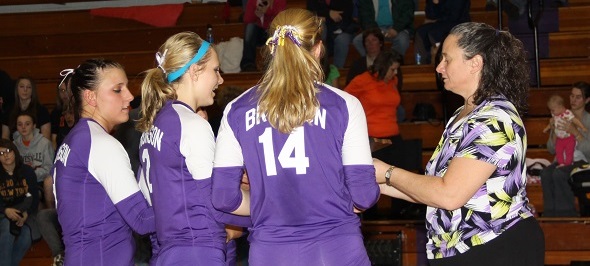
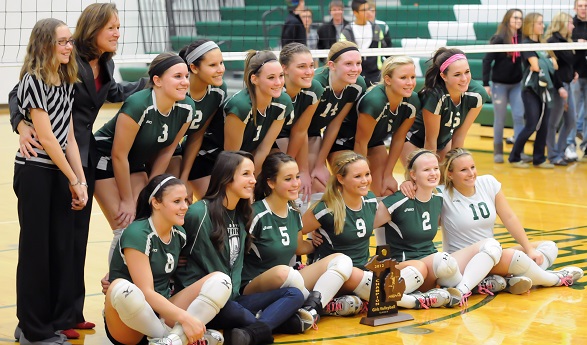
PHOTOS: (Top) Penny Allen-Cook (second from left, back row) and her Freeland volleyball team celebrate last season's Class B District championship. (Click to see more from High School Sports Scene.) (Below) Bronson volleyball coach Jean LaClair speaks with some her players during one of her more than 1,000 games as a varsity head coach. (Photo courtesy of the Sturgis Journal.)
Dock Putting Dad's Coaching Lessons to Work as Middleville TK Continues Climb
By
Steve Vedder
Special for MHSAA.com
November 3, 2025
MIDDLEVILLE – Denny Dock can't pinpoint the exact moment he thought his football-loving son would follow him into coaching, but the signs were there all along.
 For starters, there were the countless hours spent tossing a football around the backyard. Or when his young son, Jeff – not even old enough for middle school at the time – eagerly joined other Stevensville Lakeshore coaches watching film on weekends.
Maybe it was all those Friday nights spent trekking along the sideline as a ball boy for Lancers teams. Another clue might have been the Saturday afternoons the two spent together watching college football, or taking in the NFL on Sundays.
When Jeff got older, it may have been how he readily absorbed tips that helped him become a better quarterback in high school and then at Grand Valley State. It could have even been an early, uncanny ability to grasp the importance of fundamentals.
Put it all together, and it seemed inevitable coaching football loomed in Jeff Dock's future.
"That's very fair to say," said Denny Dock, who is 19th on the state's list of all-time winningest football coaches while also the winningest high school softball coach in the country. "The younger years in football were really positive for Jeff, and that doesn't happen all the time. There are negative things that can happen."
While there might have been multiple signs the younger Dock would one day join the coaching ranks, he admits it was far from a done deal. There were thoughts of becoming a biology teacher, a pastor or maybe even an orthopedic surgeon.
But coaching? Even with his father as a classic example of the positive impact a good coach could spread, Dock said it took years for him to eventually land in coaching.
"It dawned on me that there were a lot of all three of those things in being a coach," he said. "Growing up in sports is what I knew, and I ended up developing a passion for it."
That passion is actually the highest it's been in years as his Middleville Thornapple Kellogg football team this past weekend improved to 7-3, continuing the program's first winning season since 2020 and the best fall since the Trojans went 7-3 in 2018. The Trojans defeated Hastings 28-20 in a Division 2 playoff opener, and a win this Friday at Lowell would give Middleville its first District championship since 2001.
Denny Dock coached football at Hartford from 1981-83, Dowagiac from 1984-87, and then Lakeshore from 1988-2013, returning to lead the Lancers for one more season in 2020 and all together totaling a 270-79 career record, 15 league titles and five runner-up MHSAA Finals finishes.
He has kept his hand in football in aiding his son's Trojans program. He's at all the games to add support, critique, advice, strategy, tips on how practices can best be organized and long talks discussing how continual improvement can be furthered.
It's a two-way street as an old football coach who never had a losing season, and is a member of the Michigan High School Football Coaches Association Hall of Fame, can remain invested in the game while his son benefits from three decades worth of experience.
Jeff Dock said his father's real value is his ability to spot from the stands the little things that less experienced coaches may miss.
 "Play calling, how players are used, maybe a little bit about strategy," Dock said.
After playing for his father, Dock said there's no doubt he's transferred the best of what he learned into his own coaching. The older Dock was not only a highly successful football coach, he's compiled a 1,319-345-2 record in softball with eight Finals titles.
Whether it's about football or the philosophy Dock stresses in his softball program, the advice accepted from his father – who still attends softball clinics for tips on improving the Lakeshore program – is virtually across the board. It begins, however, with how a coach should treat his players.
"I was a manager growing up, and I saw his intensity and a love of his players," Dock said. "He never pushed me in any direction, but he told me about education. He always let me figure it out. One of the coolest things my parents did in raising me was to allow me to figure things out."
As far as the Xs and Os of coaching, Dock said his father prizes an organized practice. In fact, it could even be argued that both Docks enjoy a spirited and productive practice session over the microscope of Friday Night Lights.
"He never had a losing season, and it was ingrained in us just to go back to work and that that work never stops," he said. "He loves practices and being organized. Rule No. 1 with him was to make sure the players are prepared, and that you have to communicate with them. Dad would never belittle us or cuss us out.
"I saw the work he put in, how he'd wake up every Saturday thinking about the game. I saw the nitty gritty of coaching and how it was going to take work."
It was that seemingly endless work, in fact, that Denny Dock made sure his young son understood. Denny had no illusions over the pitfalls of coaching, and the pros and the cons. But before he could teach that to his son the coach, he made sure his son the quarterback understood how athletics worked.
There were challenges as a player and now for his son as a coach.
"He was always a quarterback because I think he liked the ball in his hands," Denny Dock said. "I think he liked the leadership part of the game, understanding the team part, and knowing what he had to do. That always challenged him."
While the challenge of playing is long gone for the younger Dock, the next challenge is building a program which is annually competitive. To do that, Jeff Dock said he accepts what his father knew 30 years ago.
"I'm willing to learn anything from anyone at any time," he said. "I know my dad has always thought about what he can do to become a little better every year. I'm always looking for ways to communicate and do things better. It can always be done better, but how can you get there? How can we do the little things better. That's what I learned."
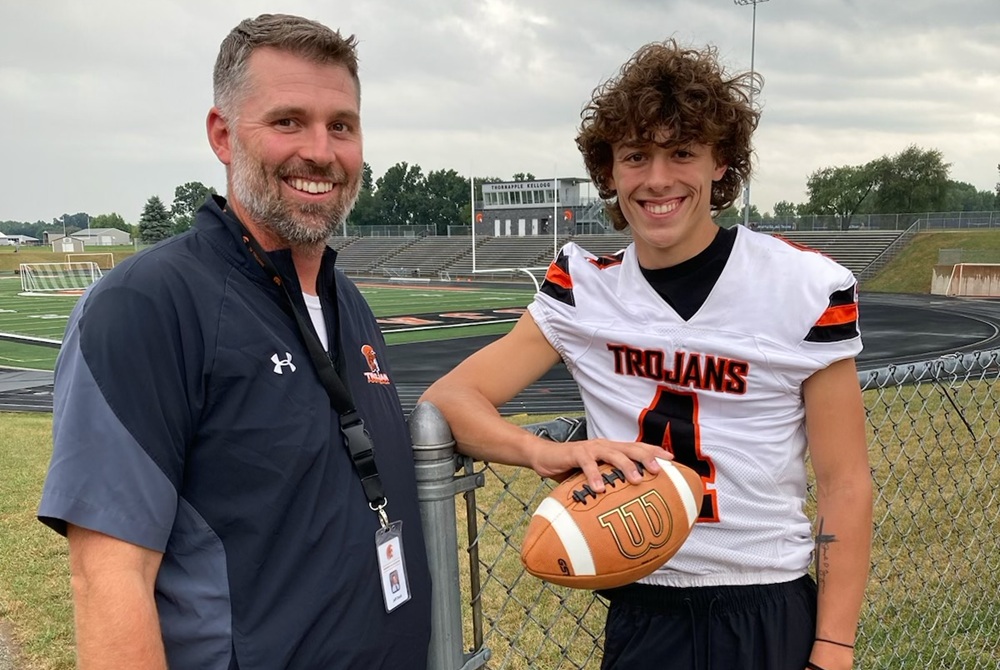
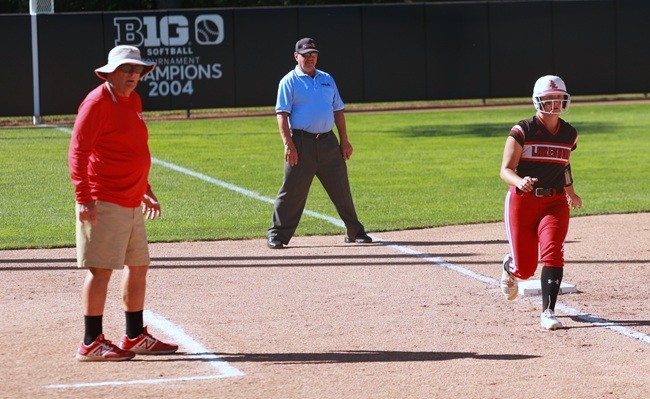
PHOTOS (Top) Jeff Dock, left, and son Micah – Middleville Thornapple Kellogg’s quarterback this season – stand for a photo at their home field. (Middle) Denny Dock, far left, coaches a base runner during Stevensville Lakeshore’s 2022 Semifinal win. (Top photo by Steve Vedder.)