

Eventually, the sun will shine ...
April 25, 2013
By Geoff Kimmerly
Second Half editor
 We all believe that, right?
Rain – and snow for some – has been the buzzword of this spring sports season. Just about every newspaper is writing about it and every athletic director, coach, player and parent is dreading it on a now-daily basis.
But eventually, we expect the weather to clear up and teams to play catch-up. To that end, there are limitations teams in some sports face when attempting to make up their games – but also opportunities to take advantage of while trying to fill out their regular-season schedules.
- Girls soccer and girls and boys lacrosse teams may play only three games during a week, Monday through Sunday. A weekend tournament – which generally includes 2 to 3 shortened games – counts as only one in this equation.
- Baseball and softball teams can play as many games as they want in a week, but no more than two on a school day – and baseball pitchers must not pitch for two days following their 30th out in a week.
- For tennis, an individual may not play more than three matches in one day – unless she or he is playing in a league championship tournament featuring more than eight schools for which a fourth match would decide the championship. That player also could not have played more than six sets that day heading into that fourth and final match.
- Golf and Track and Field do not have weekly contest limitations. Track and field athletes can compete in only four events per day.
As expected, a number of teams – especially for baseball and softball – are scheduling to smash in as many contests as possible into the next four weeks. Postseason play for tennis and lacrosse begins May 16 – three weeks from today.
But teams do have options.
One rarely used but anticipated to be used more this spring is an opportunity to continue playing regular-season contests through the final day of the MHSAA tournament in that sport. For example, a baseball team can continue making up games through June 15, the day of the MHSAA Finals in Battle Creek. A tennis team can play regular-season matches through June 1, etc.
Also, the MHSAA Executive Committee approved Thursday to allow for this spring two additional multi-team tournament dates for soccer and lacrosse, which will give those teams an opportunity to get in a few more games. That means soccer teams will be allowed to play in four multi-team tournaments instead of two, boys lacrosse four instead of two and girls lacrosse five instead of three.
Teams will have to do some juggling, no doubt, and all other tournament stipulations still apply (games generally are shortened so more can be played, etc.). But with a little creativity, teams could at least get in a few of their make-up games in this way.
Also, the Executive Committee approved a motion to waive the four-contest MHSAA tournament entry requirement for all Upper Peninsula schools in all sports this spring. As of the weekend, snow still covered parts of the U.P.
Gaps shrinking
Much has been discussed about minimums for all four MHSAA classes for 2013-14, and how they are the lowest student totals in at least a decade.
It’s true. The floor in Class A is 893 (down from 911 this school year), Class B starts at 429 (down from 449), Class C at 207 (down from 217) and Class D at 206 (down from 216).
However, there is a better way to crunch the numbers: Consider the shrinking gaps between the largest and smallest schools in each class.
For 2013-14, the gap in Class A is 1,888 students – 261 students fewer than 2007-08 and nearly 900 students fewer than in 2005-06. The gaps between largest and smallest in Classes B, C and D also are trending smaller – which means each class actually includes schools more similar in size, instead of a perceived other way around.
SAC 2013-14 on the way
We’re thankful for a valuable group of students who help us throughout the school year – our 16-member Student Advisory Council, made up of eight seniors and eight juniors from all over the state who are charged with providing feedback on issues impacting educational athletics from a student’s perspective, while also assisting at MHSAA championships and with special projects like the “Battle of the Fans.”
Selecting the next class to join is a highlight of every spring – but hardly an easy process.
A six-member selection committee, myself included, considered 62 sophomore applicants today from all over the Lower and Upper Peninsulas, representing all four of our classes and nearly every sport we sponsor.
Every candidate is impressive for a variety of reasons. That’s what makes this difficult – we could pick any number of combinations to make up our new SAC class, and no doubt leaders galore will emerge from another impressive group.
But there are only eight spots on the council. And we’ll announce who received them later next week.
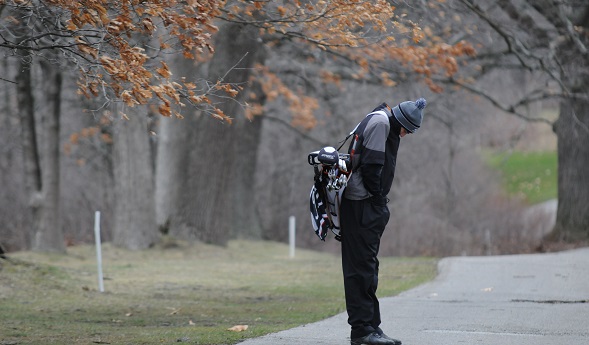
PHOTO: A golfer attempts to keep warm during a round on a dreary day earlier this season. (Click to see more at HighSchoolSportsScene.com.)

Class D Schools Set Multi-Sport Participation Record, Overall Rate Remains Steady
By
Geoff Kimmerly
MHSAA.com senior editor
September 22, 2026
The MHSAA's eighth Multi-Sport Participation Survey, conducted last spring for the 2025-26 school year, showed just more than 45 percent of athletes at member high schools participated in more than one sport – for the most part consistent with past findings although the state’s smallest schools posted a record high rate of athletes playing more than one sport.
The annual Multi-Sport Participation Survey was inspired by the MHSAA’s Task Force on Multi-Sport Participation, which was appointed in 2016 to study early and intense sport specialization – a serious issue related to health and safety at all levels of youth sports – and to promote multi-sport participation as a way to help stave off overuse injuries and burnout among athletes that have been tied to chronic injuries and health-related problems later in life.
The 2025-26 Multi-Sport Participation Survey received responses from 73.8 percent of member high schools and showed 45.3 percent of athletes at those MHSAA member high schools participating in two or more sports, an almost identical percentage as in 2024-25. For 2025-26, 47.5 percent of male athletes and 42.6 percent of female athletes played multiple sports, again percentages nearly identical to the previous school year. The percentage of multi-sport athletes remains inversely proportional to schools’ enrollments, as Class D schools – the state's smallest – again enjoyed the highest percentage of multi-sport athletes at 64.2 percent, followed by Class C schools (59.5), Class B (49.0) and Class A (38.4).
Results for Class A, B and C schools have remained consistent over the lifetime of the multi-sport participation survey, showing small increases over the years but not overwhelming changes. However, Class D multi-sport participation reached a high in 2025-26, with that 64.2 percent of athletes participating in at least two sports an increase of 6.1 percent since 2017-18. During that time, Class A multi-sport participation is up 3.0 percent, Class B is up 2.3 and Class C is up 4.3.
Battle Creek Harper Creek and Grand Rapids Northview have appeared among the top 10 percent of their respective Classes (A/B/C/D) for multi-sport participation seven of the eight years the survey has been conducted. Three more schools have appeared among the top 10 percent of their respective Classes six of the eight years – Decatur, Detroit Cody and Warren Michigan Collegiate – while East Grand Rapids, Lake Leelanau St. Mary, Manton and Parma Western have appeared among the top 10 percent of their Classes five times apiece.
In Class A, Harper Creek (73.2 percent) posted the highest percentage of multi-sport athletes for 2025-26, followed by Saginaw United (72.7), Harper Woods (72.1) and Macomb L’Anse Creuse North (65.9) also reporting at least 65 percent of athletes playing multiple sports.
Detroit Denby led Class B schools at 83.6 percent of athletes playing more than one sport, followed by Warren Michigan Collegiate (83.3), Ecorse (78.1), Detroit Osborn (75.6), Dearborn Heights Robichaud (76.2) and Flint Hamady (76.1) all topping 75 percent. In Class C, Detroit Community reported all 72 of its athletes played multiple sports during the 2025-26 school year, followed by Galesburg-Augusta (82.7 percent), Kingston (82.1), Niles Brandywine (80.7) and Martin (80.4) reaching 80 percent.
Watersmeet also reported all 27 of its athletes were multi-sport participants, followed in Class D by Lake Leelanau St. Mary (95.5 percent), Carney-Nadeau (94.8), Onekama (92.5) and Atlanta (90.9) reaching 90 percent.
The full summary report on the Multi-Sport Participation Survey is available on the “Multi-Sports Benefits” page.