


Eventually, the sun will shine ...
April 25, 2013
By Geoff Kimmerly
Second Half editor
 We all believe that, right?
Rain – and snow for some – has been the buzzword of this spring sports season. Just about every newspaper is writing about it and every athletic director, coach, player and parent is dreading it on a now-daily basis.
But eventually, we expect the weather to clear up and teams to play catch-up. To that end, there are limitations teams in some sports face when attempting to make up their games – but also opportunities to take advantage of while trying to fill out their regular-season schedules.
- Girls soccer and girls and boys lacrosse teams may play only three games during a week, Monday through Sunday. A weekend tournament – which generally includes 2 to 3 shortened games – counts as only one in this equation.
- Baseball and softball teams can play as many games as they want in a week, but no more than two on a school day – and baseball pitchers must not pitch for two days following their 30th out in a week.
- For tennis, an individual may not play more than three matches in one day – unless she or he is playing in a league championship tournament featuring more than eight schools for which a fourth match would decide the championship. That player also could not have played more than six sets that day heading into that fourth and final match.
- Golf and Track and Field do not have weekly contest limitations. Track and field athletes can compete in only four events per day.
As expected, a number of teams – especially for baseball and softball – are scheduling to smash in as many contests as possible into the next four weeks. Postseason play for tennis and lacrosse begins May 16 – three weeks from today.
But teams do have options.
One rarely used but anticipated to be used more this spring is an opportunity to continue playing regular-season contests through the final day of the MHSAA tournament in that sport. For example, a baseball team can continue making up games through June 15, the day of the MHSAA Finals in Battle Creek. A tennis team can play regular-season matches through June 1, etc.
Also, the MHSAA Executive Committee approved Thursday to allow for this spring two additional multi-team tournament dates for soccer and lacrosse, which will give those teams an opportunity to get in a few more games. That means soccer teams will be allowed to play in four multi-team tournaments instead of two, boys lacrosse four instead of two and girls lacrosse five instead of three.
Teams will have to do some juggling, no doubt, and all other tournament stipulations still apply (games generally are shortened so more can be played, etc.). But with a little creativity, teams could at least get in a few of their make-up games in this way.
Also, the Executive Committee approved a motion to waive the four-contest MHSAA tournament entry requirement for all Upper Peninsula schools in all sports this spring. As of the weekend, snow still covered parts of the U.P.
Gaps shrinking
Much has been discussed about minimums for all four MHSAA classes for 2013-14, and how they are the lowest student totals in at least a decade.
It’s true. The floor in Class A is 893 (down from 911 this school year), Class B starts at 429 (down from 449), Class C at 207 (down from 217) and Class D at 206 (down from 216).
However, there is a better way to crunch the numbers: Consider the shrinking gaps between the largest and smallest schools in each class.
For 2013-14, the gap in Class A is 1,888 students – 261 students fewer than 2007-08 and nearly 900 students fewer than in 2005-06. The gaps between largest and smallest in Classes B, C and D also are trending smaller – which means each class actually includes schools more similar in size, instead of a perceived other way around.
SAC 2013-14 on the way
We’re thankful for a valuable group of students who help us throughout the school year – our 16-member Student Advisory Council, made up of eight seniors and eight juniors from all over the state who are charged with providing feedback on issues impacting educational athletics from a student’s perspective, while also assisting at MHSAA championships and with special projects like the “Battle of the Fans.”
Selecting the next class to join is a highlight of every spring – but hardly an easy process.
A six-member selection committee, myself included, considered 62 sophomore applicants today from all over the Lower and Upper Peninsulas, representing all four of our classes and nearly every sport we sponsor.
Every candidate is impressive for a variety of reasons. That’s what makes this difficult – we could pick any number of combinations to make up our new SAC class, and no doubt leaders galore will emerge from another impressive group.
But there are only eight spots on the council. And we’ll announce who received them later next week.
PHOTO: A golfer attempts to keep warm during a round on a dreary day earlier this season. (Click to see more at HighSchoolSportsScene.com.)

Decades Later, Wernette's Wondrous 2003 Remains Nearly Unchallenged
By
Steve Vedder
Special for MHSAA.com
April 24, 2023
Nate Wernette knew his final spring at Morley Stanwood had been special, but he had no idea just how historic it was until a strange visitor showed up at the family home near Stanwood just weeks after the baseball season ended.
The man, completely unknown to the family, produced a number of framed newspaper clippings and several pages of well-documented statistical research on Wernette's recently completed senior season at Morley Stanwood. The numbers showed that Wernette, a pitcher whose skill set fell somewhere between being a hard thrower and crafty left-hander, had accomplished even more than suspected at first glance.
In fact, the research showed that Wernette's senior year arguably was the single greatest pitching season in the history of Michigan high school baseball.
"We never had any idea," said Wernette on the eve of the 20th anniversary of that historic season in 2003.
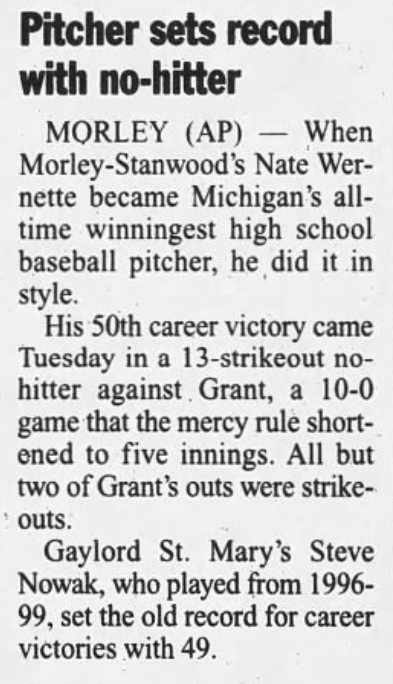
Wernette was vaguely aware that his 20 pitching wins had broken the state record of 19 wins set by Brandon LaTour of Blissfield in 1992. The pair remain among only four pitchers in state history with at least 17 wins in a single season.
But as the man's research pointed out, that feat was just the tip of the iceberg. The 20 wins pushed Wernette's career total to 56, a state record that remains seven better than Homer's Josh Collmenter's eventual total of 49 from 2001-04. What Wernette also didn't realize was his 272 season strikeouts smashed the previous record of 215 by Southgate Aquinas’ Dan Horvath from 1998 and would outlast a challenge of 223 by Collmenter in 2004, and that Wernette’s average of 15.2 strikeouts per game was at that time second (and now fourth) all-time in state history. Wernette finished his career with 583 whiffs, second in state history.
He also tossed four no-hitters that season, second on the all-time list. Three of those no-hitters, in fact, came in consecutive dominant starts from May 6-10.
While Wernette was pitching himself into the Michigan high school record book, National Federation of State High School Associations (NFHS) research shows where Wernette's numbers stand nationally. It turns out that only 10 pitchers in the country's history have won more than 20 games in a season. The all-time mark is 25 by Randolph Slaters of Mooreville High School in Missouri in 1985. Wernette’s 272 strikeouts is fourth all-time, with Salters also holding that record at 336. The 56 career wins is sixth all-time, with Terry Heiderscheit of Lansing Kee High School in Iowa holding the record of 69 from 1975-78.
Wernette admits it's probably best that he was unaware of the records at the time. His focus was on being the only senior on a young 10-player Morley Stanwood team that many suspected would be lucky to break .500 in 2003. But behind Wernette's sensational season, Morley Stanwood finished 41-3, with Wernette suffering his only defeat 3-1 to Blissfield in the Division 3 championship game.
"I was kind of glad I didn't know. Who knows what would have been in the back of my mind if I knew I was that close (to the records)," he said. "I never thought that much about it. I didn't know about the strikeout record, and I never looked at my (won-loss) record until someone mentioned that I was close to 50 and that I could break the state record."
Wernette remembers starting about 17 games that season as at least a couple of the wins came in relief. The success also didn't exactly come out of the blue as Wernette went 7-5 as a promising freshman, then put together 14-3 and 15-4 seasons as a sophomore and junior, respectively. The 15 wins remain tied for 10th all-time in state history.
Wernette's catcher his final season was sophomore Drew Thompson, who remembers Wernette as having a fastball that touched 90 mph at best. He never threw a curveball until making the high school team and really didn't master it until his last season and a half for Morley Stanwood. But Wernette, an all-conference football linebacker, had a relentless competitive streak, Thompson recalled.
 "There was his velocity and the way he threw balls that tailed away from batters," Thompson said. "A lot of high school hitters never saw balls that would move away like that. But he was a gamer who just wanted the ball in his hand. If he got into trouble, he wanted a strikeout and he had the stuff to do it.
"Everything fit together for him that year. He had confidence we would win whether we were down 1-0 or 2-1 or we were up. I remember him always being relaxed."
Wernette agrees everything indeed did fall into place that season. One of four Mohawks pitchers who could throw at least 80 mph, Wernette's place in the rotation included starting twice during the week while occasionally relieving in a weekend tournament. By the time the team was around 16 games into the season, Wernette realized something special was happening. The team played well in the usually strong Big Rapids Tournament, where the Mohawks swept Remus Chippewa Hills and Big Rapids. Morley Stanwood split a key doubleheader with Howard City Tri County, and suddenly Wernette and a painfully young Morley Stanwood club that virtually had returned little else than its No.1 pitcher was catching fire.
Wernette's 20th win came in a 3-2 decision over Rudyard in a Quarterfinal at Gaylord. Because rain on Tuesday had pushed the game back a day to Wednesday, Wernette was unable to start the team's Semifinal on Friday. But even without Wernette, the team's No. 3 hitter and first baseman when he wasn't on the mound, Morley Stanwood beat a 35-4 Goodrich team 4-3 in the Semifinal, paving the way for Wernette to pitch the Final. But Morley Stanwood made a couple key errors in the title game, and Blissfield pitcher Jake Recker – who had only a modest 4-4 record heading into the day – was excellent in a 3-1 win. The championship was part of three Finals titles over four years for Blissfield.
Wernette said his reflections on his heavy pitching load that season haven't changed in 20 years. He would take the ball whenever coach Ron Ford asked him.
"I never told him I couldn't pitch," Wernette said. "My arm never bothered me. I'd ice it after a game, and I never had an arm issue. Looking back now I know I threw more than a lot of high school pitchers, but I was all for it. I wanted the ball every chance I could get it."
While Wernette never suffered a sore arm during four years in high school, his pitching career ended five months after graduation. After attending a Detroit Tigers tryout in Grand Rapids, Wernette was advised he needed a year in college. So he shuffled off to Muskegon Community College, where during the opening weeks of fall ball, Wernette hurt his shoulder during a long toss exercise. While medical evaluations have made great strides in the last 20 years, Wernette said the numbness he felt probably meant a torn rotator cuff. He never tried pitching again.
"I probably should have stuck with it, and that's the biggest thing with me because baseball was so special," he said. "I took the game seriously, but the rest of it – like school – I wish I would have put more into it.
Wernette's spark for pitching is reflected in his two young daughters, Brooklynn, 11, and Jaycee, 8. Both are travel softball pitchers. Wernette said the family has a pitching machine set up to hone their talent.
"They're definitely into it," he said.
The records that Wernette set are probably untouchable as high schools have instituted tight mandates on the number of pitches that can be thrown over a certain number of days. For instance, the top pitchers on last year's 16 MHSAA semifinalists averaged 10.6 starts and 57.5 innings pitched. Wernette threw 125 innings as a senior.
Wernette heartily agrees there should be definite pitch limits on youngsters whose arms are not fully developed.
"I definitely see it as a good thing," he said. "Back then you never heard much about Tommy John surgeries of rotator cuffs. I never learned about that stuff until after school. I never had any concerns; I just wanted the ball every chance I could get it."
As for Wernette's remarkable season, he spends little time thinking about the achievements unless someone mentions them. But it's hardly comparable to the Bruce Springsteen "Glory Days" song of yesterday's greatness.
"Somebody will bring it up, and I have a lot of good memories. But I wish I would have done some things differently like paying more attention to school and applying myself. There was too much of just trying to get by," he said.
"But it was an honor to accomplish what I did. I'll always think that."
PHOTOS (Top) Morley Stanwood’s Nate Wernette makes his move toward the plate during the 2003 Division 3 Final against Blissfield. (Middle) Wernette’s record-setting win made the statewide news wire, appearing in various newspapers including as this clip in the St. Joseph Herald-Palladium.